Introduction
Building a successful startup has never been easy. Founders must move quickly, validate ideas rapidly, and preserve cash while competing against companies with significantly larger resources. The challenge becomes even greater during the MVP (Minimum Viable Product) stage, where every dollar and every hour matters.
Artificial Intelligence is changing this reality. Today, a small startup can achieve productivity levels that previously required entire teams. However, simply using AI tools does not automatically create efficiency. The real advantage comes from strategically integrating AI into product development, customer validation, operations, and decision making.
This article explores how startups can maximize MVP efficiency using AI while maintaining strict cost control.
Why MVP Development Is Expensive
Many startups fail because they invest too much before validating market demand.
Common MVP expenses include:
- Software development
- UI/UX design
- Content creation
- Market research
- Customer support
- Quality assurance
- Data analysis
- Marketing campaigns
Traditionally, these functions required multiple specialists. AI enables startups to reduce these costs dramatically without sacrificing speed.
Use AI Before Writing a Single Line of Code
One of the biggest mistakes founders make is building too early.
Before development begins, AI can help validate assumptions by:
- Generating customer personas
- Analyzing competitor positioning
- Identifying market gaps
- Creating survey questions
- Summarizing industry reports
- Predicting potential user objections
Instead of spending weeks on manual research, founders can obtain actionable insights within hours.
The goal is simple:
Validate the problem before building the solution.
Accelerate Product Design with AI
Design often becomes a bottleneck during MVP development.
Modern AI design tools can:
- Generate wireframes
- Create user flows
- Produce UI mockups
- Suggest design improvements
- Generate design system components
- Create marketing assets
A startup that previously needed a dedicated designer can now create professional prototypes significantly faster.
This does not eliminate designers. It allows designers to focus on strategy and user experience rather than repetitive tasks.
AI-Powered Development
Perhaps the greatest cost reduction comes from AI-assisted software development.
Modern coding assistants can:
- Generate boilerplate code
- Write APIs
- Create database schemas
- Generate tests
- Refactor code
- Explain legacy code
- Detect security issues
- Generate documentation
Developers become significantly more productive because AI handles repetitive implementation tasks.
As a result:
- Smaller teams build faster.
- Development cycles shrink.
- Technical debt is reduced.
- Documentation improves.
The startup gains more output without increasing payroll expenses.
Build Only What Users Need
A common startup failure occurs when teams spend months building features nobody wants.
AI can help prioritize development by analyzing:
- User feedback
- Support tickets
- Surveys
- Product reviews
- Community discussions
- Usage analytics
Patterns that would take humans days to identify can be discovered in minutes.
This allows founders to focus only on features that generate measurable value.
Use AI for Customer Support from Day One
Hiring support agents early can become expensive.
AI-powered support systems can:
- Answer common questions
- Guide onboarding
- Troubleshoot basic issues
- Collect customer feedback
- Escalate complex requests
This creates a better customer experience while reducing operational costs.
Most importantly, founders gain more time to focus on product-market fit.
Automate Internal Operations
Many startup costs are hidden inside operational inefficiencies.
AI can automate:
- Meeting summaries
- Task creation
- Project management updates
- Reporting
- Documentation
- Email drafting
- CRM updates
When repetitive work disappears, teams spend more time creating value.
The result is higher output without increasing headcount.
AI-Driven Marketing on a Startup Budget
Marketing often becomes one of the largest expenses for early-stage startups.
AI can dramatically reduce content production costs by generating:
- Blog articles
- Social media posts
- Video scripts
- Ad copy
- Landing pages
- Email campaigns
Instead of hiring multiple specialists immediately, startups can validate channels and messaging before expanding their marketing team.
The objective is not to replace marketers.
The objective is to achieve maximum learning with minimum spending.
Measure Everything
The most successful AI-driven startups operate using data rather than intuition.
Track metrics such as:
- Customer acquisition cost (CAC)
- User activation rate
- Retention rate
- Feature adoption
- Support ticket volume
- Revenue per user
AI can automatically identify trends and anomalies, enabling faster decisions.
Speed of learning often becomes a startup’s biggest competitive advantage.
Avoid the AI Trap
Many startups make another mistake:
They use too many AI tools.
This creates:
- Subscription overload
- Tool fragmentation
- Security risks
- Team confusion
Instead:
- Identify the highest-cost activities.
- Automate those activities first.
- Measure ROI.
- Expand gradually.
A focused AI stack is usually more effective than dozens of disconnected tools.
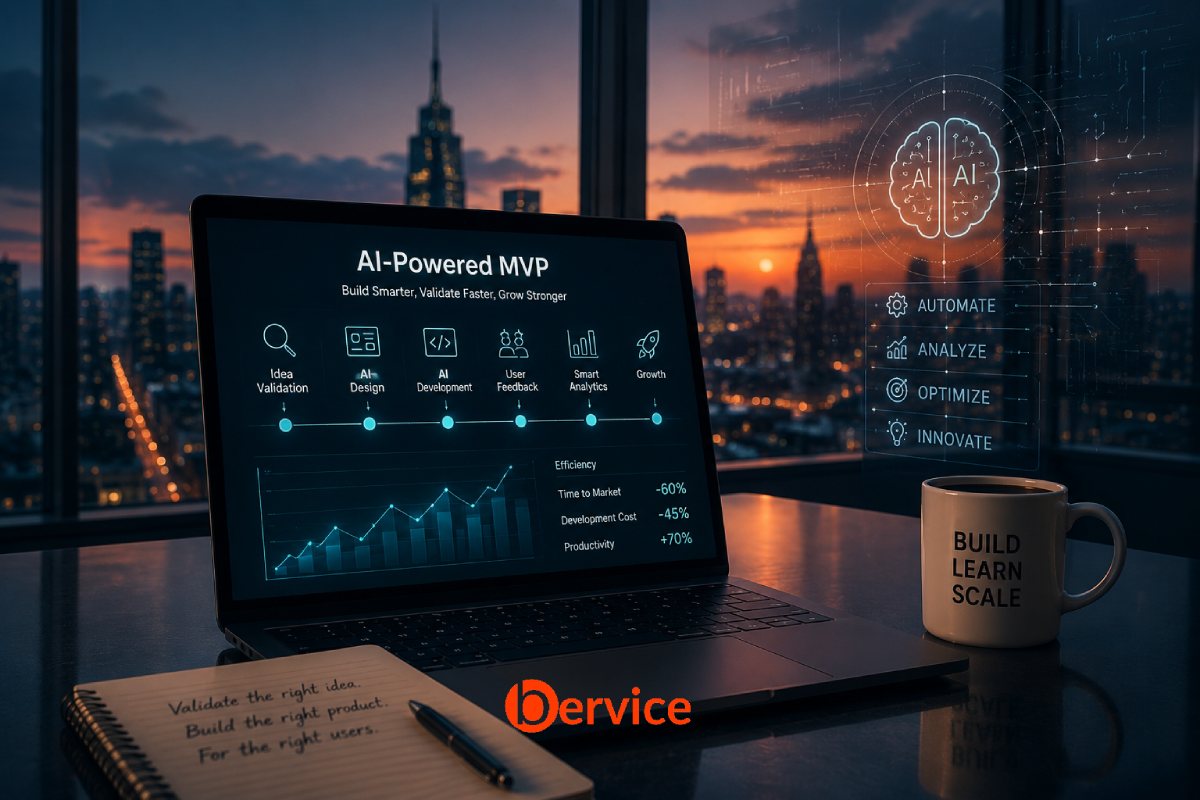
Recommended AI-First MVP Workflow
An efficient startup workflow may look like:
- AI Market Research
- AI Customer Validation
- AI Wireframing
- AI-Assisted Development
- AI Testing
- AI Analytics
- AI Customer Support
- AI Marketing Automation
This approach minimizes waste while maximizing learning speed.
Conclusion
The future belongs to startups that combine human creativity with artificial intelligence.
AI is not simply a productivity tool. It is a force multiplier that enables small teams to operate like much larger organizations.
The startups that succeed will not be those with the biggest budgets. They will be those that learn faster, iterate faster, and validate faster.
By strategically applying AI across research, development, operations, support, and marketing, founders can build stronger MVPs, reduce costs, and reach product-market fit more efficiently than ever before.
In the AI era, the winning startup is not necessarily the one that works harder.
It is the one that learns faster while spending less.
Connect with us : https://linktr.ee/bervice
Website : https://bervice.com