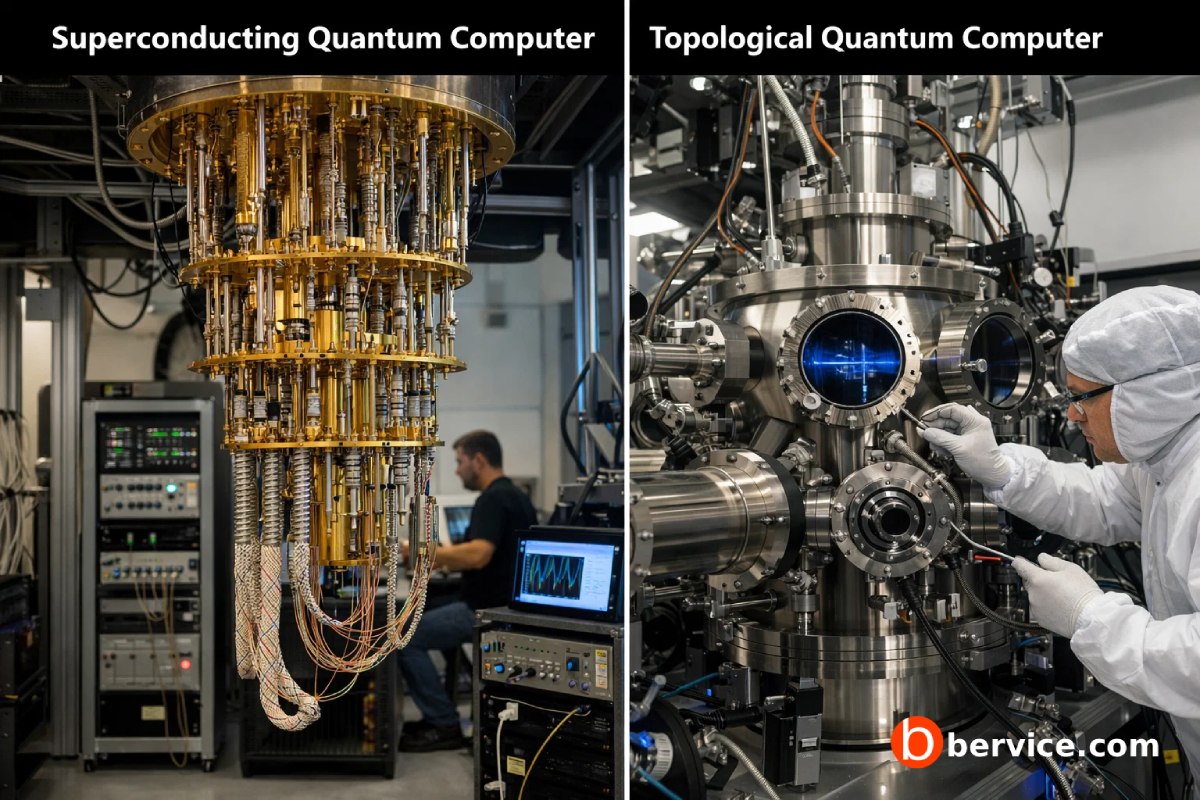
A Deep Technical and Conceptual Comparison
Introduction
Quantum computing is not a single technology but a family of radically different physical approaches aimed at exploiting quantum mechanics for computation. Among these approaches, superconducting quantum computers and topological quantum computers represent two fundamentally distinct philosophies. One prioritizes practical near-term progress, while the other aims for long-term fault tolerance through deep physical protection.
This article provides a structured and technically grounded comparison between these two paradigms, covering physics, hardware, error behavior, scalability, maturity, and long-term implications.
1. Fundamental Physical Principles
Superconducting Quantum Computers
Superconducting quantum computers are based on Josephson junctions, which are non-linear superconducting circuits operating at millikelvin temperatures. Qubits are implemented as artificial atoms whose energy levels are controlled using microwave pulses.
The most common superconducting qubit types include:
- Transmon qubits
- Flux qubits
- Charge qubits
These systems rely on macroscopic quantum coherence achieved by superconductivity.
Topological Quantum Computers
Topological quantum computers are based on topological phases of matter, specifically exotic quasiparticles known as Majorana zero modes. These modes emerge in engineered materials such as semiconductor nanowires coupled to superconductors under strong magnetic fields.
Information is encoded non-locally across pairs of Majorana modes, making it inherently protected from many local sources of noise.
Key concept: computation is performed by braiding these modes in space-time, rather than applying local control pulses.
2. Qubit Stability and Error Characteristics
Superconducting Qubits
Superconducting qubits are:
- Highly controllable
- Fast to operate
- Susceptible to decoherence
Primary error sources include:
- Charge noise
- Flux noise
- Dielectric loss
- Crosstalk
As a result, large-scale operation requires quantum error correction schemes such as the surface code, which dramatically increase the number of physical qubits needed.
Topological Qubits
Topological qubits aim to be error-resistant by design. Because information is stored non-locally, local perturbations do not easily corrupt the qubit state.
In theory, this provides:
- Intrinsic fault tolerance
- Reduced error correction overhead
- Higher logical qubit lifetimes
However, this protection is not absolute and depends on achieving a true topological phase, which remains experimentally challenging.
3. Hardware Architecture and Engineering Complexity
Superconducting Systems
Superconducting quantum computers require:
- Dilution refrigerators reaching ~10 mK
- Complex microwave control electronics
- Cryogenic amplifiers
- Large wiring overhead
Despite this complexity, fabrication leverages well-established CMOS and microfabrication techniques.
Topological Systems
Topological quantum hardware requires:
- Ultra-pure materials
- Precise nanofabrication
- Hybrid superconductor-semiconductor structures
- Fine-tuned magnetic and electrostatic environments
The engineering challenge is not scale but existence. Creating stable Majorana modes with reproducible behavior is still an open experimental problem.
4. Scalability and Roadmaps
Superconducting Roadmap
Superconducting quantum computers are currently the most mature platform, pursued by organizations such as IBM and Google.
Characteristics:
- Tens to hundreds of qubits already demonstrated
- Clear short-term scaling roadmap
- Heavy reliance on error correction
- Rapid iteration cycles
Topological Roadmap
Topological quantum computing is primarily driven by Microsoft, which focuses on building a fault-tolerant quantum computer from the ground up.
Characteristics:
- Few or zero fully validated qubits today
- Long development timeline
- Potential for massive reduction in error correction overhead
- High scientific uncertainty
5. Software and Algorithm Compatibility
Superconducting platforms currently support:
- Gate-based quantum computing
- Standard quantum algorithms like Shor, Grover, and variational algorithms
- Existing SDKs such as Qiskit and Cirq
Topological platforms require:
- Specialized gate constructions
- Hybrid architectures combining topological qubits with conventional control qubits
- New compilation and error models
As of now, most quantum software ecosystems are optimized for superconducting or trapped-ion systems rather than topological ones.
6. Current State of Reality vs Theory
| Aspect | Superconducting | Topological |
|---|---|---|
| Experimental maturity | High | Low |
| Demonstrated qubits | Hundreds | Experimental prototypes |
| Error rates | High but improving | Theoretically low |
| Error correction need | Very high | Potentially low |
| Time to usefulness | Short to medium | Long |
7. Strategic Implications
- Superconducting quantum computers are likely to dominate near-term quantum advantage experiments.
- Topological quantum computers represent a high-risk, high-reward strategy.
- The industry may converge toward hybrid architectures, using topological qubits as long-lived memory and superconducting qubits for fast logic.
Conclusion
Superconducting and topological quantum computers are not competitors in the traditional sense. They embody two opposing philosophies in quantum engineering.
Superconducting systems emphasize speed, control, and immediate progress, accepting high error rates as a cost to be managed by software and redundancy.
Topological systems pursue a deeper solution by embedding fault tolerance into the laws of physics themselves, at the cost of immense experimental difficulty.
If superconducting quantum computers are the engineering workhorses of the current decade, topological quantum computers are the long-term bet that could redefine what scalable quantum computation truly means.
The future of quantum computing will likely be shaped not by choosing one over the other, but by understanding when and how each paradigm should be used.
Connect with us : https://linktr.ee/bervice
Website : https://bervice.com