-
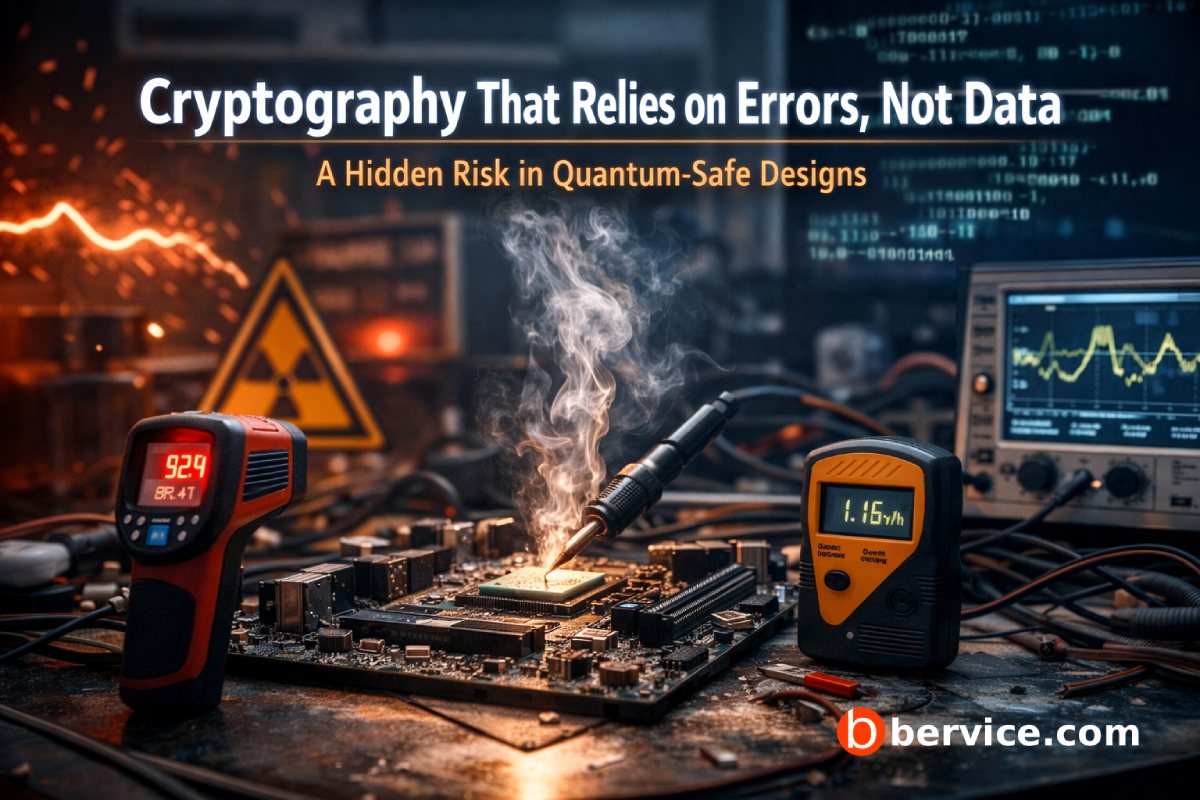
Cryptography That Relies on Errors, Not Data
A Hidden Risk in Quantum-Safe Designs As the cryptographic world prepares for the post-quantum era, much of the focus has shifted toward algorithms believed to be resistant to quantum attacks. Among the most prominent of these are noise-based constructions, particularly lattice-based cryptography. These systems promise security not from secrecy of data, but from mathematical…
-
Hardware Hacking Attacks That Start at the Silicon Level
For years, cybersecurity has been dominated by a software-centric mindset. Firewalls, antivirus engines, EDR, and application security reviews all assume one thing: that the hardware beneath them is trustworthy. That assumption is increasingly wrong. Modern attackers do not stop at operating systems or applications they go deeper, down to firmware, microcode, and even the…
-
When Encryption Depends on Errors, Not Data
A Critical Look at Noise-Based Security in Quantum-Safe Cryptography Introduction: Security Built on Uncertainty Quantum-safe cryptography was designed to survive a future where quantum computers break today’s public-key systems. To achieve this, many post-quantum schemes rely not on number-theoretic hardness, but on structured randomness, often referred to as noise.At first glance, this sounds elegant:…
-
Code Running on Living Metal When Hardware Stops Playing by the Rules
Software engineers love to believe their code runs in a clean, deterministic universe. But once you drop below the OS layer and step onto bare metal, that illusion collapses. Microcontrollers, avionics systems, and industrial controllers operate inside physics not logic and physics doesn’t care about your abstractions. 1. Hardware Is Not a Perfect Machine…
-
When Cryptography Depends on Noise, Not Data: The Hidden Risk in Quantum-Safe Systems
Quantum-safe cryptography is often promoted as the long-term shield against quantum attacks, but a critical blind spot is rarely discussed: some of these schemes fundamentally rely on noise and noise is a physical phenomenon, not a mathematical one.Once your security depends on unpredictable errors, anyone who can control those errors can start bending the…