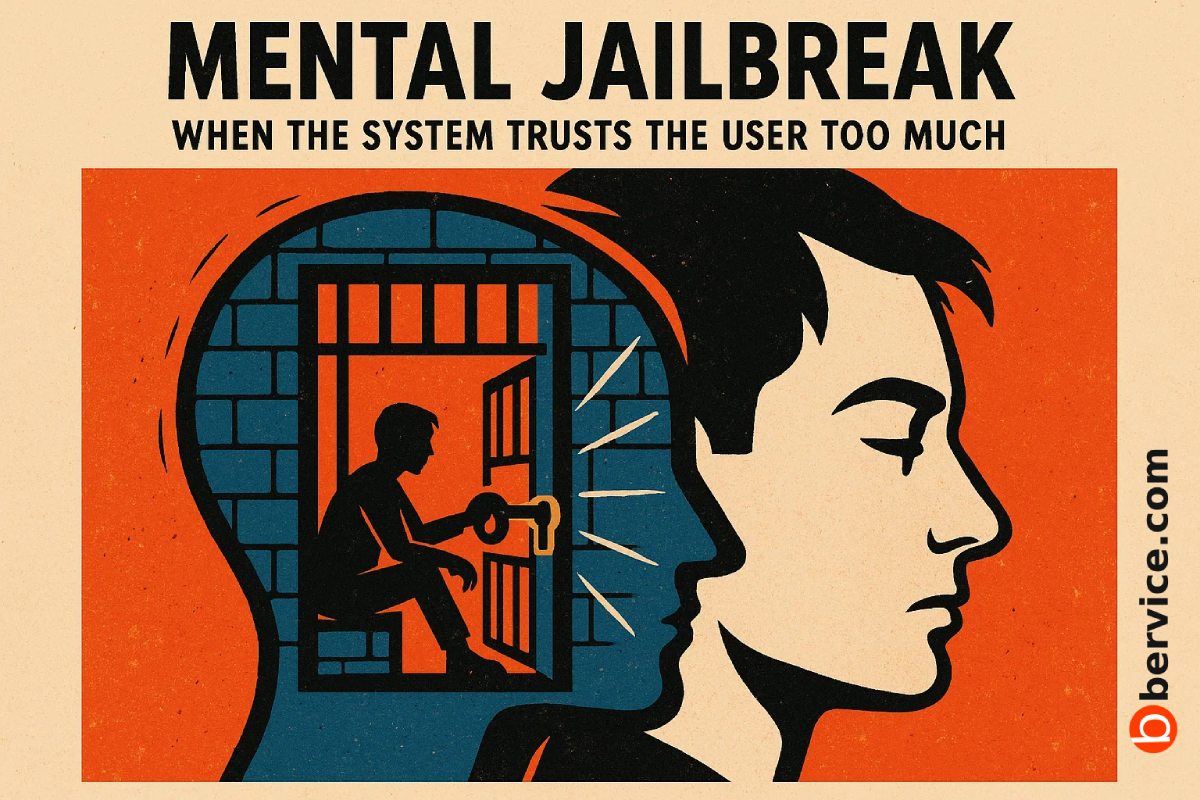
Modern mobile operating systems are designed around one fundamental assumption: the user is both the owner and the greatest threat to the device. This paradox is at the core of every security model in Android and iOS. While vendors invest heavily in sandboxing, mandatory access control, and kernel hardening, a single decision made by the user such as performing a jailbreak or gaining root access can dismantle the security architecture from the inside out. This phenomenon can be described as a “mental jailbreak”: the moment the system implicitly trusts the user, even when the user’s actions undermine its integrity.
1. The Illusion of Control: Why Mobile Security Depends on Restriction
Mobile security frameworks are built on strict trust boundaries. Every app is isolated in its own sandbox; the kernel mediates access to hardware; and critical system components enforce code signing, integrity checks, and permission gating.
The moment a user performs a jailbreak or root operation, these assumptions collapse. The OS no longer controls the environment — the user (or whoever manipulates the user) does. Attackers exploit kernel vulnerabilities and escalate privileges not because it’s elegant, but because breaking the OS’s assumptions gives them full control.
A rooted or jailbroken system effectively becomes “unsafe by design.”
2. How Jailbreaks Break the Model: A Technical Breakdown
From a technical standpoint, jailbreaks and root exploits typically undermine the following layers:
• Kernel Integrity
Attackers leverage kernel exploits such as memory corruption, privilege escalation bugs, or race conditions. Once the kernel is compromised, sandbox boundaries are meaningless.
• Code Signing and Execution Policies
iOS relies heavily on mandatory code signing. Jailbreaking introduces patches that bypass AMFI (Apple Mobile File Integrity), enabling unsigned or modified binaries to execute freely.
• Secure Boot & Trust Chain
Rooting often injects custom bootloaders or patches recovery images, injecting code before the OS even loads.
• Application Sandboxing
With root-level access, apps (or malware disguised as apps) can inspect data belonging to other applications, intercept traffic, or tamper with secure storage.
These compromises don’t just weaken security they invert it. The OS begins to trust a user who now has the same privileges as an attacker.
3. The Developer’s Defense: Surviving in a Post-Jailbreak World
Developers can’t stop users from jailbreaking, but they can ensure their apps behave defensively in hostile environments.
Key countermeasures include:
• Root/Jailbreak Detection
Applications should identify when the device is running in an altered state presence of SU binaries, modified system partitions, hooking frameworks (e.g., Frida, Cydia Substrate), or suspicious file paths.
• Runtime Integrity Verification
Detecting code injection, tampering, and memory hooking prevents attackers from modifying application behavior at runtime.
• Application-Level Encryption
Sensitive data tokens, keys, personal information must remain encrypted even if the OS becomes untrusted. Hardware-backed keystores (Secure Enclave, Titan M) are essential, but fallbacks should exist for compromised environments.
• Environment-Based Access Policies
If the device fails integrity checks, the app should restrict critical functionality, disable logins, or require additional authentication.
Developers aren’t fighting the OS—they’re fighting the absence of the OS’s security guarantees.
4. The Psychological Layer: Why “Mental Jailbreaks” Matter
The deeper issue isn’t just root access it’s misplaced trust.
Manufacturers trust users to behave responsibly. Applications trust the OS to enforce security. Users trust their devices to keep them safe. When a user decides to bypass restrictions, they unknowingly break this trust chain.
A “mental jailbreak” occurs when:
- the user underestimates the security impact of root,
- the system assumes the user won’t compromise its integrity,
- the attacker manipulates this misplaced trust.
In this model, the user becomes the threat vector, not just the victim.
5. Conclusion: Trust Is the Weakest Link
Mobile devices are secure because the system doesn’t trust the user blindly. Once that trust is broken through jailbreaking, rooting, or negligent behaviors — the entire architecture becomes fragile.
In security, the hardest truth is this:
The system collapses not when attackers gain access, but when users grant it to them willingly or unknowingly.
The “mental jailbreak” is a reminder that security is not a technical barrier; it is a trust boundary. And once it’s crossed, even the strongest operating system can’t protect itself.
Connect with us : https://linktr.ee/bervice