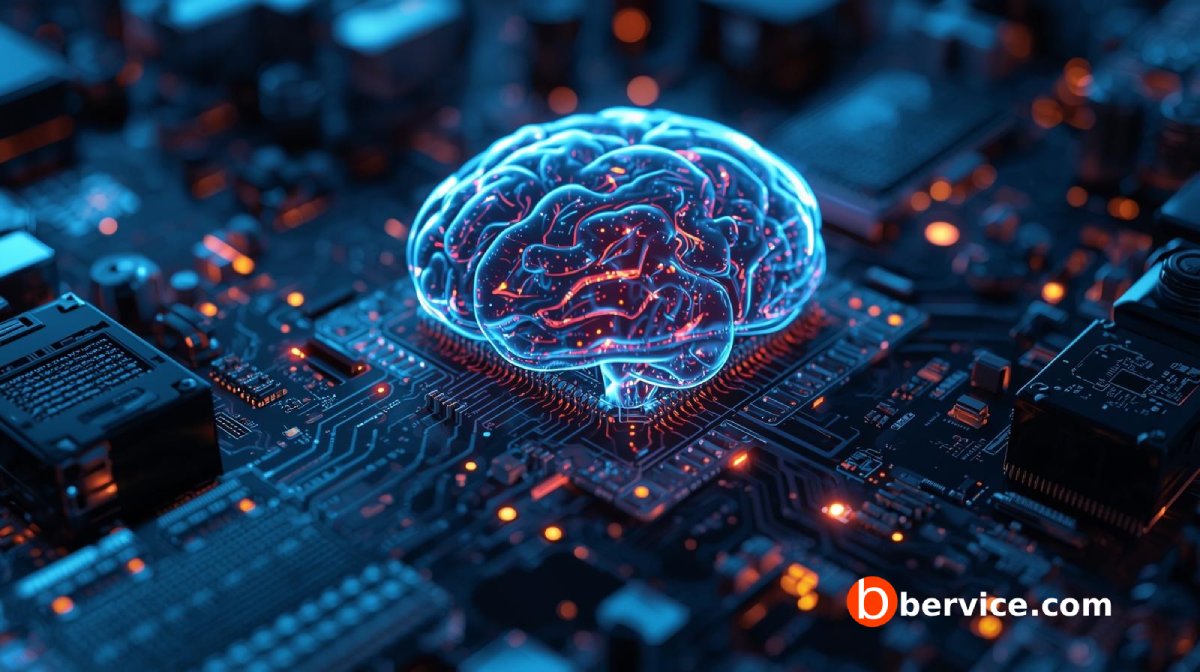
Modern computers are fast, precise, and relentless but they are also fundamentally inefficient when compared to the human brain. A brain running on roughly 20 watts can outperform today’s most powerful machines at perception, adaptation, and learning. Neuromorphic computing exists to close this gap not by making computers faster, but by making them think differently.
This is not an incremental improvement to CPUs or GPUs. It is a radical rethinking of what computation itself should look like.
1. The Limits of Conventional Computing
Traditional computing architectures are built on the von Neumann model:
- Separate memory and processing units
- Linear instruction execution
- Global clock synchronization
- Continuous data movement
This design is excellent for arithmetic and symbolic logic, but terrible for brain-like tasks such as real-time perception, contextual learning, and energy-efficient inference. The constant shuttling of data between memory and processor creates the infamous von Neumann bottleneck, wasting both time and power.
Throwing more GPUs at the problem does not fix this. It only scales inefficiency.
2. What Neuromorphic Computing Really Is
Neuromorphic computing takes inspiration directly from biological neural systems. Instead of emulating the brain in software, it re-implements core neural principles in hardware.
Key characteristics:
- Spiking Neural Networks (SNNs) instead of dense numerical layers
- Event-driven computation instead of clock-driven execution
- Massive parallelism without centralized control
- Memory and computation co-located, like synapses and neurons
In this model, information is transmitted via spikes discrete electrical events analogous to biological action potentials. If nothing happens, no energy is consumed. Silence is free.
3. Spikes, Not Numbers
Unlike traditional neural networks that process continuous values, spiking networks work in time.
- A spike represents when something happens, not just how much
- Timing encodes meaning
- Neurons integrate spikes and fire only when thresholds are crossed
This enables:
- Asynchronous computation
- Temporal pattern recognition
- Ultra-low power operation
The system reacts to events instead of polling data constantly. This is how biology achieves efficiency and neuromorphic hardware follows the same rule.
4. Real Neuromorphic Chips in the Wild
Two landmark implementations demonstrate that this is not theory:
- Intel’s Loihi chip focuses on on-chip learning and adaptive behavior, allowing networks to rewire themselves during execution.
- IBM’s TrueNorth emphasizes scale and energy efficiency, simulating millions of neurons while consuming milliwatts.
These chips abandon:
- Global clocks
- Separate RAM
- Linear instruction pipelines
What replaces them is a mesh of neuron cores communicating directly through spikes.
This is computation without a conductor.
5. Memristors: Hardware That Remembers
A critical breakthrough for neuromorphic systems is the memristor a component whose resistance depends on its history.
In practical terms:
- It behaves like a synapse with memory
- It stores weights physically, not digitally
- Learning can occur directly in hardware
This enables in-memory learning, removing the need for constant parameter updates from external memory. The hardware itself adapts just like biological tissue.
6. Why Neuromorphic Is Orders of Magnitude More Efficient
Neuromorphic systems achieve efficiency through design, not optimization:
- No clock → no wasted cycles
- No data movement → no bandwidth bottleneck
- Sparse spikes → minimal energy usage
- Parallel local computation → scalability
In many tasks, neuromorphic processors consume thousands of times less power than GPUs performing equivalent inference workloads.
This is not marginal. It is structural.
7. Where Neuromorphic Computing Actually Makes Sense
Neuromorphic systems are not general-purpose replacements for CPUs. That’s the wrong expectation.
They shine in:
- Edge AI and IoT
- Autonomous robots and drones
- Sensory processing (vision, sound, touch)
- Brain-computer interfaces
- Adaptive control systems
Anywhere the world is dynamic, noisy, and time-dependent neuromorphic wins.
8. Not Artificial Intelligence Artificial Nervous Systems
The real promise of neuromorphic computing is not faster inference. It is qualitatively different intelligence.
Systems that:
- Adapt continuously
- Learn from sparse signals
- Respond in real time
- Operate under strict energy constraints
This is not “AI that predicts.”
It is AI that perceives.
9. The Road Ahead
Neuromorphic computing will not replace classical computing. It will coexist with it just as the brain coexists with muscles and organs.
Future architectures will be hybrid:
- CPUs for logic and control
- GPUs for dense numerical learning
- Neuromorphic cores for perception and adaptation
The result is not smarter machines in the usual sense but machines that experience the world in a fundamentally new way.
Conclusion
Neuromorphic computing is not about copying the brain.
It is about respecting its principles.
When hardware stops pretending the world is linear, synchronous, and silent computation becomes something else entirely. Faster is no longer the goal. Alive is.
And that changes everything.
Connect with us : https://linktr.ee/bervice
Website : https://bervice.com