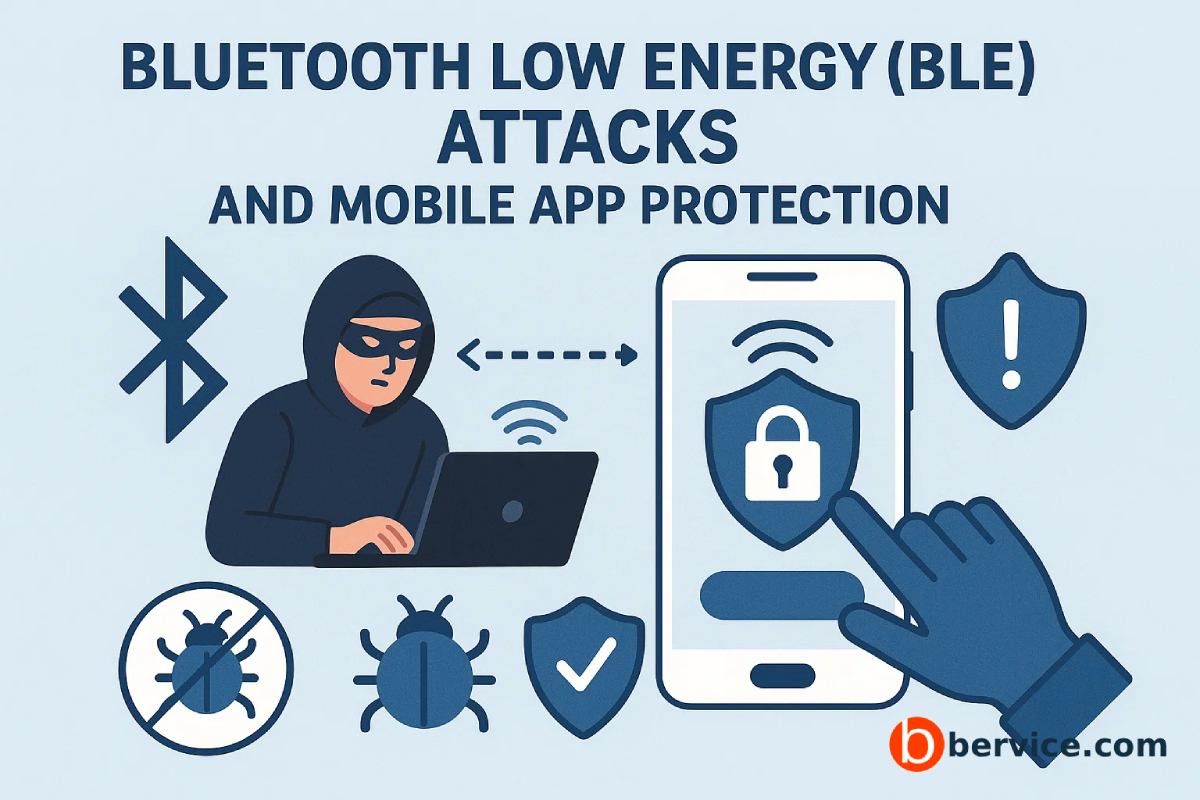
1. Understanding BLE and Its Security Exposure
Bluetooth Low Energy (BLE) has become the foundation for modern wireless communication between IoT devices, wearables, and mobile applications. Its low power consumption and fast connection establishment make it ideal for health sensors, smart locks, and tracking devices.
However, this convenience introduces a hidden risk: BLE communications often prioritize speed over security. Without proper pairing and authentication mechanisms, attackers can intercept, spoof, or manipulate BLE sessions with minimal effort.
2. Common BLE Attack Vectors
BLE’s lightweight architecture exposes several attack surfaces:
- BLE Spoofing: Attackers mimic legitimate devices by cloning their advertising identifiers (MAC and UUID), tricking apps or users into connecting to a fake peripheral.
- Man-in-the-Middle (MITM): Weak pairing protocols allow an attacker to position themselves between two devices, relaying and altering messages.
- Advertising Flooding: Attackers broadcast thousands of fake advertisements to jam BLE channels, drain device batteries, or cause denial-of-service (DoS).
- Malformed GATT Requests: By crafting invalid or oversized packets to the Generic Attribute Profile (GATT), attackers can trigger crashes or extract unintended data from vulnerable stacks.
These vectors are not theoretical — they’ve been observed in consumer devices, medical wearables, and smart home systems where security was added as an afterthought.
3. Building Defense at the Application Layer
Mobile developers often rely on BLE frameworks provided by Android or iOS, assuming these handle all security aspects. That assumption is dangerous. Security must be enforced within the app logic as well:
- Use Secure Pairing: Always enforce LE Secure Connections with Elliptic Curve Diffie-Hellman (ECDH) for key exchange. Avoid “Just Works” pairing, which offers no authentication.
- Implement Bonding Correctly: Ensure bonded devices reauthenticate after disconnection to prevent session hijacking.
- Restrict Sensitive GATT Attributes: Sensitive information (e.g., tokens, user data) should never be exposed through unprotected GATT characteristics.
- Enforce Operation Re-authentication: Require biometric or PIN verification before allowing high-risk BLE actions (e.g., unlocking doors or writing configuration data).
- Rate-Limit Advertising and Connection Attempts: To mitigate flooding or brute-force attacks.
4. Security Testing and Continuous Hardening
Even with correct implementation, BLE stacks differ across chipsets and OS versions. This variability makes fuzzing and protocol analysis essential:
- Conduct BLE fuzzing to send malformed packets and observe stack resilience.
- Analyze pairing transaction logs to detect downgrades to weaker security modes.
- Use tools like GATTacker, BtleJuice, or Ubertooth One to simulate adversarial scenarios.
- Perform penetration testing on both the mobile app and the target peripheral to identify vulnerabilities before release.
5. Conclusion: BLE Security Is a Design Choice, Not a Patch
Bluetooth Low Energy brings immense utility, but its lightweight nature makes it inherently vulnerable. Treat BLE not as a convenience layer but as an attack surface.
By integrating secure connections, strong bonding policies, GATT restrictions, and proactive fuzz testing from the earliest development stage, developers can drastically reduce the risk of spoofing, injection, and data exposure.
In short — don’t trust the link; secure the protocol.
Connect with us : https://linktr.ee/bervice