Introduction
Data compression is not only about reducing file size it is about transforming data into a form that can be encoded more efficiently. One of the most elegant examples of this idea is the Burrows–Wheeler Transform (BWT). Unlike traditional compression algorithms that directly reduce data size, BWT is a reversible data transformation that rearranges characters to make subsequent compression steps far more effective.
Originally introduced in the 1990s, BWT has become a foundational technique in modern text compression and has also found deep applications beyond compression, particularly in bioinformatics and large-scale string processing.
What Is the Burrows Wheeler Transform?
The Burrows–Wheeler Transform is a lossless, reversible transformation applied to a block of text. Its core idea is simple but powerful:
Rearrange the input text so that identical or similar characters tend to appear next to each other.
Importantly, BWT does not compress data by itself. Instead, it reorganizes the data so that traditional compression algorithms such as Run-Length Encoding (RLE) or Move-to-Front (MTF) can perform much better.
Despite its seemingly destructive rearrangement, BWT guarantees perfect reversibility, meaning the original text can be reconstructed exactly.
How the BWT Works (Conceptual Overview)
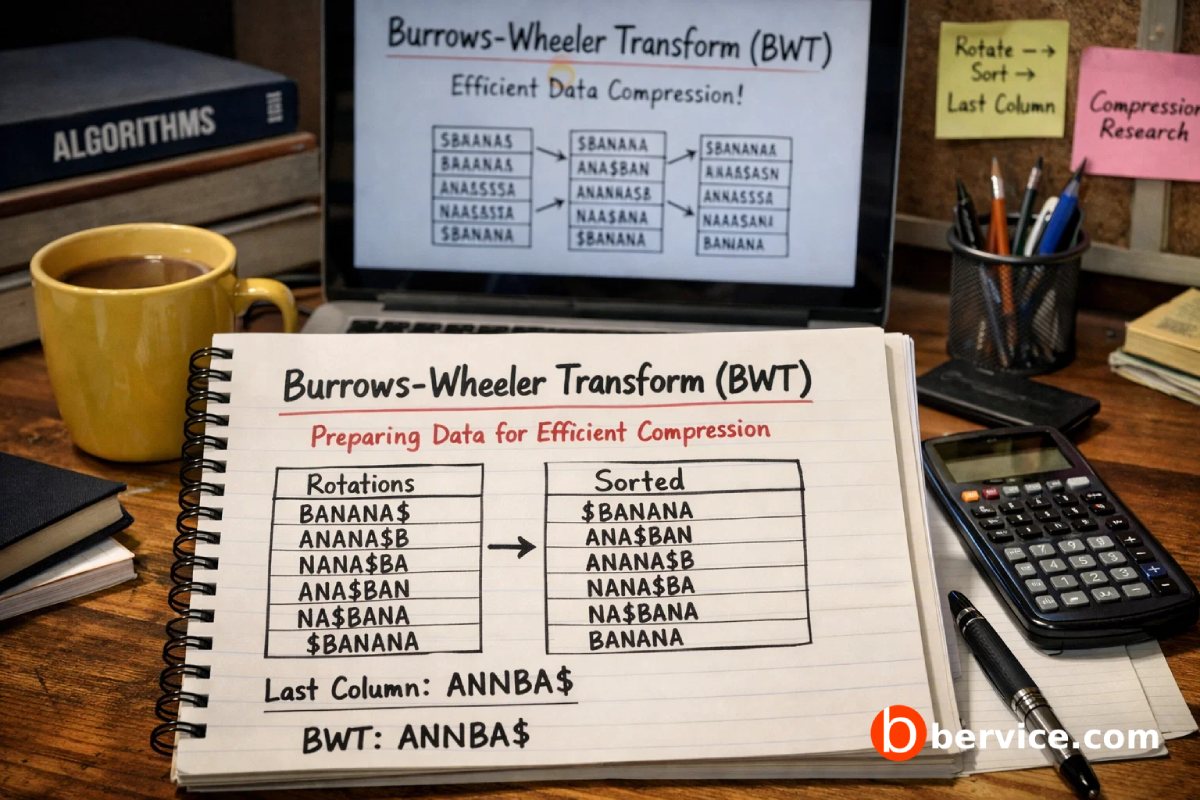
At a high level, the BWT process involves three steps:
- Generate all cyclic rotations of the input string
- Sort these rotations lexicographically
- Extract the last column of the sorted rotations
This last column becomes the transformed output.
What makes this transformation valuable is that characters with similar contexts cluster together in the output. As a result, long runs of identical characters often appear ideal for run-length based compression.
Why BWT Improves Compression Efficiency
After applying BWT, the transformed text typically exhibits:
- Higher locality of identical characters
- Longer repeated sequences
- Reduced entropy for symbol-frequency–based encoders
This makes BWT an excellent preprocessing stage for algorithms such as:
- Run-Length Encoding (RLE)
- Move-to-Front (MTF)
- Huffman coding
- Arithmetic coding
In practical compression pipelines, BWT is almost always followed by one or more of these techniques.
Reversibility: The Key Property
One of the most impressive aspects of BWT is that no information is lost, even though the original order of characters is destroyed.
The inverse transform relies on:
- The stable relationship between the first and last columns of the sorted rotations
- Character occurrence counts
- Deterministic reconstruction rules
This guarantees exact recovery of the original data, making BWT suitable for any lossless compression system.
Real-World Applications
Text Compression
BWT is famously used in high-quality compression tools, where it significantly outperforms simpler dictionary-based methods on structured text.
Bioinformatics
In genome analysis, BWT-based data structures enable:
- Fast substring searches
- Efficient indexing of massive DNA sequences
- Reduced memory usage
Modern genomic aligners and search tools rely heavily on BWT-derived indexing techniques.
Large-Scale String Processing
Any system that needs to process massive textual datasets logs, archives, or linguistic corpora can benefit from BWT-style transformations.
Strengths and Limitations
Strengths
- Fully reversible and lossless
- Dramatically improves downstream compression
- Works exceptionally well on structured and repetitive data
Limitations
- Computationally expensive for very large blocks
- Requires additional memory for rotation sorting
- Ineffective alone without follow-up compression steps
These trade offs explain why BWT is rarely used in isolation but shines as part of a well-designed compression pipeline.
Conclusion
The Burrows–Wheeler Transform is a brilliant example of algorithmic insight: instead of compressing data directly, it reshapes the data to make compression inevitable. Its combination of reversibility, elegance, and practical impact has secured its place as a cornerstone of modern compression theory.
From text archives to genomic databases, BWT demonstrates how rethinking data structure rather than data size can unlock extraordinary efficiency.
Connect with us : https://linktr.ee/bervice
Website : https://bervice.com