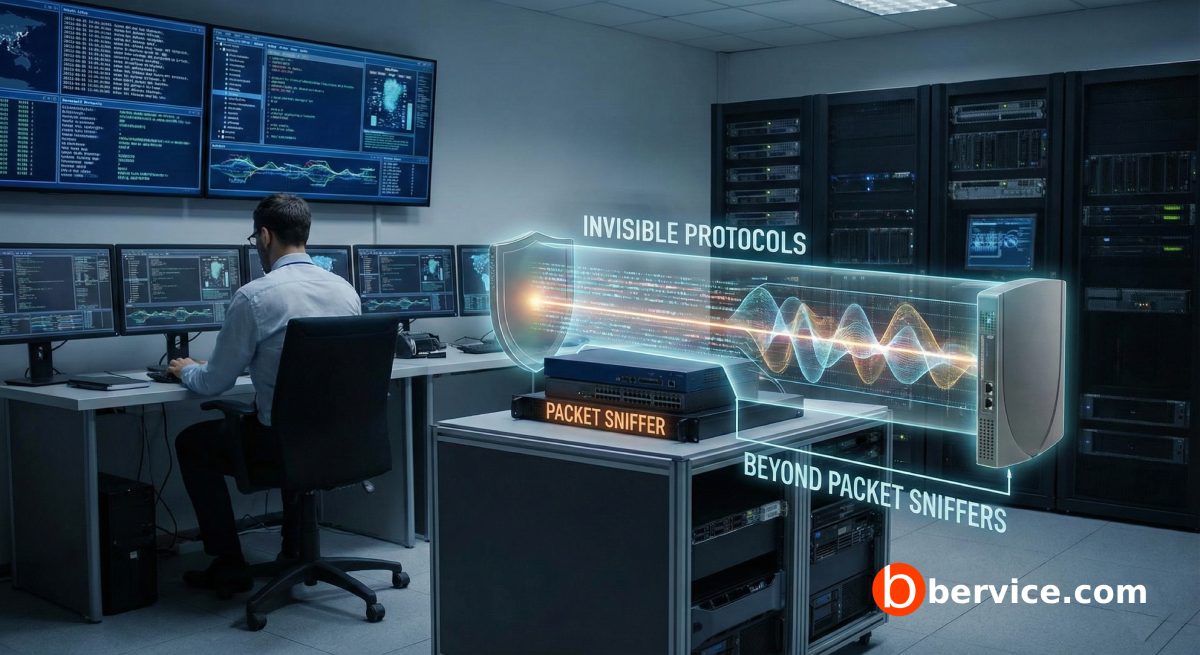
Most engineers cling to the illusion that packet-level visibility is the final source of truth. It isn’t. Modern distributed networks have evolved to the point where parts of the system remain active, coordinated, and decision-capable even when no observable IP packets exist. Mesh architectures, SDN overlays, and embedded avionics networks increasingly exchange metadata through channels traditional monitoring tools simply can’t see.
1. The Blind Spot: Metadata Tunnels Beneath IP
Conventional packet inspection assumes all meaningful communication must be represented as IP traffic flowing across standard interfaces. But SDN controllers, mesh nodes, and specialized embedded hardware often use out-of-band channels, abstract control planes, or compressed signaling paths that never surface on the monitored interface.
These micro-protocols are lightweight, device-local, and intentionally placed beneath the visibility of user-space sniffers. They exchange:
- topology updates
- neighbor health signals
- recovery instructions
- configuration hashes
- trust-state metadata
A network can be coordinating itself while every tool in your SOC shows “no meaningful traffic.”
If you depend on packet capture alone, you’re already blind.
2. Mesh & SDN: Autonomous Nodes With Their Own Logic
Mesh networks are built on decentralization: each node may act as a router, a controller, and a sensor. When two or more nodes share local state—via radio beacons, PHY-layer signaling, or controller-side metadata propagation they can alter routing without ever generating trackable IP frames.
SDN adds another layer of shadows. The separation of data-plane and control-plane means that flow rules, failover paths, and recovery actions can be manipulated inside the controller’s internal channels. None of this appears on the wire in a way traditional sniffers detect.
This produces a dangerous illusion:
the network looks quiet while it is actively reconfiguring itself.
3. When the Hidden Network Breaks: The Aviation Example
Safety-critical systems—aircraft, industrial automation, medical robotics frequently embed internal mesh-like communication layers that manage fault detection and recovery.
If an internal router or controller begins issuing faulty self-recovery messages, the system may believe:
- a link is alive when it is not
- a node has recovered while it is still failing
- redundant paths exist where none are functional
In aviation architectures, this can produce catastrophic behavior: misleading the flight computer into assuming connectivity, bypassing failover routines, and destabilizing the entire avionics network.
No packet sniffer will warn you. Nothing “looks wrong.”
But the hidden protocol is quietly rewriting reality.
4. The Architectural Problem: Observability Ends Too Early
Enterprise monitoring stacks stop at Layer 3 or 4.
Modern distributed systems don’t.
Invisible protocols live at:
- lower PHY layers
- control-plane abstractions
- chipset-internal signaling paths
- firmware-level mesh coordination loops
The industry keeps adding automation and autonomy even self-healing logic without adding corresponding observability. The outcome is predictable: networks that behave correctly until the moment they don’t, and no forensic trail explaining why.
5. The Hard Truth: You Must Monitor the Network Behind the Network
If your observability stack cannot see:
- control-plane messages
- mesh beacons
- radio-level metadata
- firmware signaling
- flow rule diffs
- topology state changes
…then you are not monitoring your network. You’re monitoring its shadow.
The real protection comes from:
- hardware-level telemetry
- SDN controller audit logs
- mesh beacon sampling
- PHY-layer pattern analysis
- integrity checks on self-recovery instructions
Packet sniffers were never designed to see these channels. Pretending otherwise is professional negligence.
Conclusion
A modern network is not a stream of packets it is a living organism with multiple layers of internal communication. If you only observe what appears at the IP layer, you are watching a puppet show and assuming it represents the full system.
The real decisions, the real risks, and the real failures often occur in the shadows: decentralized nodes exchanging metadata no tool is listening to.
Ignoring that will break systems from enterprise clusters to aircraft fleets—in ways that look impossible until they’ve already happened.
Connect with us : https://linktr.ee/bervice