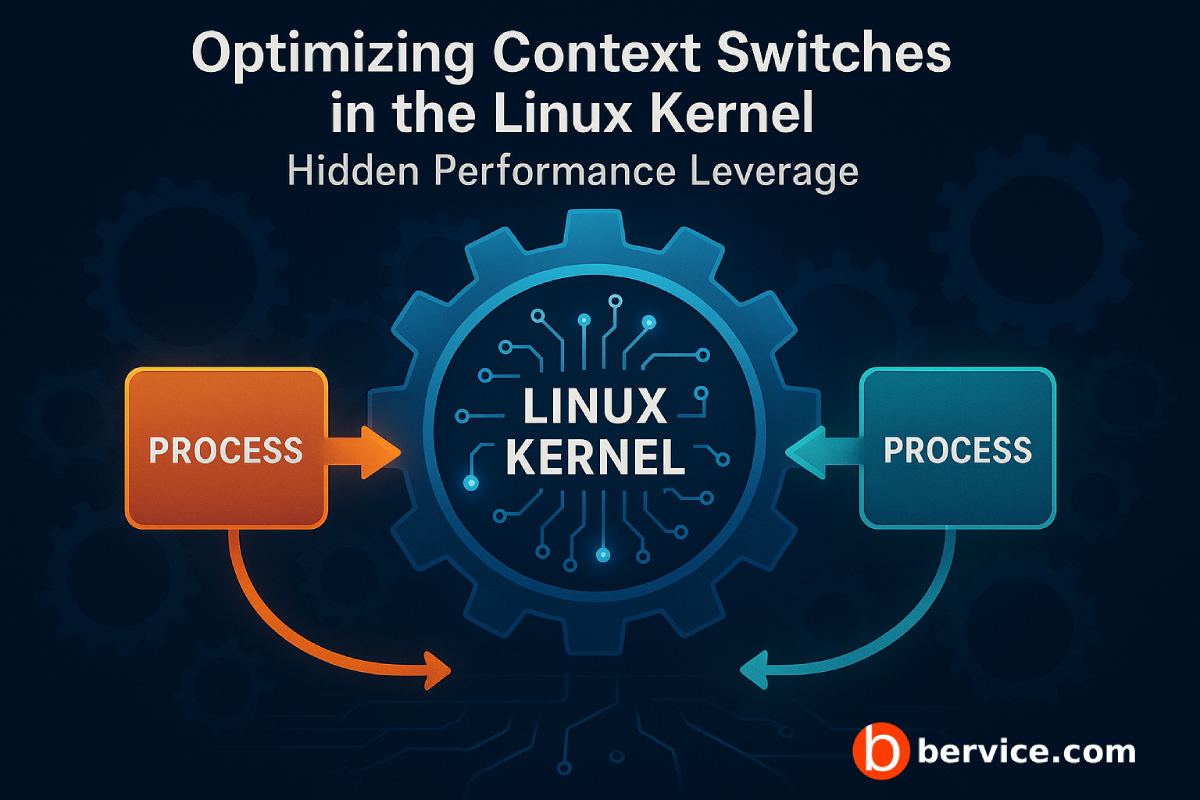
1. What Context Switching Really Costs
Every time the kernel performs a context switch — moving execution from one thread to another — the CPU flushes registers, updates the program counter, and reloads process metadata. This is not “free multitasking.” It burns thousands of CPU cycles.
When the switch rate spikes, cache locality is destroyed and scheduler overhead snowballs, especially in high-load systems.
A handful of extra context switches per second may seem harmless, but on a busy server handling thousands of threads, that overhead can accumulate into measurable latency spikes and throughput loss.
2. Why Excessive Switching Happens
The Linux scheduler uses preemption, priority-based scheduling, and CFS (Completely Fair Scheduler) to decide which thread runs next. But poor workload design or lack of CPU affinity often leads to frequent thread hopping.
The usual suspects behind excessive switching:
- 🧵 Over-threading: too many threads competing for a fixed number of cores.
- ⚡ I/O wait wakeups: threads constantly sleeping and waking.
- 🔁 Bad CPU affinity: threads bounce across cores, losing cache locality.
- 🛠️ Too many syscalls: frequent user-kernel transitions.
Each unnecessary wakeup or preemption = another context switch.
3. Practical Strategies to Reduce Context Switching
- Thread Pinning (CPU Affinity)
Lock long-running or CPU-bound threads to specific cores. This keeps cache hot and reduces scheduler churn.taskset -cp 2-3 <PID> - Use
cgroupsandcpusets
Isolate critical workloads from noisy neighbors. This prevents CPU starvation and scheduler fights.cgcreate -g cpuset:/critical echo 2-3 > /sys/fs/cgroup/cpuset/critical/cpuset.cpus echo 0 > /sys/fs/cgroup/cpuset/critical/cpuset.mems - Avoid unnecessary syscalls
Batch I/O, reduce context-dependent operations, and use asynchronous APIs to minimize kernel-user transitions. - Tune scheduler parameters
For latency-sensitive workloads, adjust preemption models, and use real-time scheduling (SCHED_FIFO/SCHED_RR) where appropriate — carefully, to avoid starvation. - Profile before tuning
Use tools likeperf,pidstat -w, orvmstatto measure context switch frequency:pidstat -w 1Ifcswchandnvcswchcounts are high, you’ve found a bottleneck.
4. Engineering for Real Performance Gains
The fastest code in the world is useless if it’s constantly paused and resumed. Every unnecessary context switch is wasted CPU time — time that could have served real work. This matters most in:
- High-frequency trading systems
- Realtime streaming services
- Web servers under heavy load
- VM or container hosts with dense workloads
Effective optimization isn’t about “removing all switches” — that’s impossible. It’s about eliminating wasteful ones through smarter scheduling, workload isolation, and reduced kernel round-trips.
🧭 Final Thought
Context switch optimization is one of those “invisible” performance levers. Most engineers obsess over algorithmic speed or scaling, but ignore the kernel’s scheduling tax.
Get that under control, and you can unlock serious performance gains without touching a single line of application logic.
✅ Pro tip: Always measure first, tune second, and validate improvements under real load. Low context switch rates aren’t a goal — predictable and controlled switching is.
Connect with us : https://linktr.ee/bervice