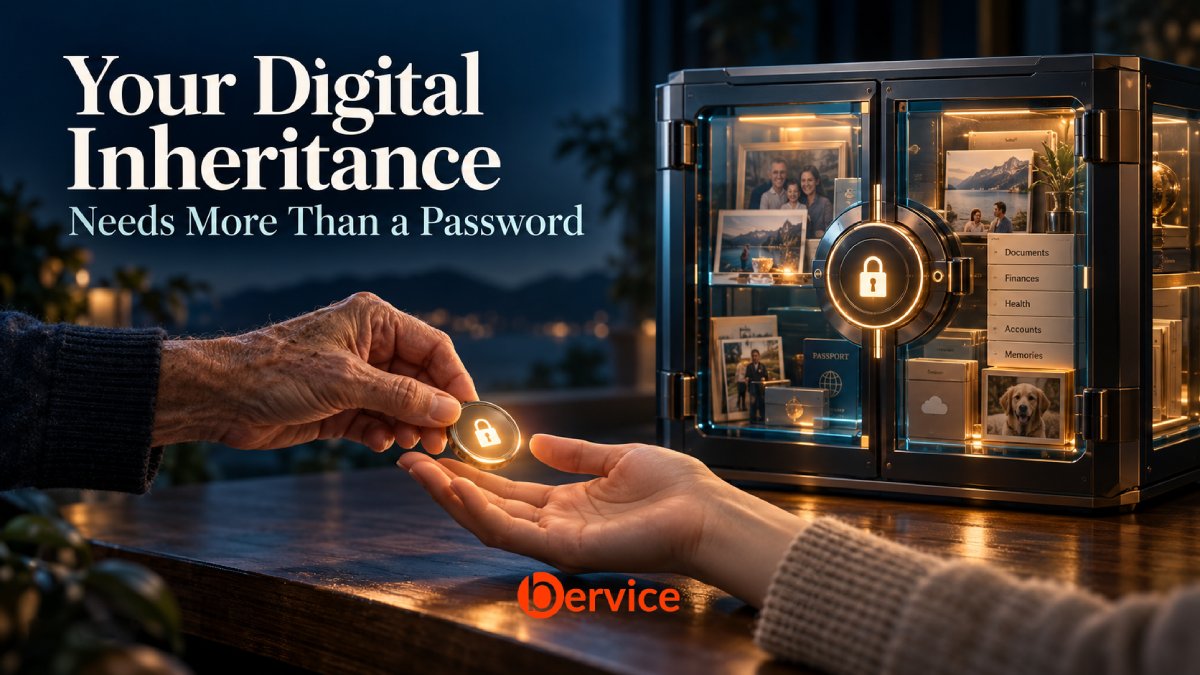
How to make essential information available to the people who need it, without surrendering your privacy before the time comes.
Imagine that someone you love suddenly becomes unable to manage their affairs.
You know they have insurance. You know important documents exist. You remember a conversation about a secure folder containing everything the family might need.
But you do not know where that folder is.
Their phone is locked. Their email requires a verification code. Their files are encrypted. The recovery instructions may be inside the very account you cannot access.
Nothing has been stolen. No security system has failed.
Yet the information is effectively out of reach.
This is the challenge of digital inheritance: protecting information during a person’s lifetime while preparing for the moment when someone else may legitimately need it.
A password alone cannot resolve that challenge.
What families need is a carefully defined path from privacy to authorized access.
A Digital Life Is More Than a Collection of Accounts
When people hear “digital inheritance,” they often think of social media profiles, photographs, or cryptocurrency.
Those may matter. But the most urgent information can be far more ordinary:
- Insurance policies and claim details.
- Property records and household agreements.
- Financial account information.
- Medical documents and care instructions.
- Business ownership records and essential contacts.
- Family photographs and personal messages.
- Instructions for subscriptions, devices, and stored files.
These categories serve different purposes.
A family member may need an insurance document immediately. An estate representative may need financial records later. A business partner may need operational documents but have no reason to read private correspondence.
Treating all of this as one inheritance package creates an unnecessary choice between complete exposure and complete inaccessibility.
A better question is:
Which information should become available, to whom, under what circumstances, and for what purpose?
Why Sharing a Password Is Not a Complete Plan
Giving a trusted person your password can feel like a practical solution.
But it creates several problems.
First, it may give them access immediately, even if your intention is to allow access only during an emergency.
Second, a password may no longer be sufficient. Authentication can depend on a phone, a security key, a trusted device, or another account.
Third, the password may change while the instructions remain untouched.
Finally, knowing how to sign in does not establish what someone is authorized to do once they are inside.
Finding a policy, downloading a family photograph, transferring an asset, and deleting an account are very different actions.
The ability to access information and the authority to act on it are separate questions.
A digital inheritance plan needs to address both.
Privacy Should Not Have to End When Planning Begins
Preparing for the future should not require opening your entire digital life today.
Someone can be deeply trusted without needing unrestricted access to everything you store.
You may want your partner to find household documents during an emergency while keeping a personal journal private. You may want a relative to receive family photographs after your death without inheriting your entire message history.
Those boundaries are reasonable.
Planning for digital inheritance is an opportunity to express them clearly.
It also protects other people. Your inbox and private conversations contain information about friends, colleagues, clients, and family members. Making an account accessible can expose their information alongside yours.
The goal should be deliberate disclosure: enough information to meet a legitimate need, with boundaries that reflect the owner’s wishes and relevant obligations.
Death and Incapacity Require Different Plans
Digital inheritance is often discussed only in the context of death.
But temporary or prolonged incapacity can create equally urgent access problems.
A person recovering from an accident may need someone to manage essential household matters for several weeks. That does not mean they want a permanent transfer of their private archive.
A plan for incapacity should therefore consider:
- What information is necessary during the emergency.
- Who is authorized to receive it.
- How the need for access will be established.
- Whether access can be limited in duration.
- How permissions will be reviewed when the person recovers.
A plan after death raises different questions about preservation, distribution, account closure, and the handling of an estate.
The legal arrangements for these situations depend on the jurisdiction and circumstances. Technical access settings should be coordinated with appropriate legal planning rather than treated as a substitute for it.
One distinction remains essential in either situation:
Access can sometimes be revoked. Information already viewed, copied, or downloaded cannot reliably be taken back.
That makes careful limits before disclosure especially important.
Separate What People Need From Everything You Have
A useful starting point is to organize information around purpose.
Essential continuity information
This is the material someone may need to keep daily life functioning: key contacts, the location of important documents, insurance details, and instructions for finding appropriate help.
It should be understandable to someone who has never used your filing system.
Estate and administrative information
This includes records that may help an authorized representative identify assets, obligations, ownership, and relevant institutions.
An account inventory can help someone discover what exists without exposing every credential in a single document.
Personal legacy
Photographs, letters, recordings, and selected creative work may have little administrative importance but enormous emotional value.
Choosing these materials intentionally can spare a family from searching through an entire private archive.
Restricted information
Some material may need to remain private, subject to applicable legal duties. Other records may belong to an employer, a client, or another person and require separate handling.
Digital inheritance does not mean that every file should pass to a family member.
It means deciding what should happen to different kinds of information.
Encryption Creates a Recovery Responsibility
Encryption can protect sensitive information from unauthorized access.
But an encrypted file still needs a usable route to its decryption key.
If the only key is lost, the existence of the file may provide little practical help. If the key is shared too broadly in advance, the intended privacy boundary may disappear.
This creates a design responsibility: recovery must be considered alongside protection.
A recovery arrangement needs to account for where the required material is held, who can obtain it, what conditions apply, and what happens if a person or device is unavailable.
There is no universal arrangement that is safest for every household. More elaborate systems can introduce additional failure points, and a process that nobody understands may fail precisely when it matters.
The practical objective is a recovery path that is both appropriately protected and usable by the intended recipient.
The Access Trigger Matters as Much as the Key
Conditional access sounds straightforward: release information when a specified event occurs.
Determining that the event has occurred is harder.
Inactivity, for example, can have many explanations. Someone may be travelling, ill, locked out, or simply taking a break from a service.
It is a signal, not proof of death or incapacity.
Any conditional release process needs clear answers to questions such as:
- What starts a request?
- What evidence is required?
- Who reviews it?
- Is the owner notified where appropriate?
- Can an incorrect request be challenged before disclosure?
- What happens if the intended recipient is unavailable?
A waiting period may help in some circumstances, but time alone does not establish authorization.
The consequences run in both directions. Premature release can permanently compromise privacy. Excessive delay can prevent a family from obtaining urgently needed records.
A credible plan acknowledges both risks.
Platform Features Help, but Their Boundaries Matter
Some services provide dedicated tools for planning future access.
Apple’s Legacy Contact feature allows a chosen person to request certain account data after the owner’s death using an access key and required documentation. However, it does not provide access to everything, including passwords and passkeys stored in iCloud Keychain. Documentation requirements can vary by country or region.
Google’s Inactive Account Manager lets users make arrangements for an account after a period of inactivity, including sharing selected data with trusted contacts. Its trigger is account inactivity, which is different from a verified finding of death or incapacity.
These tools can form part of a wider plan, but each has a defined scope.
Access to cloud data may not unlock a device. A legacy contact arrangement may exclude credentials. A plan for one account may do nothing for files stored elsewhere.
The important question is not simply whether a legacy feature is enabled.
It is whether the information your family will actually need is covered.
Avoid a Plan That Depends on Itself
One of the easiest mistakes is creating a circular recovery process.
The instructions are in your email, but accessing your email requires your phone. The phone recovery details are in your password manager. The password manager instructions are stored in your email.
Each part appears protected. Together, they may be inaccessible.
The first step in a recovery plan needs to be discoverable without already having access to the systems it is meant to recover.
That starting point does not have to reveal sensitive credentials. It may identify the relevant person, document location, or official process.
A trusted person should at least know that a plan exists and how to begin.
Test Understanding Before Testing Access
A digital inheritance plan should be understandable under stress.
Someone facing a medical emergency or bereavement should not have to interpret technical shorthand, identify unfamiliar devices, or guess which of several outdated documents is correct.
A useful review can begin without exposing private data:
Can the intended person explain where they would start? Do they know whom to contact? Can they distinguish urgent household information from private material? Is a backup person identified?
Any practical test should be designed carefully. Some actions can trigger disclosure, alter permissions, or start an irreversible process. A discussion or walkthrough may reveal gaps without activating the release mechanism.
The purpose is to validate the path, not casually open the vault.
Keep the Plan Connected to Real Life
Digital lives change.
People replace phones, move files, change relationships, close accounts, and take on new responsibilities. A person named years ago may no longer be willing or able to help.
A plan should be reviewed after meaningful changes, including a new device or authentication method, a major family event, a business transition, or a change in the people entrusted with access.
The review should cover both the information and the arrangement:
Is the essential material current? Are the intended recipients still appropriate? Does the recovery path still work? Do the permissions still reflect the owner’s wishes?
An old plan can create false confidence if nobody checks its assumptions.
What This Means for Secure Digital Storage
For Bervice, digital inheritance raises a broader question about the purpose of a secure vault.
Protecting information today is essential. So is considering whether that information can remain useful when its owner can no longer manage access.
A responsible approach to secure storage should make room for:
- Clear separation between essential records and private archives.
- Deliberately limited permissions.
- Recovery arrangements that do not depend on one device.
- Understandable access conditions and limitations.
- Records of access where the system supports them.
- Honest explanations of what can and cannot be recovered.
These are design principles, not guarantees that any particular product or configuration provides them.
Security claims should be precise, especially when families may depend on them during a crisis.
Leave a Path, Not Just a Secret
A password is a secret.
A digital inheritance plan is a set of decisions about people, information, authority, and timing.
It explains what exists, what matters, who may receive it, and how they can proceed without gaining unnecessary access before the time comes.
The strongest plan respects two wishes at once:
Keep my private life private while I am here.
Help the people I trust find what they need when I cannot help them myself.
Digital inheritance begins when we stop treating those wishes as competing goals and start planning for both.
Connect with us : https://linktr.ee/bervice
Website : https://bervice.com