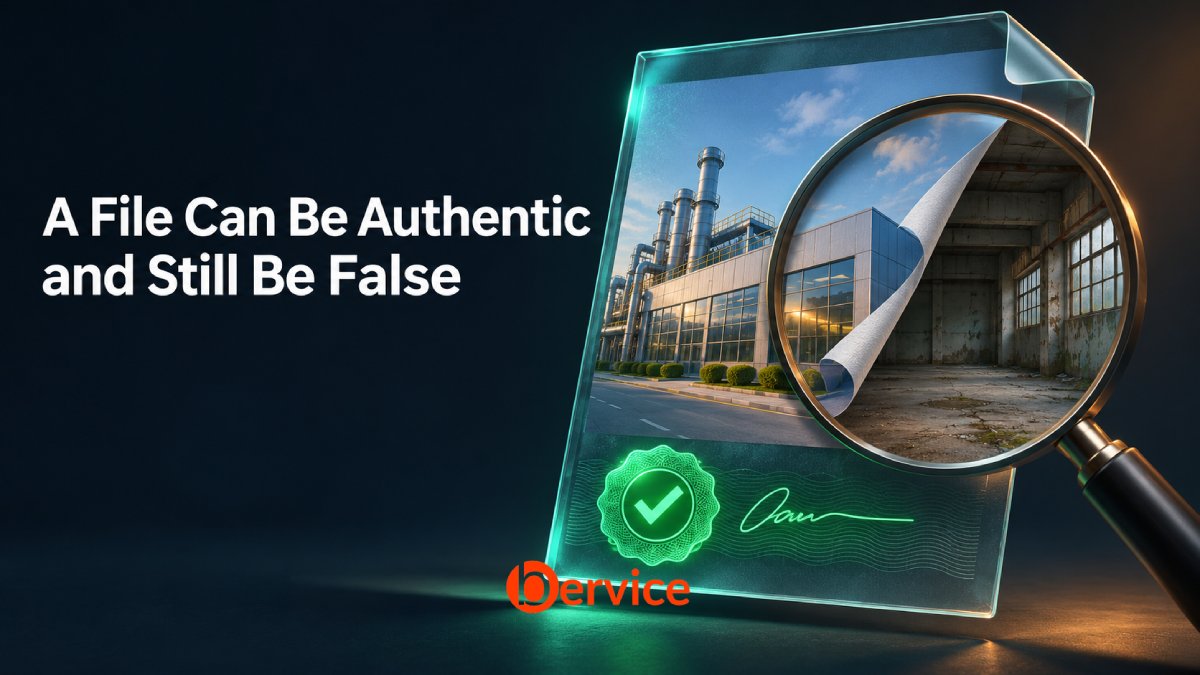
What a digital signature proves, what it cannot prove, and why the difference matters
You receive a report from a supplier.
The document is digitally signed. The signature validates. The signing certificate belongs to the company you expected. The signed content has not changed.
Inside, the report states that a product passed its safety inspection.
There is just one problem: the inspection never happened.
The document is authentic. The claim is false.
Nothing about this scenario requires a failure in cryptography. The signature can work exactly as intended while the information it protects remains inaccurate, misleading, or deliberately fabricated.
That distinction matters whenever we use digital records to make decisions.
Authenticity helps establish where information came from. Truth concerns whether its claims match reality.
A secure information system needs to respect both questions without treating them as interchangeable.
What a Digital Signature Actually Establishes
A digital signature connects signed data to a cryptographic key.
With appropriate implementation and validation, it can help establish the origin of signed information and detect changes to that information. NIST describes digital signatures in terms of data integrity, origin authentication, and support for signatory non-repudiation. These are specific security properties, each with its own assumptions.
In practical terms, verification can provide evidence that the signature corresponds to a particular public key and that the signed data remains intact.
Connecting that key to a named person or organization requires additional assurances. A mathematically valid signature alone does not establish the real-world identity of its signer. NIST addresses that identity assurance separately in its guidance for digital signature applications.
Even when identity and integrity are properly established, a different question remains:
Was the information correct when it was signed?
The signature does not inspect a warehouse, interview a witness, repeat a laboratory test, or reconcile a financial statement.
It protects a representation of events. It does not independently observe those events.
An Unchanged Error Is Still an Error
Consider a hypothetical inventory report.
A warehouse employee records 1,200 units in stock. The actual count is 900. Perhaps the employee made a mistake. Perhaps the counting system duplicated a batch. Perhaps someone inflated the number deliberately.
The organization exports the report and signs it.
Later, a recipient verifies the signature successfully.
That verification can help establish that the recipient has the signed report intact. It cannot establish that 1,200 units were physically present.
The error existed before signing.
This is the boundary that often disappears in everyday conversation. We hear “the document is verified” and interpret it as “the document is correct.”
But verification always has an object.
Was the signature verified? The signer’s identity? The calculation? The physical stock count?
Unless we specify what was checked, the word “verified” can imply much more assurance than the process actually provides.
Four Questions Behind Every Trusted File
A useful way to assess a document is to separate four questions:
| Question | What it concerns |
|---|---|
| Who signed it? | Identity and the connection between the signer and the signing key |
| Has the signed content changed? | Integrity of the data covered by the signature |
| What supports its claims? | Evidence, methods, and factual accuracy |
| Is it suitable for this decision? | Scope, relevance, currency, and authority |
These questions can produce different answers for the same file.
A report may come from a known expert and remain unchanged, yet rely on outdated measurements.
A statement may be accurate but incomplete.
A document may be genuine and factually correct while applying to a different product, location, or period.
Trust becomes more useful when these differences remain visible.
Falsehood Does Not Always Mean Fraud
It is tempting to imagine an authentic but false document as the work of a dishonest signer.
Sometimes it is. But ordinary mistakes can create the same result.
A spreadsheet may contain a broken formula. A report may use the wrong dataset. A sensor may be miscalibrated. An analyst may misunderstand a definition. A reviewer may approve a conclusion without examining the supporting evidence.
There are also cases where every sentence is technically accurate, but the overall impression is misleading.
A performance report might highlight the strongest month while omitting a year of losses. A test result might describe ideal laboratory conditions without explaining that actual operating conditions differ.
Signing such a document preserves what it says. It does not supply what it leaves out.
Integrity can preserve an omission as faithfully as it preserves a fact.
That is why factual review must examine assumptions, methods, exclusions, and context alongside the final statements.
Provenance Helps Investigation, but Does Not End It
Knowing where a file came from is valuable.
Provenance can help investigators identify the source of a claim, follow its revision history, and ask the right people how it was produced.
But a traceable chain can begin with bad information.
Imagine an incorrect measurement passing through several stages:
- An operator records the wrong value.
- A manager approves the record.
- A reporting system incorporates it into a summary.
- A partner receives and signs an acknowledgment.
- An archive preserves the documents.
Each stage may be documented accurately. The original measurement can still be wrong.
A detailed history makes the error easier to investigate. It does not retroactively make the measurement accurate.
The strongest use of provenance is to support scrutiny: showing where to look, who to ask, and which evidence to examine.
A Signature Is Not Blanket Authorization
Another distinction matters when documents trigger actions.
A supplier can genuinely sign an invoice containing new bank details. That establishes neither that the requested change is appropriate nor that the recipient should immediately make a payment.
Several questions remain:
- Is the signer authorized to request the change?
- Does the invoice correspond to an actual purchase?
- Were the goods or services received?
- Has the payment destination been independently confirmed?
- Does the action meet the organization’s approval requirements?
Authenticity contributes evidence to this process. It does not replace the process.
The same principle applies to AI agents that read documents. A signed file may contain a request, instruction, or claim. Its signature alone should not grant that content permission to control the agent’s actions.
Better Interfaces Need More Precise Language
A single green badge can conceal several different judgments.
“Verified” might mean that a signature passed a cryptographic check. A reader may assume it means that someone reviewed the facts and approved the document for use.
Interfaces should make the scope of assurance explicit.
Useful labels might include:
- Signature valid
- Signer identity validated
- Supporting evidence attached
- Content reviewed by a named reviewer
- Approved for a specified purpose
- Review required before use
These labels should appear only when the corresponding checks have actually occurred.
Even factual review should have a defined scope. Reviewing a report’s arithmetic does not establish the accuracy of its source measurements. Confirming an issuer’s identity does not establish the issuer’s competence in every subject.
Precise language helps people understand what they can reasonably rely on.
What This Means for Secure Storage
For Bervice, this distinction offers an important principle for thinking about secure information management:
Protecting a file and establishing confidence in its contents are related responsibilities with different requirements.
A secure vault can protect valuable records. But the surrounding information also matters: where a record came from, which version it represents, what evidence supports it, and whether a later correction exists.
A useful design direction is to preserve those relationships alongside the file.
For example, an inspection report becomes easier to assess when it remains connected to the relevant photographs, test results, equipment identifiers, reviewer notes, and subsequent corrections.
The purpose is not to make a vault declare every stored statement true. It is to help people retain the evidence needed to evaluate those statements.
An inaccurate record may also need to remain available as part of an investigation or historical account. Preserving it should not imply endorsing it. Clear status and correction records help maintain that distinction.
Ask What Was Actually Proven
When a file appears trustworthy, begin with a precise question:
What does the available evidence actually establish?
A signature may establish integrity under the relevant cryptographic assumptions. Identity validation may connect a key to an organization. Supporting records may strengthen a factual claim. Independent review may identify weaknesses.
Each contributes something useful. None should silently inherit the meaning of all the others.
For decisions with serious consequences, confidence should grow from relevant evidence, appropriate review, and clearly defined authority.
Cryptography is an essential part of that foundation. Its value becomes clearer when we describe its guarantees accurately.
A file can be securely stored, correctly attributed, and perfectly preserved while containing a mistake.
It can also contain a deliberate lie.
The signature may help us establish who signed the statement and whether the signed content changed. To determine whether the statement is true, we still need to examine the world it describes.
Authenticity gives information a traceable origin. Truth requires evidence.
Connect with us : https://linktr.ee/bervice
Website : https://bervice.com