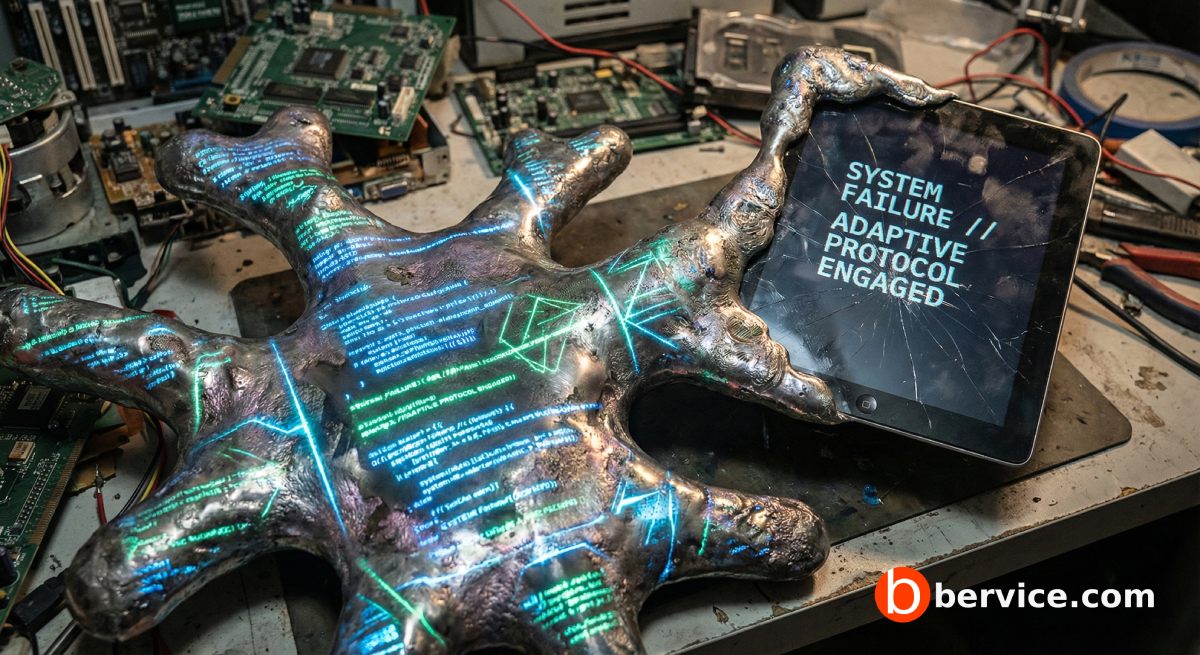
Software engineers love to believe their code runs in a clean, deterministic universe. But once you drop below the OS layer and step onto bare metal, that illusion collapses. Microcontrollers, avionics systems, and industrial controllers operate inside physics not logic and physics doesn’t care about your abstractions.
1. Hardware Is Not a Perfect Machine It’s a Dynamic Physical System
At the surface level, programming feels stable: inputs go in, outputs come out, and as long as you avoid race conditions or memory leaks, you assume the system behaves predictably.
But underneath that calm layer, the hardware is constantly battling:
- Electromagnetic interference (EMI)
- Voltage fluctuations
- Clock jitter
- Thermal variation
- Radiation-induced bit flips
These factors don’t politely follow your state machine. They create undefined hardware states that no amount of clean coding can prevent.
When a microcontroller enters one of these undefined regions, the behavior stops being digital and becomes analog even biological. Think of it as code running on “living metal,” where the substrate has moods.
2. The Jet Engine Problem: One Bit Can Change Thrust by 50%
In safety-critical systems, a single undefined state can be catastrophic.
One example: the Olympus 593 engine controller on the Concorde.
This system depended on precise sensor inputs and deterministic microcontroller behavior to regulate fuel injection. Under high heat + vibration + EMI, even a single erroneous bit in the control loop could cause:
- incorrect airflow measurement
- wrong fuel schedule
- thrust dropping from 80% to 30% instantly
This wasn’t a software bug. It was physics overriding logic.
These kinds of failures are still common today from drone flight controllers to EV battery management systems and even medical pumps.
3. The Myth of Digital Certainty
Every digital system is built on an analog foundation. That foundation is messy:
- A “1” is just a voltage range, not a perfect value
- A “clock cycle” is only as stable as the silicon temperature
- A “stable register” is stable only until cosmic radiation hits it
Engineers often pretend the hardware is a clean abstraction because it simplifies design thinking. But at scale especially in aerospace, defense, or industrial robotics ignoring the analog layer is a design failure.
Undefined hardware states happen when the system crosses thresholds the software model never considered. At that moment, the machine stops being a computer and becomes a physical organism reacting to the environment.
4. Why Software Safety Depends on Understanding Physics
High-reliability systems (avionics, nuclear, automotive, drones) already know this truth. Their solutions are extremely physical:
- Triple Modular Redundancy (TMR)
- Radiation-hardened silicon
- Clock synchronization with drift compensation
- Thermal-adaptive voltage regulators
- Real-time EMI mitigation
- Watchdog timers for analog-domain dropouts
All of these techniques exist because the hardware is never fully deterministic.
If you treat the processor as a pure logical machine, you’re building a time bomb.
5. Nature Always Wins Unless You Design for It
The takeaway is simple but uncomfortable:
Software isn’t secure or reliable unless it respects the chaos of physics.
The deeper your code goes into embedded, real-time, or safety-critical systems, the more you need to think like a physicist, not a programmer.
Because sometimes the hardware will ignore your logic and follow nature’s rules instead.
Connect with us : https://linktr.ee/bervice