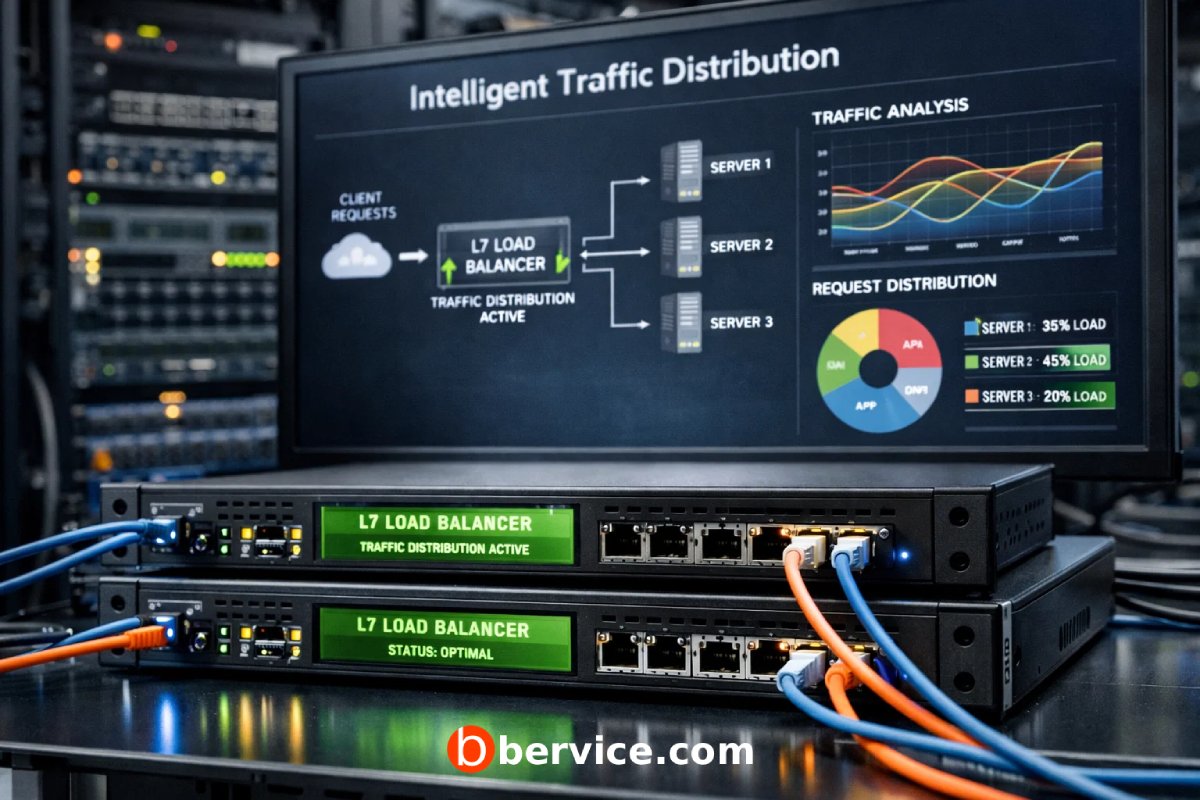
Introduction: Load Balancing Is Not Just Distribution
In modern cloud-native architectures, handling traffic is no longer about simply spreading requests evenly across servers. It is about understanding requests, predicting behavior, and making context-aware routing decisions. This is where Layer 7 (Application Layer) Load Balancers fundamentally change the game.
Unlike lower-layer balancers, Layer 7 load balancers operate with full awareness of the HTTP protocol. They inspect headers, cookies, paths, methods, and even payload characteristics to route traffic intelligently. In complex systems, this capability is not optional it is foundational.
Layer 7 vs Layer 4: Why the Difference Matters
Layer 4 load balancers work at the transport level. They see IP addresses and ports nothing more. Their decisions are fast, but blind.
Layer 7 load balancers, on the other hand:
- Parse HTTP/HTTPS traffic
- Understand request semantics
- Apply business-aware routing logic
This distinction becomes critical in systems where:
- Multiple services share the same domain
- Stateful sessions must be preserved
- APIs evolve independently
- Traffic patterns fluctuate dynamically
If your architecture includes microservices, APIs, or user-facing web applications, Layer 4 alone is insufficient.
Core Capabilities of Layer 7 Load Balancers
1. Content-Aware Routing
Layer 7 load balancers can route requests based on:
- URL paths (
/api/v1,/auth,/billing) - HTTP methods (GET, POST, PUT)
- Headers (User-Agent, Authorization)
- Cookies and session identifiers
This enables clean API versioning, gradual migrations, and service isolation without changing client behavior.
2. Session Affinity and Stateful Control
Many applications still require session persistence. Layer 7 balancers support:
- Cookie-based stickiness
- Header-based affinity
- Custom session strategies
This ensures that stateful services remain consistent without pushing unnecessary complexity into application code.
3. Intelligent Traffic Shaping
Advanced Layer 7 load balancers can:
- Perform canary releases
- Enable blue-green deployments
- Route traffic based on geography or latency
- Throttle or prioritize specific request types
This turns traffic management into a deployment and reliability tool, not just an infrastructure component.
Fault Tolerance and Resilience at Scale
A critical advantage of Layer 7 load balancing is deep health awareness.
Instead of checking whether a port is open, Layer 7 balancers can:
- Call health endpoints
- Validate response codes
- Detect partial failures
- Remove degraded services automatically
This dramatically improves:
- Mean time to recovery (MTTR)
- System availability
- User-perceived reliability
In distributed systems, this level of insight is the difference between graceful degradation and cascading failure.
Role in Microservices Architecture
Microservices introduce inevitable complexity:
- Dozens or hundreds of services
- Independent deployment cycles
- Constant version changes
Layer 7 load balancers act as the traffic control plane for this complexity. They decouple clients from service topology and allow backend systems to evolve without breaking consumers.
Without Layer 7 routing:
- Service discovery becomes fragile
- API gateways become overloaded
- Observability suffers
With it, traffic becomes programmable.
Key Tools in the Layer 7 Ecosystem
Several mature tools dominate this space:
- Nginx – Widely used, battle-tested, and highly configurable for HTTP routing and reverse proxying.
- Envoy – Designed for modern service meshes, offering deep observability and dynamic configuration.
- Azure Front Door – A global Layer 7 solution combining CDN, WAF, and intelligent routing at scale.
Each addresses different layers of the problem, but all share the same core principle: application-aware traffic control.
Conclusion: The Backbone of Modern Cloud Systems
Layer 7 load balancers are not an optimization they are a structural requirement for modern cloud architectures.
They enable:
- Smarter routing
- Safer deployments
- Higher availability
- Cleaner system boundaries
In a world of microservices, APIs, and global users, Layer 7 load balancing is the silent backbone holding everything together. If your architecture depends on HTTP and most do then Layer 7 is where real control begins.
Connect with us : https://linktr.ee/bervice
Website : https://bervice.com