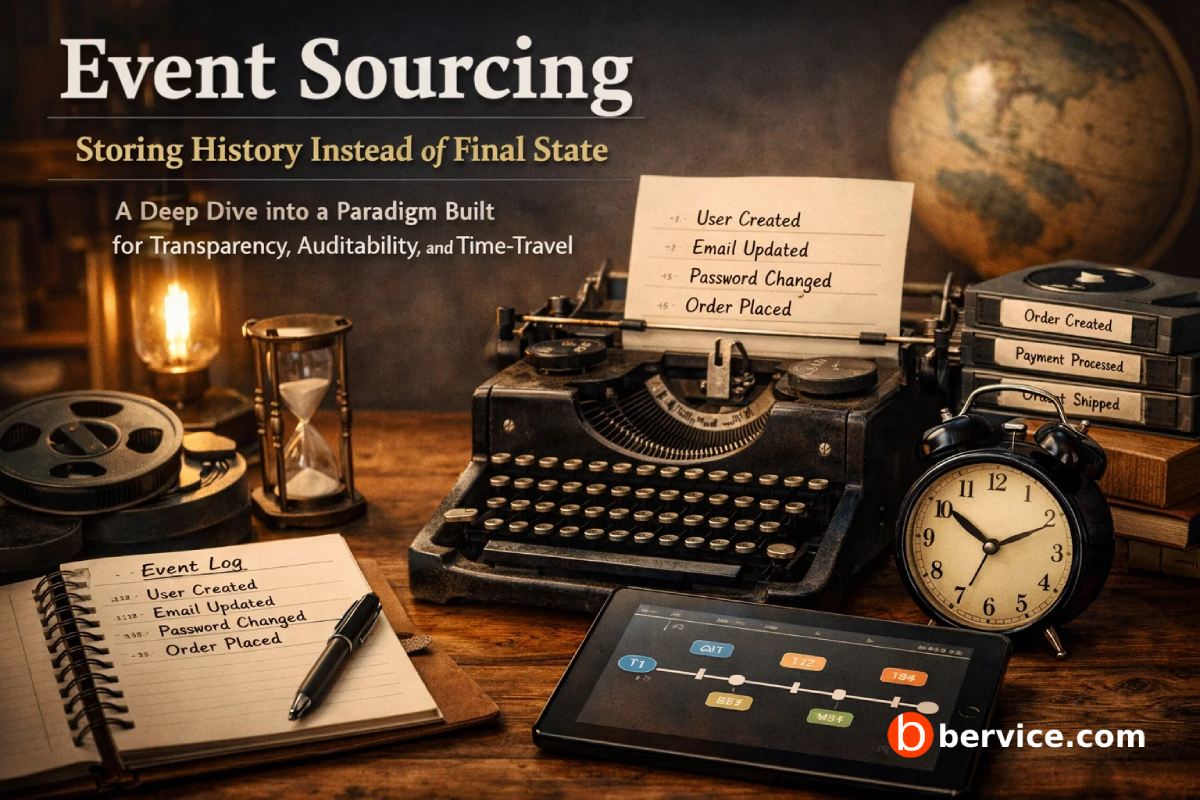
A Deep Dive into a Paradigm Built for Transparency, Auditability, and Time-Travel
Modern software systems are increasingly expected to be auditable, resilient, and explainable. In domains like finance, banking, healthcare, and large-scale platforms, knowing what the current state is is no longer enough we must also know how we got there.
This is where Event Sourcing comes in.
Event Sourcing is not just a data-storage technique; it’s a fundamental shift in how we model reality inside software systems.
1. The Core Idea of Event Sourcing
In traditional systems, databases store only the latest state of an entity:
- Account balance:
€4,250 - Order status:
SHIPPED - User role:
ADMIN
Everything that happened before is either lost or partially preserved via logs.
Event Sourcing flips this model.
Instead of storing the final state, the system stores every event that led to that state.
Examples:
AccountOpenedMoneyDeposited(€1,000)MoneyWithdrawn(€250)MoneyDeposited(€3,500)
The current balance is derived, not stored.
The state is a projection of events, not the source of truth.
2. Events as the Source of Truth
In Event Sourcing:
- Events are immutable
- Events represent facts that already happened
- Events are appended, never updated or deleted
This makes the event log an append-only, chronological ledger—similar to accounting journals or blockchain transaction logs.
Key characteristics of events:
- Past-tense (
OrderPlaced, notPlaceOrder) - Contain all required business data
- Versioned and schema-aware
3. How State Is Reconstructed
To get the current state of an entity:
- Load all events for that entity
- Replay them in order
- Apply each event to a state reducer (aggregate)
This process is deterministic:
the same events → the same state.
Optimization: Snapshots
Replaying thousands of events can be expensive.
Many systems periodically store snapshots (a cached state at a point in time) and replay only events after that snapshot.
4. Why Event Sourcing Exists (The Real Reasons)
Event Sourcing is not about trendiness or over-engineering.
It exists because some problems cannot be solved reliably with state-only storage.
4.1 Full Auditability
You can answer questions like:
- Who changed this value?
- When did it change?
- What was the system state last Tuesday at 14:37?
This is critical for:
- Banking
- Financial systems
- Compliance (GDPR, SOX, ISO)
- Legal dispute resolution
4.2 Time Travel & Debugging
You can:
- Rebuild past states
- Simulate alternative futures
- Debug production issues by replaying real events
4.3 Business Intelligence & Analytics
Events are raw business facts:
- Perfect for analytics
- Perfect for ML/AI pipelines
- Perfect for behavioral analysis
4.4 Natural Fit for Distributed Systems
Event streams:
- Scale horizontally
- Are easy to replicate
- Integrate well with message brokers and streaming platforms
5. Event Sourcing vs Traditional CRUD
| Aspect | CRUD / State-Based | Event Sourcing |
|---|---|---|
| Data Stored | Latest state | Full history |
| Mutability | Update & delete | Append-only |
| Audit Trail | Optional | Built-in |
| Debugging | Limited | Time-travel |
| Complexity | Low | High |
| Scalability | Moderate | High |
| Compliance | Hard | Natural |
Important:
Event Sourcing increases conceptual complexity.
It should be used only when its benefits are truly needed.
6. Event Sourcing and CQRS
Event Sourcing is often paired with CQRS (Command Query Responsibility Segregation).
- Commands: intent to change state
- Events: facts that something happened
- Queries: read-optimized projections
This separation allows:
- Write models optimized for consistency
- Read models optimized for performance
- Independent scaling of reads and writes
Event Sourcing does not require CQRS, but CQRS benefits greatly from it.
7. Real-World Use Cases
Event Sourcing is commonly used in:
- Core banking systems
- Payment platforms
- Trading systems
- Insurance platforms
- Supply-chain systems
- Identity & access management
- Blockchain-adjacent architectures
If your system answers questions like:
“What exactly happened?”
“Can we prove it?”
“Can we replay it?”
Event Sourcing is a strong candidate.
8. Tooling & Ecosystem
Popular tools and frameworks in the Event Sourcing ecosystem include:
- Dedicated event stores
- Persistence layers for actor systems
- Streaming platforms combined with append-only logs
These tools focus on:
- Durable event storage
- Ordered event streams
- Idempotent processing
- Event versioning and migration
9. Challenges and Trade-Offs
Event Sourcing is powerful but not free.
Common challenges:
- Steeper learning curve
- Event schema evolution
- Data migrations via replay
- Debugging distributed event flows
- More upfront architectural thinking
Rule of thumb:
If you don’t need history, auditability, or replayability don’t use Event Sourcing.
10. A Mental Model to Remember
Think of Event Sourcing as:
- A ledger, not a spreadsheet
- A memory, not a snapshot
- A story, not a photo
Event Sourcing is the system’s long-term memory
an exact, immutable record of how reality unfolded.
Final Thoughts
Event Sourcing represents a philosophical shift:
from “What is the state?”
to “What happened?”
In an era where trust, transparency, and traceability matter more than ever,
Event Sourcing is not just an architectural pattern it’s a way of modeling truth in software systems.
If your system must remember its past to make sense of its future,
Event Sourcing is worth the complexity.
Connect with us : https://linktr.ee/bervice
Website : https://bervice.com