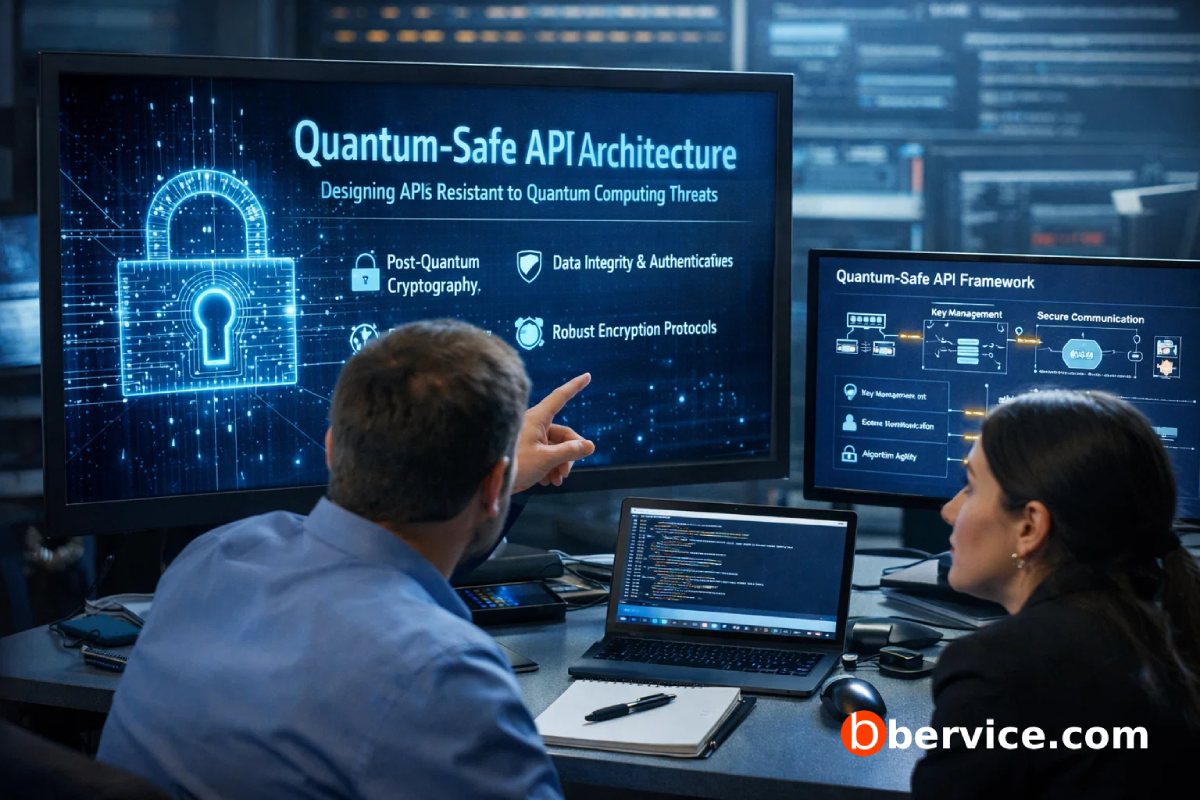
Introduction: Why Quantum-Safe APIs Matter
The rapid progress of quantum computing represents a structural threat to today’s digital security. Most modern APIs rely directly or indirectly on classical public-key cryptography such as RSA and Elliptic Curve Cryptography (ECC). These systems are secure against classical computers but become fundamentally vulnerable once sufficiently powerful quantum computers exist. Algorithms like Shor’s algorithm can, in principle, break RSA and ECC in polynomial time.
A Quantum-Safe API (also called Quantum-Resistant or Post-Quantum Secure API) is an architectural response to this risk. Its goal is not speculative security, but long-term resilience: ensuring that API communications, authentication, and data integrity remain secure even in a post-quantum world.
The Core Threat Model
To understand why Quantum-Safe APIs are necessary, it is important to clarify the threat model:
- Harvest Now, Decrypt Later
Attackers can record encrypted API traffic today and decrypt it in the future once quantum capabilities mature. - Broken Trust Primitives
Digital signatures, TLS handshakes, API tokens, and key exchanges based on RSA/ECC lose their security guarantees. - Long-Lived Data Risk
APIs handling sensitive data (identity, health, financial, governmental, or critical infrastructure data) often require confidentiality guarantees lasting decades.
Quantum-Safe API design assumes that quantum adversaries will eventually exist, even if they do not yet.
What Makes an API Quantum-Safe?
A Quantum-Safe API is not defined by a single algorithm, but by a layered architectural strategy:
1. Post-Quantum Cryptography at the API Layer
Instead of RSA or ECC, Quantum-Safe APIs rely on Post-Quantum Cryptography (PQC) algorithms, particularly:
- Lattice-based cryptography
- Code-based cryptography
- Hash-based signatures
- Multivariate polynomial schemes
Among these, lattice-based constructions are currently the most widely adopted due to their performance and security properties.
Key characteristics:
- Very large key sizes compared to classical crypto
- Security based on hard mathematical problems resistant to known quantum algorithms
- Designed to survive both classical and quantum attacks
2. Quantum-Resistant Key Exchange
In a Quantum-Safe API, secure key exchange must not depend on Diffie-Hellman or ECDH alone.
Typical approaches include:
- Pure PQC key exchange
- Hybrid key exchange, combining classical + PQC methods
Hybrid models are common during transition periods, ensuring:
- Backward compatibility
- Defense-in-depth if either cryptographic system is compromised
This ensures that even if classical crypto fails, the session remains secure.
3. Multi-Stage Secure Handshakes
Quantum-Safe APIs often use multi-stage authentication and key negotiation instead of a single handshake.
This may involve:
- Initial identity assertion
- Quantum-safe key encapsulation
- Session re-keying at short intervals
- Ephemeral secrets with forward secrecy
The goal is to reduce the value of any single compromised exchange.
4. Quantum-Safe Authentication & Signatures
Authentication mechanisms such as:
- API keys
- JWTs
- OAuth tokens
- Signed requests
must also transition away from classical digital signatures.
Quantum-Safe APIs replace or augment these with:
- Hash-based signatures for high-integrity operations
- PQC signature schemes for identity validation
- Short-lived credentials to limit exposure
Architectural Principles of a Quantum-Safe API
Principle 1: Crypto Agility
A Quantum-Safe API must be cryptographically agile:
- Algorithms must be swappable without redesigning the entire system
- Protocol versions must be negotiable
- Deprecation paths must be built-in
Hard-coding cryptography is a long-term liability.
Principle 2: Minimal Trust Surface
Quantum-Safe APIs reduce centralized trust:
- No permanent master keys
- No long-lived secrets stored server-side
- Prefer client-generated keys
This limits the blast radius of future cryptographic breaks.
Principle 3: Explicit Threat Awareness
A Quantum-Safe API assumes:
- Network traffic is observable
- Storage systems may be breached
- Future decryption is a realistic threat
Security is designed around inevitable exposure, not perfect secrecy.
Performance and Practical Constraints
Quantum-Safe APIs are not free of trade-offs:
- Larger payloads due to big keys and signatures
- Higher CPU and memory usage
- Longer handshake times if not optimized
However, modern designs mitigate these issues through:
- Session caching
- Hybrid negotiation
- Selective PQC usage only where long-term security is required
For most real-world APIs, the overhead is manageable and decreasing as implementations mature.
Where Quantum-Safe APIs Are Essential
Quantum-Safe API architectures are especially critical in:
- Financial infrastructure
- Identity and authentication services
- Cloud storage and secure data exchange
- Blockchain and decentralized systems
- Government and defense platforms
- Healthcare and genomic data APIs
Any system that must remain secure for 10–30 years should already be planning this transition.
The Future: Quantum-Safe as a Baseline
Quantum-Safe APIs are not a niche or experimental concept. They represent the next baseline for secure system design.
Just as HTTPS replaced HTTP, and TLS replaced plaintext protocols, Quantum-Safe cryptography will eventually replace classical public-key systems. APIs that fail to evolve will inherit structural insecurity regardless of how strong they appear today.
Conclusion
A Quantum-Safe API is not about fear of quantum computers it is about realism. Cryptographic history shows that once a primitive is broken, recovery is costly and often too late.
Designing APIs with Post-Quantum Cryptography, layered security, and cryptographic agility ensures that systems remain trustworthy in a future where quantum computing is no longer theoretical.
Any API built for the future must be Quantum-Safe by design, not by retrofit.
Connect with us : https://linktr.ee/bervice
Website : https://bervice.com