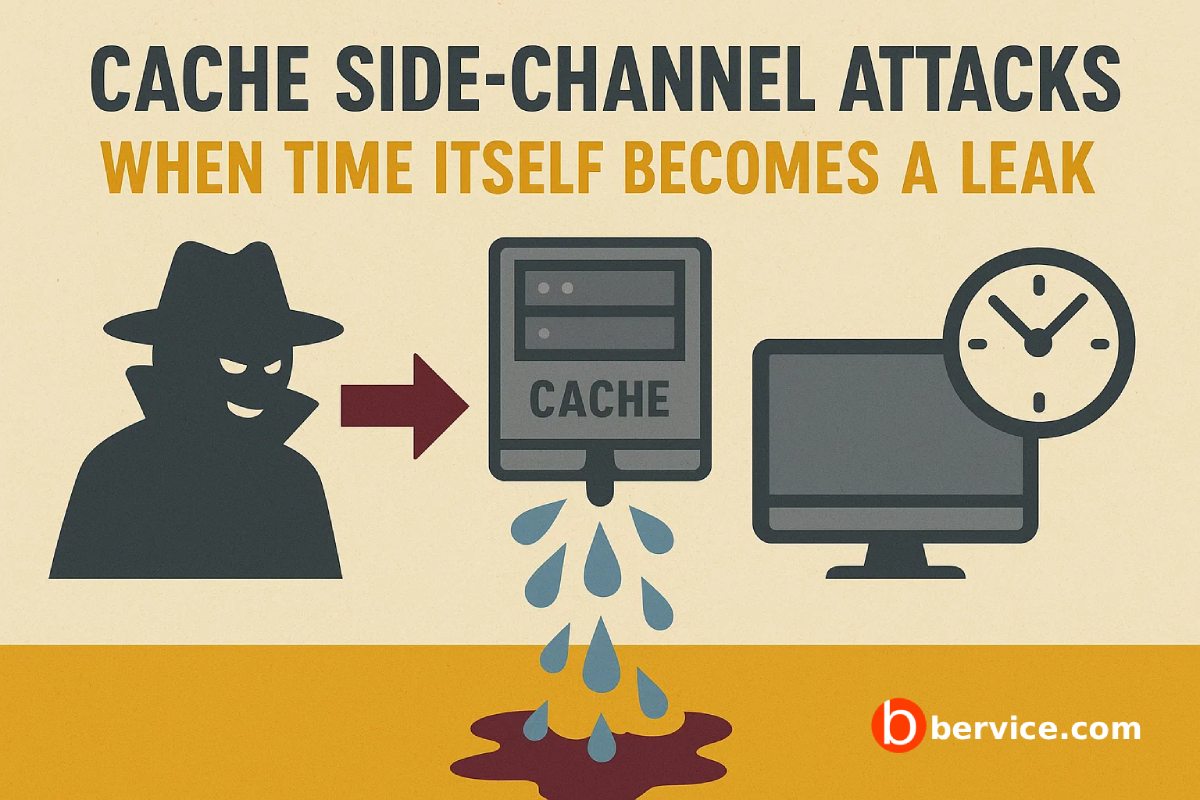
Modern computing systems rely on multilayered memory hierarchies designed for speed, not secrecy. CPU caches — L1, L2, L3 — exist to accelerate access to frequently used data. But that optimization introduces a blind spot: timing differences. Attackers can observe tiny delays in memory access and extract information that should never be accessible. No privileged API, no file system access — just pure microarchitectural leakage.
1. How Cache Side-Channels Actually Work
At their core, these attacks measure how long it takes to access a memory location. If an address is already cached, the access is extremely fast. If it was evicted or never cached, the access is slower. This microscopic timing difference becomes the attack surface.
Two classic primitives dominate:
- Flush+Reload: Attacker flushes a specific cache line, waits, and then reloads it. If the reload is fast, the victim accessed it in the meantime.
- Prime+Probe: Attacker fills a cache set (prime), lets the victim run, then rechecks which lines were evicted (probe).
These primitives require no direct memory access to the victim’s data. Timing alone reveals patterns.
2. The Spectre & Meltdown Breakthrough
The world understood how bad this can get only after Spectre and Meltdown.
Spectre
Spectre abuses branch prediction and speculative execution. The CPU speculatively executes a path, touching memory that the victim would otherwise never reach. Those speculative reads leave traces — cache footprints. Even though the results are discarded architecturally, the microarchitectural side effects leak secrets like passwords, cryptographic keys, and kernel memory.
Meltdown
Meltdown goes deeper. It exploits out-of-order execution to access privileged kernel memory from user space. The CPU executes an illegal memory load before checking permissions, then rolls back the result — but the transient access still leaves cache traces that can be measured.
Both attacks proved an uncomfortable truth:
The CPU’s attempt to be fast makes it fundamentally leaky.
3. Practical Exploitation
Cache side-channels can:
- Recover AES keys by watching which S-box entries are cached
- Extract RSA keys from modular exponentiation operations
- Steal keystrokes by monitoring GUI event loops
- Break sandbox boundaries in browsers
- Correlate operations in virtual machines on shared hardware
This is not theoretical anymore. It happens in the real world, especially in multi-tenant cloud environments.
4. Defenses None Are Perfect
Mitigating these attacks is painful, expensive, and often incomplete.
Software Defenses
- Constant-time cryptography: remove secret-dependent branches and table lookups.
- Cache partitioning: isolate processes using page coloring or cache allocation technology.
- Retpolines: mitigate Spectre by preventing speculative indirect branches.
- Fencing instructions (LFENCE): block speculative execution at sensitive boundaries.
But these are patches, not cures. Many require refactoring entire cryptographic libraries.
Hardware Defenses
- Speculative execution barriers
- Stronger privilege checks before execution
- Reworked caching and predictor logic
- New ISA extensions to control speculation
The problem? CPUs have a 20-year legacy of performance-first design. Reversing that is slow.
5. Why This Threat Won’t Go Away
As long as CPUs continue to optimize using speculative execution, caching, branch predictors, and out-of-order pipelines, timing-based leakage will remain.
Worse:
- Clock speeds won’t increase significantly anymore
- Performance comes from microarchitectural tricks
- Those tricks create side-channels
Attackers don’t need malware. They just need time measurements. Even sandboxed code — JavaScript included — can exploit these leaks.
6. The Harsh Reality
Security teams with a shallow view think software patches solve Spectre-class attacks. They don’t. These weaknesses are baked into silicon. We’re dealing with architectural design problems, not misconfigurations.
The uncomfortable truth:
In modern computing, time itself becomes a carrier of secrets.
And unless future CPUs are redesigned from the ground up, this class of attacks will remain a permanent part of our threat landscape.
Connect with us : https://linktr.ee/bervice