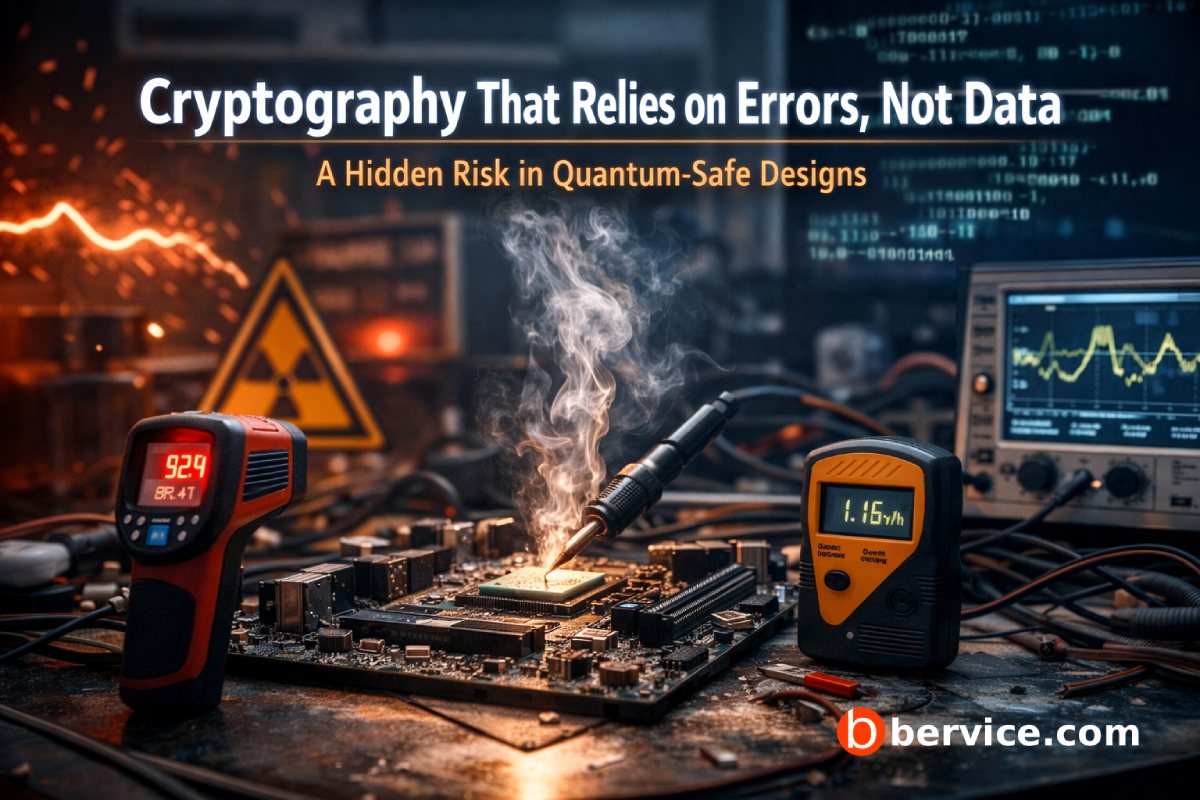
A Hidden Risk in Quantum-Safe Designs
As the cryptographic world prepares for the post-quantum era, much of the focus has shifted toward algorithms believed to be resistant to quantum attacks. Among the most prominent of these are noise-based constructions, particularly lattice-based cryptography. These systems promise security not from secrecy of data, but from mathematical hardness rooted in error.
That shift, however, introduces a subtle and often under-discussed risk:
what happens when cryptographic security depends on noise and noise can be influenced?
Noise as a Security Primitive
In classical cryptography, security is usually derived from well-defined mathematical problems: factoring large integers, computing discrete logarithms, or solving elliptic curve equations. In contrast, many quantum-safe schemes rely on problems like Learning With Errors (LWE) or Ring-LWE.
At a high level, these systems work because:
- Small random errors are deliberately injected into computations
- These errors make reversing the computation computationally infeasible
- Without knowing the original noise, an attacker cannot recover the secret
In theory, the randomness of these errors is what keeps the system secure.
When Errors Are No Longer Random
The assumption underpinning noise-based cryptography is that errors are:
- Random
- Unbiased
- Uncontrollable by an attacker
In real-world systems, however, cryptographic algorithms do not run in a vacuum. They run on physical hardware CPUs, memory, power rails, and clock systems all of which are subject to physical constraints.
This introduces a critical question:
Are cryptographic “errors” truly random if the hardware producing them can be influenced?
Hardware Faults as an Attack Surface
Modern processors are not perfectly deterministic machines. Their behavior can be affected by:
- Temperature changes
- Voltage fluctuations
- Clock instability
- Electromagnetic interference
- Radiation (natural or induced)
If an attacker can partially influence these conditions, they may be able to:
- Bias error distributions
- Reduce entropy in noise generation
- Trigger repeatable fault patterns
In noise-based cryptography, this is particularly dangerous because errors are not a side effect—they are part of the security model itself.
Fault Injection Meets Post-Quantum Cryptography
Fault injection attacks are not new. They have been studied for decades in smart cards, embedded devices, and hardware security modules. What changes in the post-quantum setting is the role of faults.
In classical schemes, faults usually:
- Leak information indirectly (side channels)
- Cause incorrect outputs that can be exploited
In lattice-based systems, faults can:
- Alter the noise distribution itself
- Turn “hard” mathematical problems into easier ones
- Create correlations that should not exist
This means an attacker does not need to break the math only to shape the errors.
Controlling the Unpredictable
If a cryptographic system assumes that errors are unpredictable, then an attacker who can partially control those errors gains leverage over the system’s security.
Even limited control such as:
- Slightly increasing temperature during key generation
- Inducing transient voltage drops
- Applying localized electromagnetic fields
may be enough to:
- Reduce effective security margins
- Make attacks statistically feasible
- Undermine long-term secrecy guarantees
The danger lies not in a single failure, but in systematic bias over time.
Why This Matters More Than It Sounds
Post-quantum cryptography is often positioned as “future-proof.” But many deployments will protect:
- Long-lived secrets
- Encrypted archives
- Government, financial, and medical data
If the security of these systems depends on assumptions about noise that do not hold under physical influence, then the risk is not theoretical it is architectural.
A system that is mathematically secure but physically fragile is not secure in practice.
Rethinking Quantum-Safe Security Models
This does not mean lattice-based cryptography is broken. It means that cryptography and hardware can no longer be treated as separate layers.
Robust post-quantum systems must consider:
- Fault-resistant implementations
- Hardware-level randomness guarantees
- Constant-time and constant-behavior designs
- Monitoring for environmental manipulation
- Defense-in-depth beyond mathematical hardness
Security cannot rely on errors if errors themselves can be engineered.
Conclusion: When Security Depends on Noise, Noise Becomes the Target
Quantum-safe cryptography represents a necessary evolution but it also changes the threat model. When randomness and error are elevated from implementation details to security foundations, they inevitably attract attackers.
If your security depends on errors, then:
- Errors must be protected
- Noise must be verified
- Hardware must be trusted or assumed hostile
Because once an attacker can control the error,
the cryptography stops being unpredictable and unpredictability is the last line of defense.
Connect with us : https://linktr.ee/bervice
Website : https://bervice.com