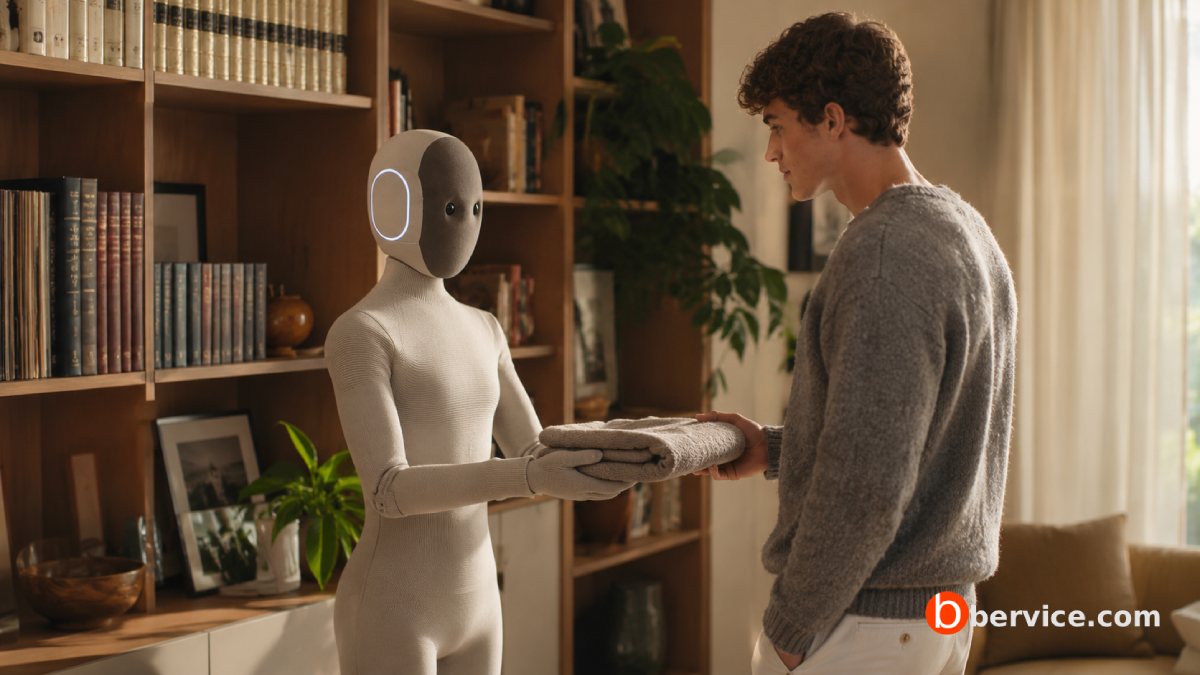
1. The Beginning of Home Humanoid Robots
For many years, humanoid robots were mostly seen in science fiction, research labs, or technology exhibitions. They looked impressive, but they were not ready to live with ordinary people or help inside real homes. Today, that is beginning to change. One of the most talked-about examples is NEO, a humanoid robot developed by 1X Technologies, an AI and robotics company focused on building robots for everyday human environments.
NEO is designed as a home assistant robot. Its purpose is not just to move like a human, but to understand human spaces, learn household tasks, and support people with daily activities. According to 1X, NEO uses its Redwood AI generalist model to learn and repeat tasks, starting with basic autonomy and improving over time. The company also says that for more complex tasks, a human expert can remotely supervise the robot at scheduled times so it can learn new abilities.
This makes NEO different from traditional smart devices. A smart speaker can answer questions. A robotic vacuum can clean floors. But a humanoid robot aims to interact with the physical world in a much broader way. It can potentially open doors, carry objects, organize rooms, help with laundry, and support people who need assistance at home.
2. What Makes NEO Important?
NEO is important because it represents a new stage in artificial intelligence: embodied AI. Most AI systems today live inside screens. They answer text, generate images, analyze data, or write code. Humanoid robots bring AI into the physical world.
This is a much harder problem. A chatbot only needs to process language. A humanoid robot must understand speech, vision, movement, balance, timing, objects, rooms, people, safety, and social behavior. It must know not only what a command means, but also how to safely perform it in a real environment.
For example, if a person says, “Please bring me a glass of water,” NEO would need to understand the request, identify where the glass is, move safely through the home, avoid obstacles, pick up the glass without breaking it, possibly fill it, and bring it back. This requires a combination of language understanding, computer vision, robotics control, planning, and real-time decision-making.
3. How NEO Learns with Artificial Intelligence
NEO learns through a combination of AI models, real-world data, human supervision, and repeated task experience. The basic idea is similar to how humans learn practical skills: observe, try, receive correction, improve, and repeat.
The robot uses AI to interpret its environment. Cameras and sensors help it understand what is around it. Language models help it understand human instructions. Movement models help it decide how to walk, reach, hold, lift, or place objects. Over time, the robot can improve by learning from successful and unsuccessful actions.
One of the most important learning methods in humanoid robotics is imitation learning. This means the robot learns by watching human actions or by being guided through a task. Another method is teleoperation, where a human operator remotely controls or supervises the robot. This allows the robot to collect examples of how tasks should be done in real homes.
1X has described NEO as using AI to learn and repeat tasks, while also offering scheduled expert supervision for difficult tasks. This means the robot may not know everything immediately. Instead, it can gradually become more capable as it receives more task examples and feedback.
4. From Remote Supervision to More Autonomy
A major challenge with humanoid robots is that full autonomy is still difficult. Homes are unpredictable. A kitchen in one house is different from a kitchen in another house. Clothes, furniture, pets, children, lighting, stairs, and object placement all create complexity.
Because of this, early humanoid robots may still need some level of human assistance behind the scenes. Reports about NEO have highlighted that remote supervision and data collection are part of the learning process. This is useful for training, but it also creates serious privacy questions because the robot may operate inside very personal spaces.
At the same time, the industry is moving toward less human dependence. Reports from 2026 say 1X has been working on “world model” approaches that could help NEO learn more from recorded video and its own experience, instead of relying only on human teleoperation.
This transition is important. A home robot will only become truly useful if it can safely act on its own most of the time. But full autonomy must be earned carefully, because mistakes in the physical world can cause real harm.
5. What Can NEO Do for Humans?
The main promise of NEO is practical assistance. It is designed to help people with everyday tasks that take time, energy, or physical effort. These may include carrying items, tidying rooms, helping with laundry, opening doors, supporting routines, and assisting people with basic household activities.
For busy families, NEO could reduce repetitive chores. For elderly people, it could provide physical support and companionship. For people with disabilities, it could help with tasks that are difficult or tiring. For professionals working from home, it could become a personal assistant that handles small physical tasks while also responding to voice commands.
This could be especially valuable in countries with aging populations. Many societies are facing shortages of caregivers and support workers. Humanoid robots will not replace human care, but they may reduce pressure on caregivers by helping with simple, repetitive, or physically demanding tasks.
6. Benefit One: More Independence for Elderly and Disabled People
One of the strongest arguments for humanoid robots is independence. Many elderly people want to stay in their own homes instead of moving into care facilities. However, daily tasks can become harder with age, injury, or disability.
A humanoid robot could help by picking up dropped items, carrying groceries, reminding users about routines, bringing medication, opening doors, or calling for help in an emergency. Even small forms of assistance can make a big difference when repeated every day.
This does not mean robots should replace family, nurses, or human caregivers. Human care includes emotion, judgment, empathy, and trust. But a robot like NEO could become a support layer that helps people remain independent for longer.
7. Benefit Two: Reducing Repetitive Household Work
Housework consumes a large amount of human time. Cleaning, laundry, organizing, carrying, and preparing simple items may not require deep creativity, but they require constant attention. A general-purpose home robot could reduce this burden.
This is where humanoid shape matters. Human homes are built for human bodies. Doors, handles, drawers, stairs, shelves, washing machines, kitchens, and furniture are designed around human movement. A humanoid robot can use the same spaces and tools without requiring the entire home to be redesigned.
If NEO becomes reliable, it could be more flexible than single-purpose robots. Instead of buying separate machines for vacuuming, delivery, monitoring, and lifting, one humanoid platform could gradually learn many tasks.
8. Benefit Three: Personalized Assistance
NEO’s long-term value may come from personalization. A useful home robot should not behave the same way in every house. It should learn the user’s preferences, daily routines, room layout, object locations, and communication style.
For example, one person may want the robot to organize items in a specific way. Another person may want reminders at certain times. A family may want the robot to avoid children’s rooms or private spaces. Over time, the robot could become more useful because it understands the household context.
However, personalization creates a trade-off. The more a robot understands about a person’s life, the more sensitive its data becomes. This is one of the biggest ethical issues around home humanoid robots.
9. Benefit Four: A New Interface for AI
Today, people mostly interact with AI through text boxes, apps, and voice assistants. Humanoid robots could become a new interface for AI. Instead of only asking questions, people could ask the AI to perform actions in the physical world.
This could change how humans use technology. A robot assistant could combine conversation, memory, visual understanding, and physical action. It could answer a question, find an object, move it, organize it, and explain what it did.
This is why humanoid robots are not just “machines with legs.” They are a possible bridge between digital intelligence and real-world action.
10. The Risks: Privacy Inside the Home
The biggest concern around NEO and similar robots is privacy. A home robot may need cameras, microphones, sensors, maps, and behavioral data to work properly. This means it could collect extremely sensitive information: what people say, where they sleep, what they own, who visits, what habits they have, and what problems they face.
Privacy concerns become stronger when remote supervision is involved. If a human expert can remotely supervise the robot to help it learn tasks, users need clear answers: What can the operator see? When can they access the robot? Is access recorded? Can users approve or deny each session? Is video stored? Is it used for training? Can it be deleted?
Technology media and AI incident trackers have already highlighted privacy risks around NEO because of teleoperation and data collection concerns, even where no direct harm has been reported.
For home robots, privacy cannot be treated as a small feature. It must be part of the core design.
11. The Risks: Safety and Physical Harm
Unlike software AI, a humanoid robot can physically affect the world. If it makes a mistake, it may drop something, damage property, block a path, scare a child, hurt a pet, or injure a person.
This is why safety is more difficult in robotics than in chatbots. A wrong text answer is a problem, but a wrong physical action can be dangerous. Home robots must understand fragile objects, human movement, personal boundaries, stairs, wet floors, pets, children, and emergency situations.
A safe robot must know when not to act. It must be able to stop immediately. It must avoid forceful movement near humans. It must ask for confirmation before doing uncertain tasks. It must have clear manual controls and emergency shutdown options.
The safest humanoid robot is not the one that acts the most confidently. It is the one that understands uncertainty and behaves cautiously.
12. The Risks: Overdependence on Robots
Another risk is human overdependence. If robots become common in homes, people may rely on them too much for basic routines, care, decision-making, and social interaction.
This could be especially sensitive for elderly people, children, and isolated individuals. A robot may provide reminders, conversation, and support, but it should not become a replacement for human relationships.
There is also a psychological risk. If a robot speaks naturally and behaves politely, people may form emotional attachments to it. That is not always bad, but companies must be careful not to manipulate users emotionally for profit, subscription retention, or data collection.
13. The Risks: Jobs and Economic Disruption
Humanoid robots could also affect jobs. If robots become capable of cleaning, carrying, organizing, warehouse work, hospitality tasks, and basic care support, some workers may face pressure.
At first, these robots will likely be expensive and limited. But if production scales and AI improves, their impact could grow. The question is not only whether robots will replace jobs. The better question is: Who benefits from the productivity they create?
If humanoid robots reduce labor costs only for large companies, inequality may increase. But if they help small businesses, caregivers, hospitals, families, and disabled people, they could create social value. The outcome depends on policy, pricing, access, training, and business models.
14. The Risks: Security and Hacking
A home robot must be treated as a high-risk connected device. If hacked, it could expose cameras, microphones, maps, personal routines, and possibly physical control.
This creates serious security requirements. NEO and similar robots need strong encryption, strict access control, transparent logs, local processing where possible, regular security updates, and clear user permissions.
A robot inside the home is more sensitive than a laptop or phone in some ways, because it can move through private spaces. Security failure would not only be a data problem. It could become a physical safety problem.
15. What Responsible Design Should Look Like
For humanoid robots to be accepted, companies need more than impressive demos. They need trust. Responsible design should include clear privacy controls, visible recording indicators, local processing where possible, user-approved remote sessions, detailed access logs, easy data deletion, and strict limits on what data can be used for training.
Users should be able to define private zones in the home. They should be able to pause cameras and microphones. They should know when a remote expert is connected. They should have the right to review, export, and delete stored data.
The robot should also explain uncertainty. If it does not know how to perform a task safely, it should say so. It should not pretend to be more capable than it is.
16. The Future of NEO and Humanoid AI
NEO is part of a larger movement toward general-purpose robotics. Robotics companies are trying to build machines that can learn many tasks instead of being programmed for only one job. NVIDIA has also described the rise of “generalist robotics,” and 1X has been connected to this broader ecosystem of robot learning and simulation tools.
The future will likely involve a mix of simulation training, real-world learning, human demonstrations, video-based learning, and AI models that understand both language and physical action. The robots that succeed will not simply be the strongest or most human-looking. They will be the safest, most useful, most trustworthy, and easiest to live with.
NEO may not be perfect at the beginning. Early home humanoid robots will probably have limitations. They may need supervision, updates, and user patience. But they represent the start of a major shift: AI moving from screens into human environments.
17. Final Thoughts: A Helpful Robot or a Privacy Risk?
NEO shows both the promise and the danger of the next generation of AI. On one side, it could help people live more independently, reduce repetitive work, support aging societies, and make AI more practical in daily life. On the other side, it raises serious concerns about privacy, safety, surveillance, security, emotional dependency, and economic disruption.
The key question is not only “Can we build humanoid robots?” The more important question is “Can we build them responsibly?”
A humanoid robot inside the home must earn trust every day. It must be useful without being invasive. It must learn without exploiting private life. It must help humans without reducing human dignity. If companies can solve these challenges, NEO and similar robots may become one of the most important technologies of the coming decade.
But if privacy, safety, and transparency are ignored, the dream of a helpful home robot could quickly become a new form of surveillance inside the most personal space we have: our homes.
Connect with us : https://linktr.ee/bervice
Website : https://bervice.com