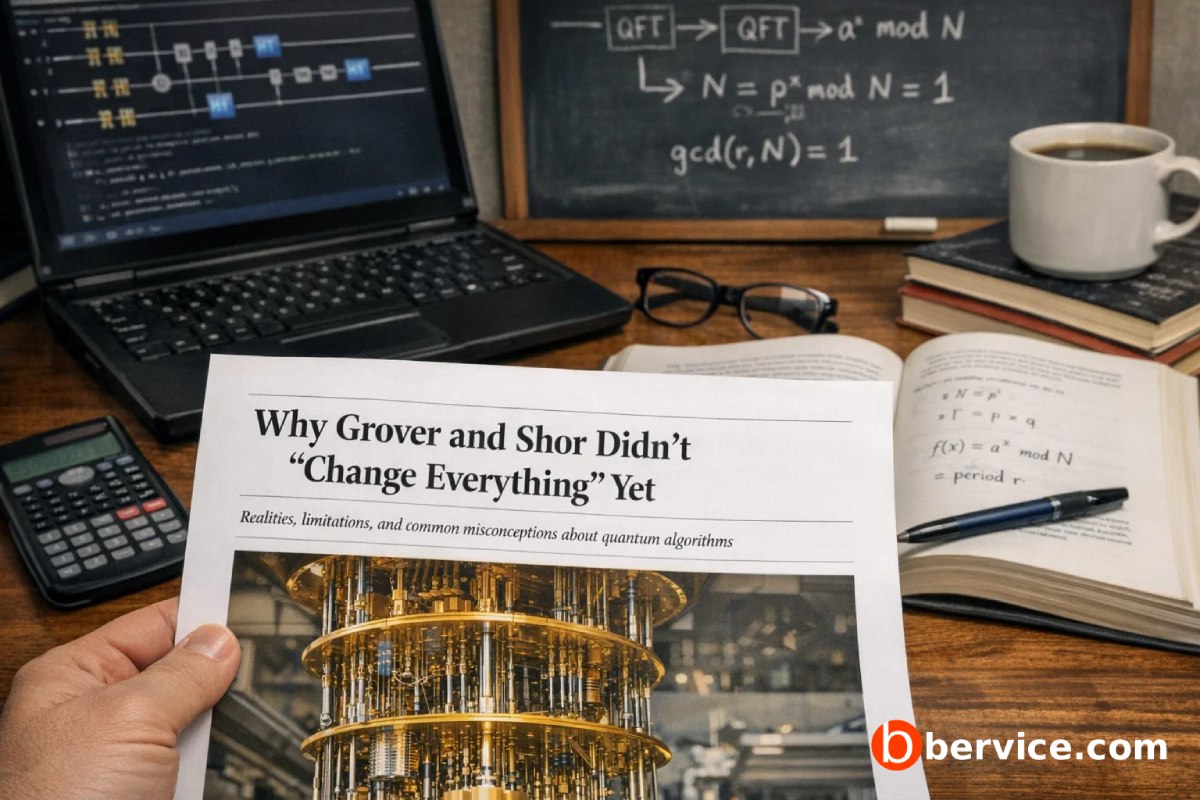
Realities, limitations, and common misconceptions about quantum algorithms
Introduction
Grover’s search algorithm and Shor’s factoring algorithm are often presented as the two “killer apps” of quantum computing. They are elegant, mathematically powerful, and genuinely important milestones in the history of computation. Yet many people notice something confusing: decades after these algorithms were discovered, the real world still looks mostly the same. We are not casually factoring giant numbers on laptops with quantum chips, and we are not instantly searching massive databases with magical speedups.
This gap between theory and reality does not mean the algorithms were overhyped in a dishonest way, but it does mean they are frequently misunderstood. The truth is more subtle: Grover and Shor are extremely important in the right setting, but they do not automatically translate into universal practical advantage, especially on today’s hardware. Their impact depends on problem structure, error rates, data access assumptions, and large constant factors that are often ignored in popular explanations.
This article explains why these algorithms have not become everyday transformative tools yet, what they truly promise, and where the biggest misunderstandings come from.
1. “Important” in theory does not mean “useful” on current machines
Quantum algorithms typically assume an ideal model: clean qubits, long coherence times, fast gates, and error rates low enough to run deep circuits. Real devices today are noisy, limited in scale, and sensitive to environmental effects. Even if an algorithm offers a dramatic asymptotic speedup, it might require so many operations that small error rates compound and destroy the result.
Shor’s algorithm is the clearest example. Factoring large RSA sized integers requires a fault tolerant quantum computer with error correction, which greatly increases the number of physical qubits and operations needed. Theoretically, Shor breaks factoring in polynomial time. Practically, the overhead from error correction and logical qubit requirements pushes the needed hardware far beyond what is available today.
So the algorithm is important because it changes what is possible in principle, and because it reshaped cryptography planning. But it is not “not important” just because it is not practical yet. Its importance is real, but it is not immediate.
2. Shor is not a universal “encryption breaker”
A major misconception is that Shor’s algorithm “breaks encryption.” More precisely, it efficiently solves factoring and discrete logarithms on a fault tolerant quantum computer. That directly threatens cryptosystems that rely on those problems, like RSA and classic elliptic curve cryptography in common forms.
But not all encryption collapses. Symmetric cryptography such as AES is not broken by Shor. Instead, Grover gives a quadratic speedup for brute force key search, which usually can be mitigated by doubling key sizes. Also, modern post quantum cryptography is designed specifically to resist known quantum algorithms including Shor and Grover.
So Shor is devastating for certain public key systems, but it does not imply “all security is dead.” That framing is one of the biggest oversimplifications.
3. Grover’s speedup is smaller than many people think
Grover’s algorithm offers a quadratic speedup for unstructured search. If a classical brute force search takes N steps, Grover takes about sqrt(N) steps. That is significant, but it is not an exponential speedup. Many popular summaries describe quantum speedups as if they are always exponential, which is simply false.
This matters because quadratic speedups are sometimes not enough to justify the cost and complexity of quantum hardware. For many practical tasks, classical heuristics, indexing, structure exploitation, or parallelization can cut the search space dramatically. If the real world problem has structure, it may not even fit Grover’s “unstructured search” model, or there may be classical methods that perform better than naive brute force.
Also, Grover requires repeated calls to an oracle function, and the cost of implementing that oracle can dominate the runtime. In practice, people often compare “Grover iterations” to “classical steps” without accounting for how expensive a quantum oracle is to build and run fault tolerantly.
4. Data loading and the “oracle assumption” hide major costs
A quiet but critical detail is that many quantum algorithms assume efficient access to data in superposition. For Grover, you need an oracle that marks solutions. For many quantum machine learning proposals, you need a method to load classical data into quantum states quickly. These are not free.
If your “database search” is a literal classical database sitting on a classical server, Grover does not automatically let you search it faster unless you have a realistic mechanism to query it coherently as part of a quantum circuit. If you must read N items classically to load them, the advantage can vanish. This is sometimes called the input bottleneck.
In other words, speedups in the abstract algorithmic model can be canceled by the physical and architectural cost of connecting quantum computation to classical data sources. This is not a minor footnote. It is often the difference between “theoretical possibility” and “engineering reality.”
5. Constant factors, circuit depth, and error correction overhead matter enormously
Asymptotic complexity is a long term lens. For real systems, constant factors can dominate. Quantum circuits are expensive in terms of gate fidelity, time, calibration, and error correction overhead. Even if Grover reduces the number of search iterations from N to sqrt(N), each iteration can be extremely costly when implemented fault tolerantly.
Shor’s algorithm is even more demanding. Its practical use requires not just more qubits, but high quality logical qubits maintained through extensive error correction. Error correction introduces large overhead in physical qubits and gate counts.
So one reason these algorithms have not been “that important” in day to day life is that the theoretical speedup exists in a regime we cannot yet reach with reliable hardware at scale.
6. “Newer” algorithms exist, but fewer deliver clean, general advantages
Another misconception is that quantum computing is stuck on Grover and Shor, as if nothing else matters. In reality, many quantum algorithms and subroutines exist: amplitude estimation, quantum walks, Hamiltonian simulation, phase estimation variants, and algorithms for certain linear algebra and optimization tasks.
But why do Grover and Shor remain the headline examples? Because their speedups are clear, provable, and easy to explain. Many other algorithms provide advantages only under specific assumptions about input models, sparsity, condition numbers, distributions, or access patterns. Others offer polynomial improvements that are meaningful only in certain niches. Some are promising but lack strong end to end practical demonstrations that beat the best classical methods on realistic instances.
So it is not that “quantum algorithms failed.” It is that strong, broad, unconditional speedups are rare, and the most famous ones require hardware we do not yet have.
7. Classical computing improved faster than many forecasts assumed
When Grover and Shor were introduced, future classical improvements were hard to predict. Since then, classical hardware, parallel computing, GPUs, distributed systems, and algorithmic heuristics have advanced massively. Many tasks that looked difficult decades ago are now routine because classical systems scaled and software improved.
This matters because the competitive baseline is not “naive classical brute force,” it is the best known classical approach implemented on modern hardware with enormous engineering effort. Quantum advantage must beat that real baseline, not a simplified textbook baseline.
8. The “quantum supremacy” narrative confused people about usefulness
Public discourse often mixed up different milestones:
- Demonstrating a quantum device can perform a specific contrived computation faster than a particular classical simulation
- Demonstrating a useful quantum advantage on a real world task
- Building fault tolerant systems that run deep algorithms like Shor at meaningful sizes
These are very different achievements. Early demonstrations were important scientifically, but they were not the same as practical general purpose quantum computing. When those distinctions were not communicated clearly, some people concluded “quantum already won” while others concluded “quantum is hype,” and both reactions miss the reality.
9. What Grover and Shor are genuinely good for
Even with all limitations, these algorithms remain foundational.
Shor’s algorithm matters because:
- It forces a migration away from factoring and discrete log based public key cryptography.
- It provides a clear target for fault tolerant quantum engineering.
- It drives research in post quantum cryptography, cryptographic agility, and long term security planning.
Grover’s algorithm matters because:
- It sets a general bound on quantum speedups for unstructured search and brute force.
- It influences security parameters for symmetric cryptography.
- Its techniques inspired broader amplitude amplification ideas used in other algorithms.
So they are important intellectually and strategically even if they are not daily tools.
10. The most common misconceptions, corrected
- Misconception: Shor breaks all encryption.
Reality: It threatens RSA and ECC like systems, not symmetric encryption directly, and defenses exist. - Misconception: Grover gives exponential speedups.
Reality: It gives quadratic speedup for unstructured search. - Misconception: Quantum computers will instantly speed up any problem.
Reality: Speedups depend on structure and on realistic access models for data. - Misconception: If it is polynomial, it is automatically practical.
Reality: Overheads from error correction and circuit depth can dominate. - Misconception: Since we do not see Shor in practice, it is not real.
Reality: It is mathematically sound; practicality is limited by hardware.
Conclusion
Grover and Shor are not “less important.” They are important in a precise, conditional way. Their perceived lack of real world impact so far comes from the mismatch between idealized algorithmic models and the practical constraints of quantum hardware, plus widespread misunderstanding about what speedups mean and when they apply.
The more accurate story is this: quantum computing is still transitioning from scientific prototypes to engineered fault tolerant machines. Shor represents a major long term cryptographic threat once fault tolerance is achieved. Grover provides a general lens on brute force and search, but its quadratic advantage often competes with powerful classical structure exploitation and practical bottlenecks like data loading and oracle construction.
If we talk about these algorithms with the right assumptions and limits, they stop looking like magic and start looking like what they really are: deep, rigorous results that reshape the boundaries of computation, but only become revolutionary when the engineering catches up.
Connect with us : https://linktr.ee/bervice
Website : https://bervice.com