1. The Next Frontier Is Not Just Space
For decades, space exploration was mainly about rockets, astronauts, satellites, and national prestige. Today, the story is changing. The new space race is not only about reaching the Moon or Mars. It is about building intelligent systems that can operate beyond Earth with limited human control.
Artificial intelligence is becoming the nervous system of the future space economy. Rockets, satellites, robots, vehicles, communication networks, and space stations will all need AI to survive, adapt, and make decisions in extreme environments.
This is where Tesla, SpaceX, Starlink, and Elon Musk’s broader vision begin to connect.
2. Tesla Is Not Only a Car Company
Many people still see Tesla as an electric vehicle company. That view is becoming too narrow. Tesla is increasingly positioning itself as an AI and robotics company.
Its cars are already computers on wheels. They collect visual data, process the environment, learn from driving behavior, and use neural networks to make decisions. The same foundation that helps a Tesla car understand roads, pedestrians, signs, and obstacles can also be adapted to robots.
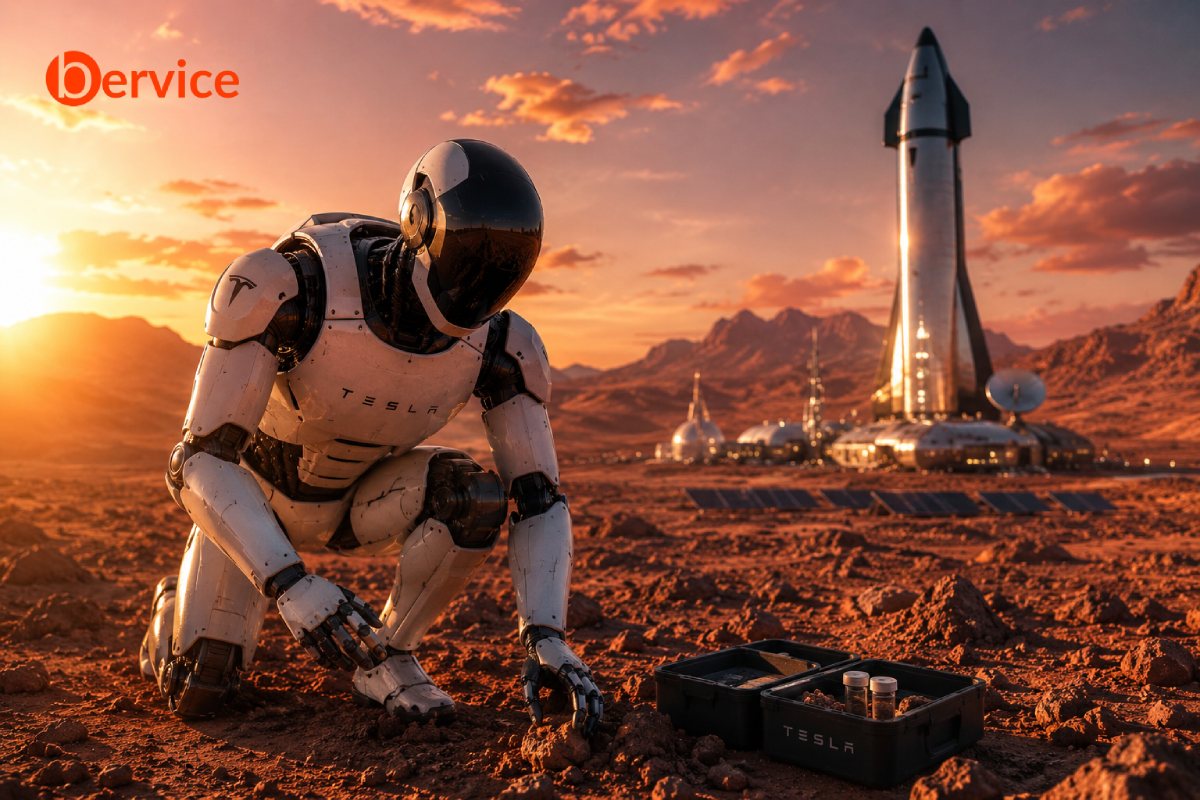
This is why Optimus, Tesla’s humanoid robot, matters. It is not just a side project. It represents Tesla’s attempt to move AI from screens and vehicles into the physical world.
3. Why Space Needs Robots Before Humans
Space is dangerous, expensive, and unforgiving. Sending humans to Mars requires life support, radiation protection, food, water, oxygen, medical systems, and safe habitats. Every mistake can become fatal.
Robots do not need oxygen. They do not need sleep. They can work in extreme temperatures. They can be repaired, replaced, or sacrificed in ways humans cannot.
That is why the idea of sending humanoid robots like Optimus before humans is strategically important. Robots could test the environment, prepare landing zones, inspect equipment, assemble structures, move cargo, and build early infrastructure.
In simple terms: before humans live on Mars, machines may need to prepare Mars for humans.
4. The Tesla and SpaceX Connection
Tesla builds AI for the physical world. SpaceX builds access to space. Starlink builds global communication infrastructure. Together, these systems could form the foundation of an off-Earth intelligent economy.
SpaceX provides the transport layer through Starship. Starlink provides the communication layer through satellite internet. Tesla could provide the robotic labor layer through Optimus and autonomous systems.
This combination is powerful because space exploration is not only a transportation problem. It is also a logistics problem, a construction problem, a communication problem, and an automation problem.
5. Starship as the Delivery System
Starship is central to the entire vision. If SpaceX can make Starship fully reusable, it could dramatically reduce the cost of sending mass into orbit and eventually to the Moon or Mars.
That matters because building a real space economy requires scale. A few astronauts and small scientific payloads are not enough. Future missions may need thousands of tons of equipment, power systems, habitats, vehicles, robots, tools, and communication hardware.
AI needs bodies. Robots need transport. SpaceX wants Starship to become the delivery truck of the solar system.
6. Starlink as the Space Internet
Starlink is already one of the largest satellite networks ever deployed. Its importance goes beyond home internet. A large satellite network can support remote operations, ships, aircraft, disaster zones, military communication, and eventually space-based infrastructure.
For AI in space, communication is critical. Robots on Mars cannot always rely on real-time control from Earth because of signal delay. Depending on planetary positions, communication between Earth and Mars can take several minutes one way.
This means future space robots must be semi-autonomous. They need to understand tasks, avoid danger, repair problems, and make local decisions without waiting for humans.
Starlink-like systems may become part of the communication backbone for that future.
7. Optimus: The Physical AI Layer
Optimus is Tesla’s attempt to create a general-purpose humanoid robot. The reason humanoid design matters is simple: the human world is already built for human bodies.
Doors, stairs, tools, handles, vehicles, warehouses, factories, and homes are designed around human shape and movement. A humanoid robot can theoretically use existing infrastructure without everything being redesigned.
In space, this could become useful. If robots can use human tools, carry human equipment, and operate inside human-designed habitats, they could become the first workforce for Moon bases, Mars bases, and orbital stations.
But this is still extremely hard. Walking on Earth is not the same as working on Mars. Dust, radiation, temperature swings, low gravity, power limits, and mechanical wear are serious challenges.
8. Tesla’s Real Goal: AI That Acts
Most AI today is still trapped inside software. It writes, predicts, analyzes, generates images, answers questions, and helps with digital work.
Tesla is trying to build AI that acts in the real world.
A car that drives itself is one example. A robot that moves objects, works in factories, or performs physical labor is another. In the long term, a robot that can help build infrastructure on another planet is the extreme version of that same idea.
This is the key point: Tesla’s AI strategy is not only about intelligence. It is about embodied intelligence.
9. Why Mars Changes Everything
Mars is not just a destination. It is a forcing function.
On Earth, humans can fix problems quickly. On Mars, machines must be more independent. They must diagnose faults, adapt to unexpected conditions, and continue operating with limited support.
That environment pushes AI toward higher autonomy. It also forces better robotics, better batteries, better solar systems, better communication, better materials, and better simulation.
If a robot can work reliably on Mars, it can probably work almost anywhere on Earth.
10. The Economic Logic Behind the Vision
The business logic is also important. Space is not only scientific. It may become industrial.
Future space industries could include satellite manufacturing, asteroid resource analysis, lunar construction, orbital data centers, space solar power, planetary internet, and robotic exploration services.
AI would be the operating layer for all of this. Human labor is too expensive and limited in space. Robotic labor is the only realistic path to scale.
Tesla’s robotics, SpaceX’s launch capacity, and Starlink’s connectivity could become parts of one larger machine: an autonomous infrastructure network beyond Earth.
11. The Risks and Skepticism
This vision sounds exciting, but it should not be accepted blindly. Tesla has missed timelines before. Full self-driving has taken much longer than originally promised. Humanoid robotics is still far from mass deployment. Mars missions are extremely difficult.
There are also serious ethical and political questions. Who controls AI infrastructure in space? Should one company have so much influence over global connectivity, orbital logistics, and future planetary settlement? How should safety, accountability, and regulation work outside Earth?
The future of AI in space cannot be left only to hype. It needs engineering discipline, international rules, transparency, and realistic expectations.
12. What Tesla Really Wants to Do
Tesla’s deeper goal is not simply to sell cars, robots, or software. Its larger ambition appears to be building machines that can perceive, decide, move, and work at scale.
On Earth, that means autonomous vehicles, robotaxis, smart factories, and humanoid robots. In space, it could mean robotic construction, autonomous exploration, and preparation for human settlement.
So when people ask, “What does Tesla want to do in space?” the answer is not that Tesla wants to become a rocket company. That is SpaceX’s role.
Tesla’s possible role is different: to build the intelligent machines that make space useful, livable, and scalable.
13. Conclusion: AI Is the Bridge Between Earth and Space
The future of space will not be built by rockets alone. Rockets open the door, but AI and robotics may build what comes after.
SpaceX can transport. Starlink can connect. Tesla can automate. Together, these technologies point toward a future where humans do not explore space alone. They send intelligent machines first.
Whether this vision succeeds or not, the direction is clear: the next era of space exploration will be powered by artificial intelligence, robotics, and autonomous infrastructure.
The real question is no longer only, “Can we reach Mars?”
The deeper question is:
Can we build intelligent systems capable of working there before we arrive?
Connect with us : https://linktr.ee/bervice
Website : https://bervice.com