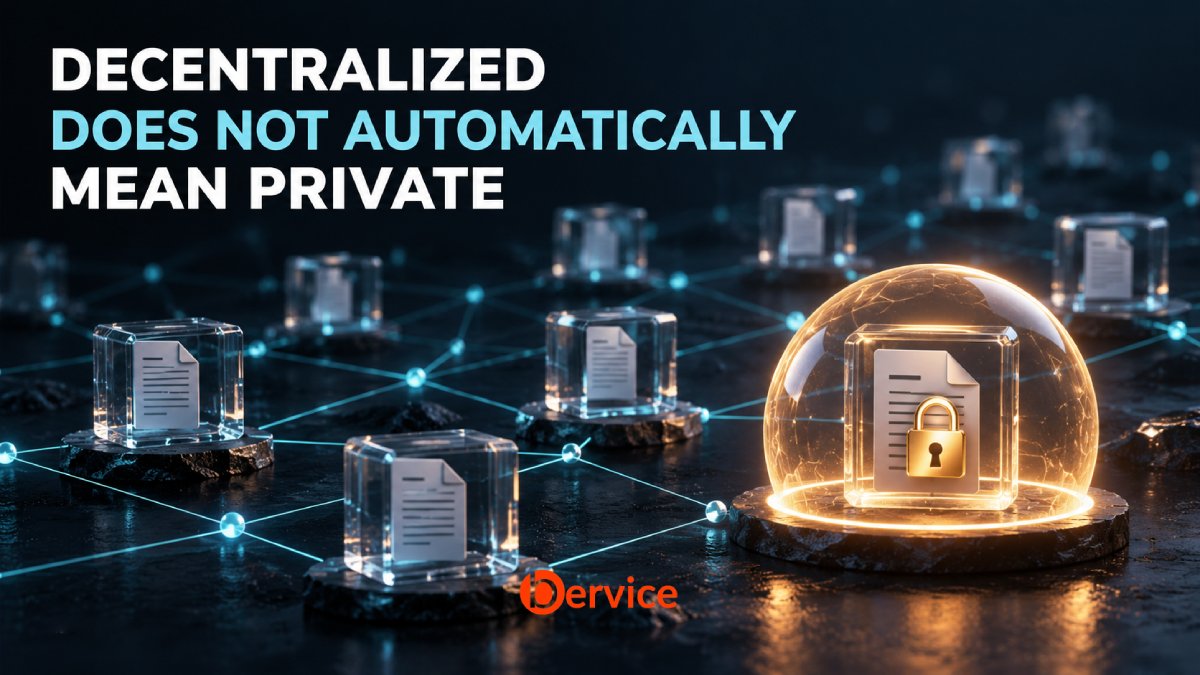
Distributing data changes where it lives. Protecting privacy requires deliberate decisions about who can read it, what others can observe, and how access is controlled.
A company uploads a confidential contract to a decentralized storage network.
The file is distributed across independent infrastructure. It no longer depends entirely on one server or one storage provider. Its content can be identified and checked using cryptographic mechanisms.
Has the company made the contract private?
Not necessarily.
If the document was published without content encryption, distributing it may have expanded the opportunities to obtain it. If it was encrypted, its confidentiality still depends on how encryption keys are generated, stored, shared, and recovered. Even when the content remains unreadable, surrounding activity may reveal information about the people and organizations involved.
Decentralization can be valuable. But it answers a different question from privacy.
For businesses evaluating secure file infrastructure, that distinction should be the beginning of the conversation.
Three Properties That Should Never Be Confused
Decentralization, confidentiality, and access control are related, but each addresses a different problem.
| Property | The question it answers | What it does not establish by itself |
|---|---|---|
| Decentralization | How are infrastructure, authority, or operational dependencies distributed? | That information is hidden from unauthorized parties |
| Confidentiality | Who can read the protected information? | That infrastructure is distributed or access can be withdrawn |
| Access control | Who is permitted to perform which actions, under what conditions? | That every stored copy is encrypted or previously disclosed information can be recovered |
Privacy extends beyond all three. It also concerns what a system collects, what observers can infer, how long information persists, and whether people have meaningful control over its use.
A system can be decentralized and publicly readable. It can be centralized and maintain strong confidentiality. It can also combine distributed storage, client-side encryption, and carefully designed authorization.
The architecture must establish each property separately.
Decentralization Changes Dependencies
Decentralization can distribute storage, processing, validation, or governance among multiple participants.
Depending on the design, this may reduce reliance on a particular operator, improve resilience against certain failures, or make unilateral interference more difficult.
However, the word “decentralized” is incomplete without identifying what is distributed.
A service may distribute file storage while relying on one company for authentication. It may use multiple storage providers while keeping all encryption keys in one administrative account. A decentralized protocol may be accessed through a single gateway that becomes a practical dependency for its users.
These arrangements are not automatically unsuitable. They simply have different trust assumptions.
A useful evaluation asks:
- Who can interrupt availability?
- Who can change permissions?
- Who can obtain decryption keys?
- Who can observe user activity?
- Which operations depend on a single organization?
Counting storage nodes cannot answer all of these questions.
Public Infrastructure Can Be Transparent by Design
Some decentralized systems intentionally make information broadly observable.
Ethereum’s documentation, for example, explains that a standard transaction is pseudonymous and permanently recorded on the public ledger. An address does not necessarily contain a person’s name, but that does not make the associated activity confidential. ethereum.org
This distinction matters beyond financial transactions.
Replacing a name with an identifier does not necessarily prevent identification. If that identifier becomes associated with a person, organization, or known event, activity linked to it may become more revealing.
Transparency can support independent verification and accountability. It can also conflict with requirements to conceal commercial relationships or sensitive activity.
Neither outcome should be inferred from decentralization alone.
The relevant question is: What does the system intentionally expose, and to whom?
Transport Encryption Does Not Make Stored Content Private
Another common misunderstanding concerns the word “encrypted.”
Encryption can protect different stages of a file’s lifecycle:
- In transit: while information moves between systems.
- At rest: while information is stored.
- End to end: between intended endpoints, with key access designed to exclude intermediaries.
These protections have different boundaries.
IPFS provides a concrete example. Its documentation states that it uses transport encryption but does not provide content encryption by default. It also explains that provider metadata published to the public distributed hash table includes peer identifiers and the content identifiers they provide. IPFS Docs
Consequently, an encrypted connection to a storage network does not establish that files remain unreadable to the infrastructure handling them.
For confidential material, content protection must be designed explicitly. IPFS documentation recommends encrypting content before adding it to the network when content visibility is a concern. IPFS Docs
Even then, the implementation matters. Where encryption happens, which endpoints see plaintext, and who receives the keys determine the actual confidentiality boundary.
The Key Can Matter More Than the Storage Location
Imagine a document encrypted before upload and replicated across independent storage nodes.
The nodes hold ciphertext. Under the intended cryptographic assumptions, they cannot read the document without the necessary key.
That is a meaningful protection.
But consider several possible designs:
The provider holds the keys.
Storage may be distributed while confidentiality still depends on the provider’s key management and administrative controls.
The user holds the keys.
The provider may have less ability to read content, but recovery and device security become critical.
An organization controls access through a key service.
This can support managed sharing, but the key service becomes an important security and availability dependency.
None of these arrangements can be evaluated from the storage topology alone.
A technically credible privacy claim should explain who can decrypt information during ordinary use, account recovery, administrative intervention, and incident response.
“Encrypted” describes a mechanism. Key custody determines much of its practical meaning.
Access Control Needs an Enforcement Boundary
A sharing screen can display a convincing permission model:
View only. Expires tomorrow. Access revoked.
The important question is how those rules are enforced.
If a restriction applies only to one application or gateway, it may not constrain other routes to information that is otherwise publicly retrievable. If the underlying file is encrypted, restricting key delivery can create a stronger boundary, but recipients who already possess the key and ciphertext may retain access.
NIST’s zero trust architecture guidance reinforces a relevant principle: trust should not be granted implicitly because of network location or asset ownership. Authentication and authorization must be tied to access to resources. CSRC
For decentralized file systems, the architectural lesson is to identify exactly where authorization takes effect.
Does the system control retrieval of ciphertext? Release of a decryption key? Access to a managed viewer? Permission to modify a record?
Those are different capabilities, with different limits.
Revocation Cannot Undo Disclosure
Suppose an external adviser receives permission to read a confidential report.
Later, the company removes that permission.
A well-designed system may stop future downloads through its service, refuse new key requests, and prevent access to updated versions.
It cannot reliably make the adviser forget what they read. Nor can ordinary permission changes erase screenshots, exported plaintext, or independently retained copies.
Key rotation can protect future versions when implemented appropriately. It does not retroactively protect an older version from someone who already possesses its ciphertext and the corresponding key.
This limitation is not unique to decentralized systems. It applies whenever readable information reaches a recipient.
That is why product language must distinguish between revoking future access and reversing a past disclosure.
Private Content Can Still Produce Revealing Metadata
A document can remain unreadable while the activity around it reveals useful information.
Depending on the architecture, observers may learn:
- When data is uploaded or requested.
- Approximate file sizes.
- Which network endpoints communicate.
- Whether activity repeats at predictable intervals.
- Which identifiers appear together.
An observer might not know the contents of a legal document but could notice a pattern of activity associated with negotiations or a dispute.
These are possibilities to assess through a threat model, not consequences that occur identically in every network.
Metadata protection requires its own decisions about routing, logging, identifiers, retention, and information exposed to intermediaries.
Encrypting content is essential in many designs. It does not answer every privacy question.
Distribution Also Changes Retention Questions
Replication can support availability. It also makes it important to define what deletion means.
Removing a file from one interface or stopping one node from retaining it does not establish that every independent copy has disappeared.
Encryption can reduce the consequences of retained ciphertext, but that protection depends on the keys remaining unavailable and the cryptographic design remaining effective over the required confidentiality period.
Organizations should therefore distinguish between removing a listing, ending active retention, deleting controlled replicas, and making encrypted data inaccessible through key destruction.
Each is a different operational claim.
For sensitive information, retention requirements should influence the architecture before publication.
What Businesses Should Ask Before Trusting a Privacy Claim
A useful technical review starts with concrete questions:
- What is decentralized?
Storage, identity, key management, governance, or only one component? - Who can see plaintext?
Include applications, administrators, recovery services, and recipient devices. - Where are permissions enforced?
Identify the mechanism and any alternative access paths. - What metadata remains visible?
Include gateways, storage participants, analytics, and operational logs. - What happens after revocation or deletion?
Separate future access restrictions from previously obtained copies. - What evidence supports the claims?
Look for architecture documentation, defined threat models, relevant independent assessments, and clearly stated limitations.
These questions turn a broad promise into something a business can evaluate.
A Credible Standard for Bervice
For Bervice, technical credibility can come from explaining these boundaries clearly.
A strong privacy narrative connects each claim to a mechanism: encryption before upload, a documented key custody model, authorization at defined boundaries, limited metadata collection, and precise descriptions of revocation and retention.
Any public claim should reflect the implemented system and available evidence.
Businesses do not need every architectural detail in a headline. They do need enough clarity to understand who they are trusting and what remains exposed.
Decentralization describes how a system distributes responsibility.
Confidentiality describes who can read information.
Access control describes how permitted actions are governed.
Privacy depends on how those choices work together throughout the life of the data.
Connect with us : https://linktr.ee/bervice
Website : https://bervice.com