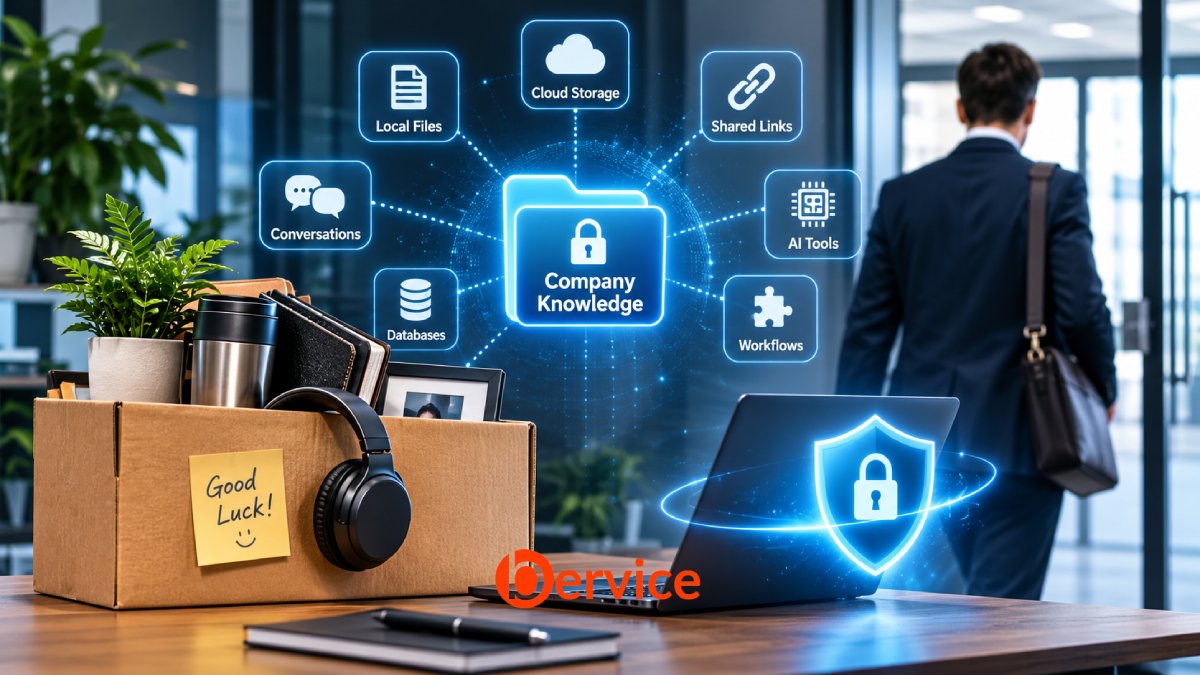
Employee departure is more than an HR process. It is a test of how well an organization understands, controls, and preserves its own knowledge.
1. The Employee Leaves. But Does Their Data?
When an employee leaves a company, the process usually follows a familiar checklist.
Their email account is disabled. Their access to internal systems is revoked. Company devices are returned. Passwords are changed. HR completes the necessary documentation.
From an administrative perspective, the employee has left.
But from an information security and knowledge management perspective, something much more complicated has happened.
What about the documents stored on their personal workstation? What happens to files downloaded before their departure? Are shared links still accessible? What about company information copied into external AI tools, personal cloud storage, messaging applications, or collaboration platforms?
Disabling an account does not automatically remove everything that account has touched.
Modern organizations distribute their knowledge across dozens of systems, devices, applications, and individual workflows. As a result, an employee’s departure can leave behind an invisible network of information that the company may no longer fully understand.
The real question is not simply whether the employee has lost access.
It is whether the organization still knows where its knowledge exists.
2. Company Knowledge Is No Longer Stored in One Place
There was a time when organizational information was relatively centralized.
Documents lived on company servers. Emails were stored in corporate systems. Project records were maintained in shared databases. Access was controlled through relatively predictable infrastructure.
Today, the situation is very different.
An employee might interact with company information through:
- Local folders on a laptop or desktop.
- Personal or corporate cloud storage.
- Shared Google Drive or Microsoft OneDrive links.
- Slack, Microsoft Teams, and other messaging platforms.
- Project management tools such as ClickUp, Jira, or Notion.
- Browser downloads and temporary files.
- External applications connected through APIs.
- AI assistants and third-party productivity tools.
- Personal notes, spreadsheets, and documentation.
Each interaction can create another copy, reference, connection, or dependency.
For example, an employee may download a financial report, upload it to a project management platform, share it with a contractor, and later use selected information in an AI-powered application.
The original file may remain in the company’s storage system, but its information has traveled much further.
This creates a fundamental problem: The company’s knowledge is distributed, but its visibility is not.
3. The Hidden Copies Nobody Thinks About
One of the most overlooked risks during employee offboarding is the existence of secondary data copies.
Organizations often focus on the original location of a document without considering every place where that document may have been duplicated.
Consider a simple scenario.
A project manager downloads an internal project report to prepare a presentation. They make a local copy, extract several tables into a spreadsheet, send the spreadsheet through a messaging application, and upload the presentation to an external collaboration platform.
When that employee leaves, the company might disable their corporate account and delete their access to the original report.
But what happens to the other versions?
Some may still exist on devices. Others may remain in shared folders. Some may be accessible through links that were created outside the company’s identity management system.
Even more importantly, some information may have become part of another document or workflow, making it difficult to identify as a copy of the original.
Deleting one file does not necessarily eliminate its derivatives.
This is why data lifecycle management must go beyond file ownership and account permissions.
Organizations need to understand how information moves, where it is replicated, and which systems retain access to it.
4. Shared Links Can Outlive the People Who Created Them
Shared links are designed to make collaboration easier.
An employee can share a document with a supplier, contractor, consultant, or external partner without creating a new account for every recipient.
However, convenience can introduce long-term security problems.
Imagine an employee creates a link that allows anyone with the URL to access a confidential document.
That link may be:
- Saved in an external email conversation.
- Forwarded to another person.
- Stored in a messaging application.
- Embedded in project documentation.
- Bookmarked in a browser.
- Included in another application or automated workflow.
When the employee leaves, the original creator’s account may be disabled, but the shared link could remain functional.
The important distinction is that access permissions and employee identities are not always directly connected.
Some sharing mechanisms depend on the document owner’s account. Others depend on organizational policies, independent permissions, or externally managed access settings.
Therefore, companies should not assume that disabling an employee’s account automatically invalidates every link they previously created.
A proper offboarding process should identify active external shares, review their business purpose, transfer ownership where appropriate, and revoke unnecessary access.
5. The AI Problem: Company Knowledge Can Travel Beyond Company Systems
Artificial intelligence has introduced another dimension to this challenge.
Employees increasingly use AI assistants to summarize reports, analyze spreadsheets, draft proposals, review contracts, and organize information.
These tools can significantly improve productivity.
However, they also create new questions about information governance.
What happens when an employee uploads an internal document to an external AI service?
Does the organization have visibility into that interaction? What data retention rules apply? Can the information be accessed by other users within the service? Is the content retained, used for service improvement, or processed by connected third-party providers?
The answers depend on the specific service, account configuration, contractual terms, and data processing settings.
The problem becomes even more complicated when employees use personal accounts rather than organization-managed accounts.
Consider this scenario:
An employee uses an AI assistant to analyze several internal documents. The assistant generates summaries, extracts key business information, and produces a strategic report.
The employee then leaves the company.
The original documents remain under company control, but the generated outputs, conversation history, and derived knowledge may exist somewhere else.
Even if the original files are deleted, the organization may not know whether their information has been retained in another form.
This does not mean every AI interaction creates a security incident. It means that AI usage needs to become part of the organization’s data governance and employee departure policies.
The next generation of enterprise security must understand not only where files are stored, but also where information is processed and transformed.
6. Knowledge Loss Is Just as Dangerous as Data Leakage
Security discussions often focus on preventing information from leaving the organization.
But there is another problem that receives less attention: information that disappears when an employee leaves.
Not every valuable piece of company knowledge exists in a formal document.
Some of it lives in individual experience.
An engineer may understand why a particular system was configured in a certain way. A project manager may know the history behind a delayed decision. A developer may understand undocumented dependencies between services. A sales manager may know why a particular customer requires a different approach.
These details may never have been recorded in a central knowledge base.
When these employees leave, the organization loses more than access to their accounts.
It can lose context, reasoning, historical decisions, and operational experience.
This creates what can be called organizational knowledge debt.
Knowledge debt accumulates when critical information depends on individuals instead of documented, accessible, and maintainable systems.
Like technical debt, it may remain invisible until something goes wrong.
A system fails. A customer raises an issue. A new employee tries to understand an old decision. Suddenly, the organization discovers that the person who understood the problem is no longer there.
The solution is not to document every conversation or monitor every employee.
It is to identify which knowledge is operationally important and ensure that it becomes part of the organization’s shared institutional memory.
7. Offboarding Should Be an Information Lifecycle Process
Traditional offboarding is often treated as a single event.
A better approach is to treat it as a structured information lifecycle process.
This process should begin before the employee’s final day and continue after their departure.
A mature offboarding framework should include several stages.
Stage One: Discover
Identify the systems, devices, applications, repositories, and shared resources associated with the departing employee.
This includes more than their official corporate accounts.
Organizations should also consider connected applications, external collaboration tools, API integrations, and company information stored on approved local devices.
Stage Two: Classify
Not all information requires the same treatment.
Some files are temporary. Others are essential business records. Some contain confidential customer information, while others represent intellectual property or operational knowledge.
Classification helps determine what should be retained, transferred, archived, or deleted.
Stage Three: Preserve
Before removing access, identify critical documents, project records, technical knowledge, customer relationships, and unresolved responsibilities.
Ownership should be transferred to an appropriate team or organizational account.
The objective is to preserve business continuity without unnecessarily retaining personal information.
Stage Four: Revoke
Review and remove access that is no longer required.
This should include:
- Corporate accounts and authentication sessions.
- API keys, tokens, and application credentials.
- VPN and remote access permissions.
- Shared folders and external links.
- Third-party application integrations.
- Active sessions on company-managed devices.
Credential rotation should be considered where departing employees had access to shared secrets or privileged systems.
Stage Five: Verify
The process should not end when someone clicks a deactivation button.
Organizations need evidence that the required actions were completed.
Was document ownership transferred? Were external links reviewed? Were unnecessary permissions revoked? Were important project records preserved?
Without verification, offboarding becomes a checklist of intended actions rather than a controlled security process.
8. The Missing Layer: Organizational Memory
Most companies have systems for managing employees, devices, documents, and access permissions.
However, fewer organizations have a unified understanding of how these elements relate to one another.
A document may belong to a project. The project may depend on a specific external service. That service may have been configured by an employee who has now left. The configuration may depend on credentials stored in a separate system.
Looking at these resources independently makes it difficult to understand the complete picture.
Organizations need a better way to connect information, decisions, systems, and operational responsibilities.
This is where organizational memory becomes important.
An effective organizational memory layer should help companies understand:
- Where critical information is stored.
- Which projects and workflows depend on it.
- Who is responsible for maintaining it.
- Which external systems interact with it.
- What decisions were made and why.
- Which knowledge needs to be preserved before responsibilities change.
This is not about creating another storage folder.
It is about creating a structured understanding of the organization’s information environment.
A company should not have to depend on an employee’s memory to understand how its own systems work.
9. Privacy and Security Must Work Together
There is an important distinction between protecting company information and monitoring employees.
An effective offboarding strategy should not become an excuse for unrestricted surveillance.
Organizations should collect and review only the information necessary for legitimate business, security, legal, and operational purposes.
This means defining clear policies around:
- Company-owned versus personal devices.
- Business accounts versus personal accounts.
- Employee privacy and data ownership.
- Retention and deletion requirements.
- Access to former employees’ communications.
- Legal holds and regulatory obligations.
- External data processing and third-party services.
The objective should be controlled information governance, not unlimited visibility into personal activity.
A mature organization understands that security and privacy are not opposing goals.
They must be designed together.
10. The Future: Companies That Remember Without Depending on Individuals
As businesses become more connected and increasingly rely on AI-powered workflows, the cost of losing organizational knowledge will continue to grow.
Employees will change roles, contractors will finish projects, consultants will leave, and external partnerships will end.
These are normal parts of business operations.
What should not be normal is losing visibility into company information every time a person leaves.
The organizations that manage this transition effectively will be those that treat knowledge as a strategic asset.
They will understand that information has a lifecycle:
It is created, accessed, modified, shared, transformed, transferred, retained, and eventually deleted.
Every stage needs appropriate ownership and governance.
This also creates an opportunity for a new generation of enterprise operating systems.
Instead of simply storing documents or managing permissions, these systems can help organizations build a continuously updated picture of their knowledge, responsibilities, and dependencies.
The goal is not to prevent employees from leaving.
The goal is to ensure that the organization remains operational, informed, and secure when they do.
Conclusion: Your Employees Leave. Your Knowledge Shouldn’t.
An employee’s departure should never expose how little an organization knows about its own information.
Disabling accounts is necessary, but it is only one part of the process.
Company knowledge may remain in local files, shared links, external applications, AI conversations, undocumented workflows, and the experience of individuals.
Some of these traces create security risks. Others represent knowledge that the company cannot afford to lose.
The challenge is to manage both.
The future of enterprise security will not be defined only by who can access company information.
It will also depend on whether organizations understand where that information goes, how it changes, and what happens when the people responsible for it are no longer there.
A company should never lose its memory just because someone leaves the building.
Connect with us : https://linktr.ee/bervice
Website : https://bervice.com