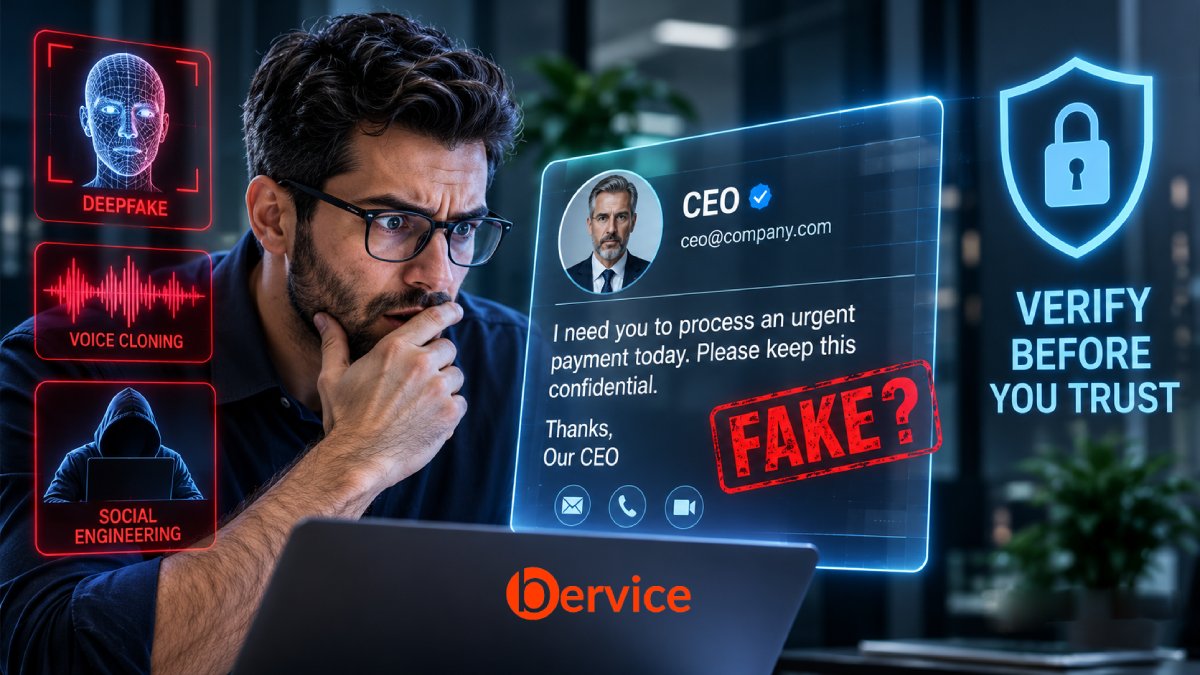
How AI-Powered Identity Impersonation Is Transforming Social Engineering Into One of the Biggest Security Threats Facing Modern Businesses
Introduction: When Your CEO Is No Longer Who You Think They Are
Imagine receiving an email from your CEO at 8:47 AM.
The message is short, direct, and urgent:
“I need you to handle a confidential payment immediately. We are finalizing an acquisition, and I don’t want this discussed with anyone else. I’ll explain everything later.”
The sender’s name is correct. The email signature looks familiar. The writing style matches the way your CEO normally communicates. Perhaps the message even comes with a voice note confirming the request.
You have no obvious reason to question it.
So you follow the instructions.
But there is one problem: your CEO never sent that message.
This is no longer a hypothetical cybersecurity scenario. Artificial intelligence is changing the economics of identity impersonation, making it easier to reproduce someone’s voice, appearance, communication style, and even their professional identity.
For years, businesses focused on protecting their systems, passwords, networks, and sensitive information. Today, another critical security question is emerging:
How do you protect an organization when attackers can convincingly pretend to be the people you trust most?
The traditional boundaries between genuine communication and digital deception are becoming increasingly difficult to recognize.
And businesses may not be prepared for what comes next.
1. The New Generation of Social Engineering
Social engineering has existed long before artificial intelligence.
Attackers have historically manipulated employees through phishing emails, fake phone calls, fraudulent invoices, and impersonation attempts. Their objective has always been relatively simple: exploit human trust to gain access to something valuable.
What has changed is the level of sophistication.
Previously, creating a convincing impersonation required considerable effort. Attackers needed to understand the target, reproduce their communication style, and sometimes spend weeks building a believable relationship.
AI has significantly reduced that effort.
Modern AI tools can help attackers:
- Generate highly personalized emails that imitate someone’s writing style.
- Reproduce voices using relatively short audio samples.
- Create realistic video appearances through deepfake technology.
- Analyze publicly available information to understand company structures.
- Simulate conversations that reflect an individual’s professional behavior.
- Produce convincing messages in different languages without obvious translation errors.
This creates a dangerous combination: automation, personalization, and psychological manipulation.
An attacker no longer needs to impersonate an entire company. They may only need to impersonate one trusted individual at the right moment.
And that individual could be the CEO, CFO, CTO, HR director, or even an external business partner.
2. Deepfake CEOs: When Seeing and Hearing Are No Longer Enough
One of the most concerning developments in AI-powered fraud is the ability to reproduce human identity through synthetic audio and video.
Consider a company that regularly holds video meetings with its senior management team.
An employee receives an invitation to an urgent meeting. Several familiar executives appear on screen. Their faces, voices, and communication styles seem authentic.
During the meeting, the CFO requests an urgent transfer to a new business account.
The employee follows the instruction because the request appears to come directly from senior management.
However, the participants may be AI-generated representations of real executives.
This type of attack is not simply about creating fake images. It exploits the assumption that visual and audio communication automatically establish authenticity.
A widely reported incident in Hong Kong in 2024 demonstrated how serious this threat can become. An employee at a multinational company was reportedly deceived into transferring approximately US$25 million after participating in a video conference involving deepfake representations of company executives.
The incident highlighted a fundamental weakness in traditional business security:
Recognizing someone’s face or voice is not the same as verifying their identity.
As generative AI continues to improve, organizations must reconsider how much trust they place in familiar voices, video calls, and digital appearances.
3. Why Traditional Security Awareness Is No Longer Enough
For years, companies have trained employees to recognize suspicious emails.
Common warning signs include:
- Unusual sender addresses.
- Poor grammar and spelling.
- Unexpected attachments.
- Suspicious links.
- Unfamiliar payment requests.
These practices remain useful, but they are no longer sufficient.
AI-generated communication can be grammatically perfect, contextually relevant, and professionally written.
An attacker can study an executive’s public interviews, social media posts, previous communications, and organizational responsibilities to produce messages that feel natural.
The message may even reference a real project, an upcoming transaction, or an internal business event.
This makes traditional phishing awareness increasingly difficult to apply.
Consider the difference:
| Traditional impersonation | AI-powered impersonation |
|---|---|
| Generic email templates | Personalized communication |
| Obvious language mistakes | Natural professional writing |
| Fake or suspicious sender details | More convincing identity presentation |
| Basic voice imitation | AI-generated voice cloning |
| Static phishing messages | Interactive AI-generated conversations |
| Limited personalization | Context-aware manipulation |
The problem is not that employees have suddenly become less careful.
The problem is that the signals they were trained to trust are becoming easier to reproduce.
Security awareness must therefore evolve from simply identifying suspicious communication to independently verifying the identity and authority behind important requests.
4. The Real Target Is Human Trust, Not Just Technology
One of the biggest misconceptions in cybersecurity is that sophisticated attacks always begin with sophisticated technical exploitation.
In reality, many successful attacks begin with human behavior.
Employees naturally respond to authority, urgency, responsibility, and familiarity.
Attackers understand this.
AI allows them to combine these psychological triggers with highly convincing digital identities.
For example, an attacker impersonating a CEO might use:
Authority:
“This has been approved by the board.”
Urgency:
“We need to complete this before the market opens.”
Confidentiality:
“Please keep this between us until the announcement.”
Familiarity:
“Thanks for handling the previous transaction. I need your help again.”
Each element increases the likelihood that an employee will act without questioning the request.
The most dangerous part is that the employee may believe they are doing exactly what a responsible team member should do.
This is why AI-powered social engineering should not be treated exclusively as a technology problem.
It is fundamentally a trust and verification problem.
Organizations need to establish systems in which important decisions do not depend entirely on whether someone appears trustworthy.
5. From Email Fraud to Complete Digital Identity Attacks
The next stage of this threat goes beyond impersonating someone in a single email.
AI can potentially support coordinated attacks across multiple communication channels.
Imagine the following scenario:
- An employee receives an email from the CEO requesting a confidential discussion.
- Shortly afterward, they receive a message through a familiar messaging platform.
- A voice call follows, apparently confirming the request.
- A video meeting is arranged with several familiar executives.
- The employee receives a payment instruction containing legitimate-looking business details.
Each interaction reinforces the credibility of the previous one.
The attacker is no longer relying on a single fraudulent message. They are constructing an entire digital experience around a fabricated identity.
This is particularly concerning because many businesses use separate platforms for email, internal messaging, video conferencing, project management, and financial approvals.
If those systems do not share reliable identity verification and authorization mechanisms, attackers may exploit the gaps between them.
A convincing identity across multiple platforms can create the illusion of legitimacy without establishing that the person behind those communications is actually authorized to make the request.
6. Why Businesses Need Identity Verification Beyond Passwords and MFA
Multi-factor authentication (MFA), access controls, endpoint protection, and email security remain essential components of a cybersecurity strategy.
However, these controls address different security questions.
A password helps establish access to an account.
MFA adds another layer of authentication.
Role-based access control determines what an authenticated account can access.
But none of these mechanisms automatically proves that a particular business instruction was genuinely authorized by the person whose name appears on it.
For example, even if an employee accesses a legitimate corporate email account, a fraudulent payment request can still be submitted through that account.
Similarly, a deepfake video call does not necessarily involve compromising any corporate account at all.
This creates a need for a broader security model.
Businesses should consider implementing:
1. Independent verification channels
Sensitive instructions should be confirmed through a separately established communication channel, not through contact details provided in the suspicious message.
2. Multi-person authorization
High-value financial transactions should require approval from more than one authorized individual.
3. Identity-bound approvals
Important decisions should be linked to authenticated identities and recorded authorization events rather than informal messages alone.
4. Transaction-specific verification
Approvals should identify the exact action, recipient, amount, and relevant context.
5. Continuous access monitoring
Organizations should monitor unusual access patterns, account activity, and changes to sensitive permissions.
6. Clear escalation procedures
Employees must know that questioning an executive’s request is a security responsibility, not a professional failure.
The objective is not to eliminate trust between employees and management.
It is to ensure that trust is supported by verifiable processes.
7. The Missing Layer: Verifying Who Is Really Behind an Action
As AI-generated identities become more convincing, organizations need to rethink the foundations of digital trust.
One possible direction is the development of stronger digital identity and authorization infrastructure.
Instead of relying only on names, email addresses, profile photographs, or recognizable voices, businesses can introduce cryptographically verifiable identity mechanisms.
These mechanisms can help establish:
- Whether a digital identity is associated with a verified individual.
- Whether a person has a legitimate organizational role.
- Whether an individual is authorized to perform a specific action.
- Whether an approval has been modified after authorization.
- Whether a transaction or decision has a traceable verification record.
Technologies such as decentralized identity (DID), verifiable credentials, and cryptographic digital signatures offer useful foundations for this approach.
For example, a company’s CFO could hold a digitally verifiable credential confirming their organizational role and associated permissions.
When approving a financial transaction, the approval could be cryptographically signed and linked to the specific transaction details.
The receiving system could then verify the signature and authorization independently of the communication channel used to initiate the request.
This changes the fundamental security question.
Instead of asking:
“Does this message look like it came from our CFO?”
The organization asks:
“Can we cryptographically verify that this approval came from an authorized identity and applies to this exact transaction?”
There is an important distinction here.
Digital signatures do not automatically prove that the human behind every action is legitimate or acting voluntarily. A compromised device, stolen signing key, or unauthorized use of an authenticated session can still create risks.
Therefore, cryptographic identity must be combined with secure key management, appropriate authentication, authorization policies, and independent verification.
The goal is to make digital trust measurable, traceable, and enforceable.
8. What Should CEOs and Business Leaders Do Now?
The responsibility for addressing AI-powered impersonation cannot be delegated entirely to the IT department.
Executives themselves are among the most attractive targets because their identities carry organizational authority.
Business leaders should begin by examining how trust currently operates inside their organizations.
A practical starting point includes:
Establish a verification policy for sensitive requests.
No urgent financial transaction, confidential data disclosure, or privileged access change should depend exclusively on an email, voice call, or video meeting.
Create a second-channel confirmation process.
Employees should use previously verified contact information to independently confirm unusual instructions.
Introduce financial approval thresholds.
High-risk transactions should require independent authorization, regardless of who appears to have requested them.
Protect executive digital identities.
Limit unnecessary exposure of internal organizational information, review account security, and establish procedures for reporting impersonation attempts.
Train employees using realistic AI scenarios.
Security exercises should include synthetic voices, sophisticated emails, fake video meetings, and multi-channel impersonation attempts.
Develop an incident response process.
Employees must know exactly whom to contact when they suspect an executive’s identity has been compromised.
Most importantly, leadership must create a culture in which verification is expected.
An employee who pauses a suspicious request should be recognized as protecting the organization, not slowing it down.
9. The Future of Business Security: Trust Must Become Verifiable
We are entering an era in which digital identity can be reproduced with extraordinary realism.
A person’s face can be simulated. Their voice can be generated. Their writing style can be imitated. Their professional relationships can be studied and manipulated.
This does not mean that every email or video call should be treated as fraudulent.
It means that businesses can no longer use familiarity as their primary security mechanism.
The traditional model of digital trust was largely built around recognizable signals:
- I recognize the sender.
- I recognize the voice.
- I recognize the face.
- I recognize the communication style.
- Therefore, I trust the request.
But this model becomes increasingly fragile when AI can reproduce those signals.
The future requires a different approach.
Trust should be supported by independently verifiable identities, cryptographic proof, transparent authorization, and accountable digital actions.
This is also where privacy-conscious and decentralized infrastructure may become increasingly relevant.
Organizations should be able to verify identities and permissions without unnecessarily exposing personal information or creating centralized databases containing every employee’s sensitive identity data.
Selective disclosure, verifiable credentials, and privacy-preserving cryptographic techniques can help support this objective.
The challenge is no longer simply protecting information from unauthorized access.
It is protecting the integrity of the people, decisions, and instructions that drive an organization.
Conclusion: Your Next Security Breach Might Sound Exactly Like Your CEO
Artificial intelligence is creating extraordinary opportunities for businesses.
It is also giving attackers new ways to exploit one of the oldest vulnerabilities in human society: trust.
A fraudulent message does not need to look suspicious anymore. A fake executive does not need to sound artificial. A manipulated video meeting does not need to contain obvious visual errors.
The more convincing these technologies become, the less reliable human recognition becomes as a standalone security control.
Businesses must move beyond the assumption that familiar communication means legitimate authority.
They need systems that verify identities, validate permissions, authenticate important decisions, and create trustworthy records of critical actions.
Because in a world where anyone can potentially look and sound like your CEO, recognizing the person is no longer enough.
The real question is whether you can prove who authorized the action.
And that may become one of the most important cybersecurity questions of the AI era.
Key Takeaways
- AI is making executive impersonation faster, cheaper, and more convincing.
- Deepfake audio and video can undermine traditional identity recognition.
- Social engineering increasingly exploits authority, urgency, familiarity, and confidentiality.
- Passwords and MFA alone cannot guarantee the legitimacy of business instructions.
- Decentralized identity, verifiable credentials, and cryptographic signatures can strengthen digital trust.
- Businesses need independent verification and authorization processes for sensitive actions.
Bervice Perspective
At Bervice, we believe the future of cybersecurity must go beyond protecting accounts and devices. As AI makes digital identities easier to imitate, organizations need stronger foundations for verifying identity, authority, and intent.
The next generation of business security will not be built on appearances. It will be built on verifiable trust.
Connect with us : https://linktr.ee/bervice
Website : https://bervice.com