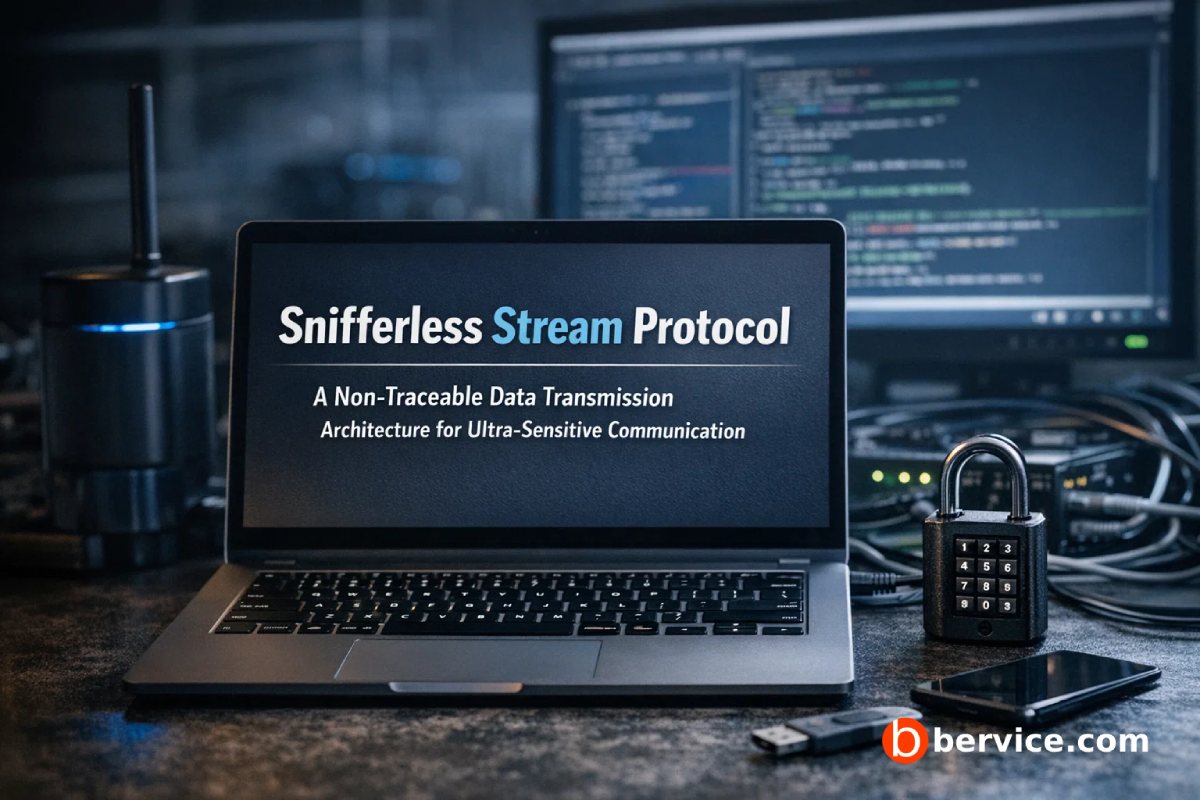
In a world where deep packet inspection (DPI), traffic fingerprinting, and behavioral analytics continuously evolve, traditional encryption is no longer sufficient to guarantee operational secrecy. Encryption protects content but it does not necessarily conceal metadata, structure, or transmission patterns. The Snifferless Stream Protocol introduces a different paradigm: not merely encrypting data, but eliminating recognizable transmission structure altogether.
1️⃣ The Problem: Encryption Still Leaves Patterns
Even when payloads are encrypted using strong cryptography (e.g., AES-256 or hybrid post-quantum schemes), network observers can often infer:
- Packet timing patterns
- Flow symmetry
- Sequence structure
- Size consistency
- Path regularity
Modern network intelligence systems reconstruct traffic behavior even without decrypting it. This is where Snifferless Stream diverges fundamentally.
2️⃣ Core Concept of Snifferless Stream
Snifferless Stream is designed as a structureless transmission method.
Instead of sending ordered packets through a fixed or semi-fixed path, the protocol:
- Converts data into micro-fragments (data particles)
- Randomizes structure and sequence
- Distributes fragments across multiple indirect routes
- Dynamically shifts routing signals in real time
- Avoids deterministic packet timing
There is no stable pattern to analyze.
From the perspective of a network analyzer, traffic appears statistically chaotic and non-correlatable.
3️⃣ Particle-Based Fragmentation Model
In Snifferless Stream:
- The original data is transformed into granular fragments.
- Each fragment is stripped of linear dependency.
- Fragments are injected into multiple asynchronous paths.
- No single path carries reconstructable information.
This means:
- Intercepting one path yields incomplete entropy noise.
- Even intercepting multiple paths does not guarantee ordering capability.
- There is no traditional packet reassembly model at the transport level.
Only the intended receiver using a synchronized wave-key can reorganize the fragments from their dispersed state.
4️⃣ Dynamic Path Mutation
Traditional multi-path transmission still exhibits structural predictability. Snifferless Stream removes that by:
- Using real-time signal modulation to alter fragment routing
- Injecting variable delays
- Randomizing packet sizes
- Eliminating timing symmetry
Paths are not static. They mutate continuously.
No traceable structure remains long enough for correlation engines to build traffic fingerprints.
5️⃣ Wave-Key Reconstruction Mechanism
The receiver uses what can be described as a wave-based reconstruction key:
- A time-synchronized decoding schema
- Fragment entropy alignment
- Signal-phase correlation
Without this key:
- Fragments remain indistinguishable from noise
- Ordering cannot be reconstructed
- Integrity cannot be validated
The reconstruction process exists only at the receiver endpoint. No intermediate node ever holds sufficient context to assemble the stream.
6️⃣ Resistance to Network Analysis
Snifferless Stream is designed to resist:
- Passive packet sniffers
- Deep packet inspection
- Statistical flow analysis
- Traffic fingerprinting systems
- Pattern-based intrusion detection
It does not merely encrypt content it removes recognizable communication behavior.
7️⃣ Packet Loss Tolerance
A distinctive feature of Snifferless Stream is that it is inherently tolerant to packet loss.
Because fragments are:
- Redundant at entropy level
- Non-linearly reconstructable
- Decoupled from strict ordering
Loss of individual particles does not necessarily compromise message recovery.
This makes it especially suitable for:
- High-latency environments
- Adversarial networks
- Intermittent infrastructure
- Stealth transmissions
8️⃣ Use Cases for Ultra Sensitive Data
Snifferless Stream is suited for contexts where:
- Metadata exposure is unacceptable
- Traffic observability must be minimized
- Adversaries possess advanced traffic analytics
- Even encrypted communication must remain statistically invisible
Potential domains include:
- Secure decentralized systems
- High-security enterprise channels
- Defense-grade communications
- Sensitive digital identity transmission
- Distributed encrypted storage coordination
9️⃣ Philosophical Shift: From Encryption to Invisibility
Traditional cybersecurity focuses on confidentiality through encryption.
Snifferless Stream represents a conceptual shift toward confidentiality through structural invisibility.
If a transmission cannot be reconstructed, correlated, or fingerprinted it effectively becomes indistinguishable from background entropy.
And in adversarial environments, invisibility often surpasses encryption.
🔐 Final Thought
The future of secure communication is not just about stronger cryptography it is about eliminating observable patterns.
Snifferless Stream is not simply a protocol.
It is an architectural philosophy:
No structure.
No trace.
No reconstruction without the wave-key.
For ultra-sensitive data transfer especially where packet loss is acceptable such an approach may redefine what “secure transmission” truly means.
Connect with us : https://linktr.ee/bervice
Website : https://bervice.com