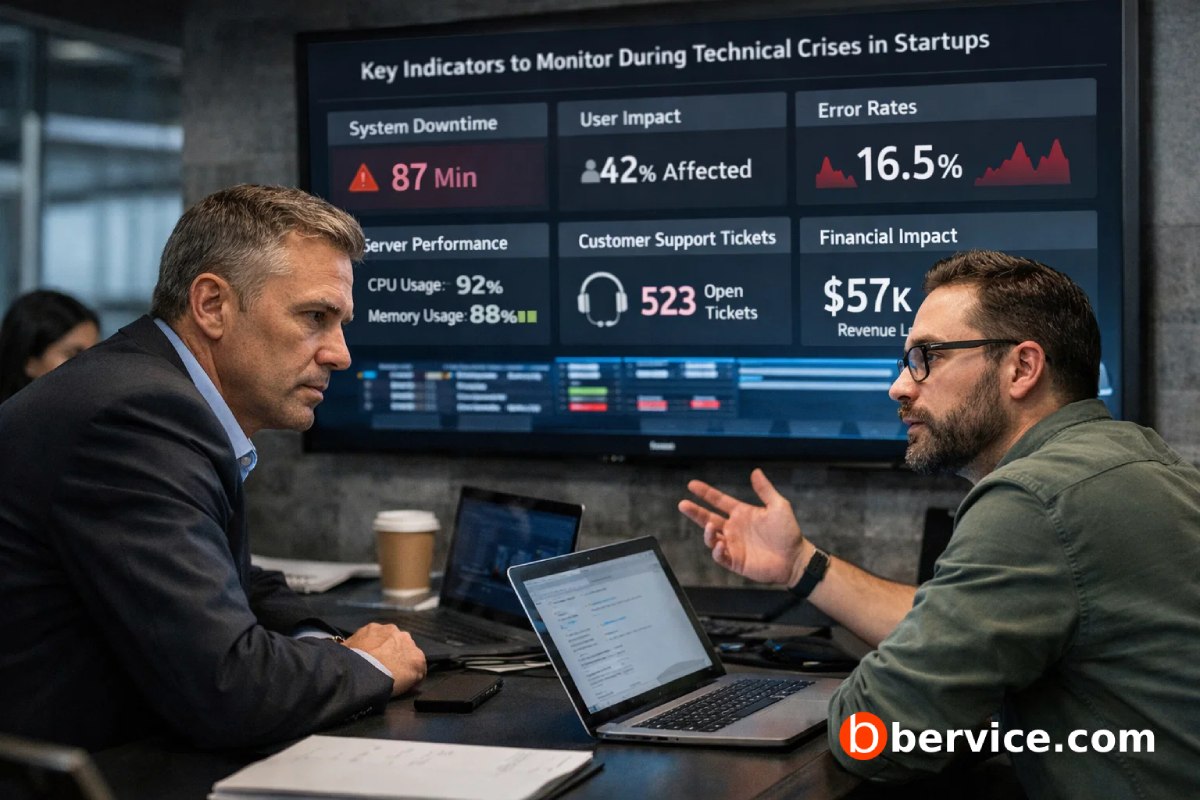
Startups are particularly vulnerable to technical crises. Unlike large organizations with redundant systems and extensive operational buffers, startups often operate with limited resources, small engineering teams, and rapidly evolving infrastructure. When a technical crisis occurs such as system outages, infrastructure failures, security incidents, or scaling problems the ability of leadership to monitor the right indicators becomes critical. In such moments, the CEO and CTO must move beyond routine dashboards and focus on a small set of decisive signals that determine whether the company can stabilize operations and regain momentum.
A technical crisis is not purely a technical problem. It is simultaneously an operational, financial, and reputational risk. The CEO must understand the business impact of the crisis, while the CTO must diagnose and stabilize the underlying systems. Their coordination depends heavily on shared visibility into a group of measurable indicators that reflect system health, operational capacity, and organizational response speed.
1. System Availability and Reliability
The first and most immediate indicator during a technical crisis is system availability. This refers to whether the core services of the startup are operational and accessible to users. Metrics such as uptime percentage, service availability across regions, and failure rates provide the first signal of the crisis severity.
A sudden drop in uptime or an increase in failed requests often indicates infrastructure failure, software deployment issues, or cascading service dependencies. For CTOs, monitoring real time service health dashboards and error rates helps isolate the failing components. For CEOs, understanding how long the service disruption lasts helps estimate revenue loss, user dissatisfaction, and potential reputational damage.
Closely related to availability are reliability metrics such as Mean Time to Detect (MTTD) and Mean Time to Recover (MTTR). These indicators measure how quickly the engineering team identifies the problem and how long it takes to restore the system. In crisis scenarios, these metrics become more valuable than traditional development performance metrics.
2. Infrastructure Stress and Capacity Indicators
Many technical crises emerge when infrastructure reaches unexpected limits. Rapid user growth, traffic spikes, or inefficient code paths can overwhelm servers, databases, or network layers.
Key indicators that CEOs and CTOs should monitor include CPU usage across services, memory consumption, database query latency, network throughput, and storage capacity thresholds. When these metrics approach critical limits, system stability can deteriorate quickly.
Infrastructure stress indicators also reveal whether the startup’s architecture is capable of scaling. If the crisis is caused by capacity limits rather than software defects, the CTO must decide whether to scale horizontally, optimize services, or temporarily reduce system load.
From the CEO’s perspective, infrastructure stress signals a deeper strategic issue: whether the startup’s technology foundation is ready for growth. Repeated capacity crises often indicate architectural debt that must be addressed urgently.
3. Error Rate and Transaction Integrity
In many crises, systems appear operational while silently producing incorrect results. Payment systems may fail to process transactions correctly, databases may produce inconsistent states, or APIs may return incomplete data.
Monitoring error rates and transaction integrity becomes essential. Indicators include API failure percentages, failed database writes, data consistency checks, payment processing errors, and service timeouts.
These indicators are particularly critical for startups operating financial platforms, payment systems, or marketplaces where data integrity directly affects trust. Even small inconsistencies can escalate into legal and financial risks.
For the CTO, these metrics guide debugging and service isolation. For the CEO, they provide early warning of potential customer complaints, financial losses, or regulatory exposure.
4. Security and Incident Signals
Some technical crises are caused not by system failure but by malicious activity. Security incidents such as unauthorized access attempts, abnormal traffic patterns, data leakage risks, or API abuse require immediate attention.
Indicators that must be monitored include unusual login patterns, rapid API request spikes, suspicious IP traffic, authentication failures, and unexpected privilege escalations. Modern startups often rely on automated monitoring tools to flag such anomalies.
During a crisis, the CTO must determine whether the issue is operational or security related. The CEO must simultaneously assess the reputational and legal implications of potential breaches. Rapid detection and containment are essential to prevent escalation.
5. Engineering Response Capacity
A frequently overlooked indicator during technical crises is the operational capacity of the engineering team itself. Technical problems can escalate if the team lacks the bandwidth, expertise, or coordination to resolve them quickly.
Metrics such as incident response time, number of engineers actively engaged in the incident, communication clarity across teams, and deployment rollback capability determine how effectively the startup can respond.
For the CTO, this means ensuring that incident management procedures are clear and that engineers can deploy fixes rapidly without introducing new failures. For the CEO, the concern is whether the team structure is sufficient to handle emergencies without exhausting key personnel.
In many startups, technical crises expose hidden organizational weaknesses such as knowledge silos, undocumented infrastructure, or reliance on a single engineer who understands critical systems.
6. User Impact and Customer Behavior
Technical indicators alone do not fully capture the severity of a crisis. The real impact appears in user behavior and customer feedback. Monitoring user level indicators helps leadership understand how the crisis affects real users.
Key indicators include active user drops, failed user actions, support ticket spikes, refund requests, and negative feedback across communication channels. Sudden changes in user activity often reveal which parts of the product are most affected.
The CEO must interpret these signals to prioritize communication with customers, investors, and partners. Meanwhile, the CTO uses them to identify which systems must be restored first.
7. Financial Exposure Indicators
Technical crises can quickly translate into financial damage. Revenue generating features may stop functioning, transaction pipelines may break, or infrastructure costs may spike due to emergency scaling.
Indicators to monitor include failed payment volume, lost transaction value, emergency infrastructure costs, and revenue decline during system outages. These financial signals help leadership estimate the economic impact of the crisis and determine whether emergency investments are required.
In severe cases, technical crises may threaten contractual obligations with partners or service level agreements with enterprise customers.
8. Technical Debt and Architectural Weak Points
Once the immediate crisis stabilizes, leadership must examine the deeper structural indicators that caused the crisis. These often relate to technical debt accumulated during rapid product development.
Indicators such as fragile dependencies between services, outdated libraries, lack of automated testing, limited observability, and undocumented infrastructure often surface during crisis investigations.
For the CTO, this stage is about identifying systemic weaknesses and designing architectural improvements. For the CEO, the challenge is balancing short term product delivery with long term system stability.
Conclusion
Technical crises in startups are inevitable, especially in fast growing companies that continuously evolve their infrastructure and products. The difference between startups that collapse during crises and those that emerge stronger often lies in leadership visibility. CEOs and CTOs must focus on a small but critical set of indicators that reveal system health, operational capacity, user impact, and financial exposure.
By closely monitoring system availability, infrastructure stress, error rates, security signals, engineering response capacity, user behavior, and financial indicators, startup leaders can transform chaotic technical incidents into manageable operational challenges. Ultimately, the ability to interpret these signals and respond decisively determines whether a startup can survive and continue its path toward sustainable growth.
Connect with us : https://linktr.ee/bervice
Website : https://bervice.com