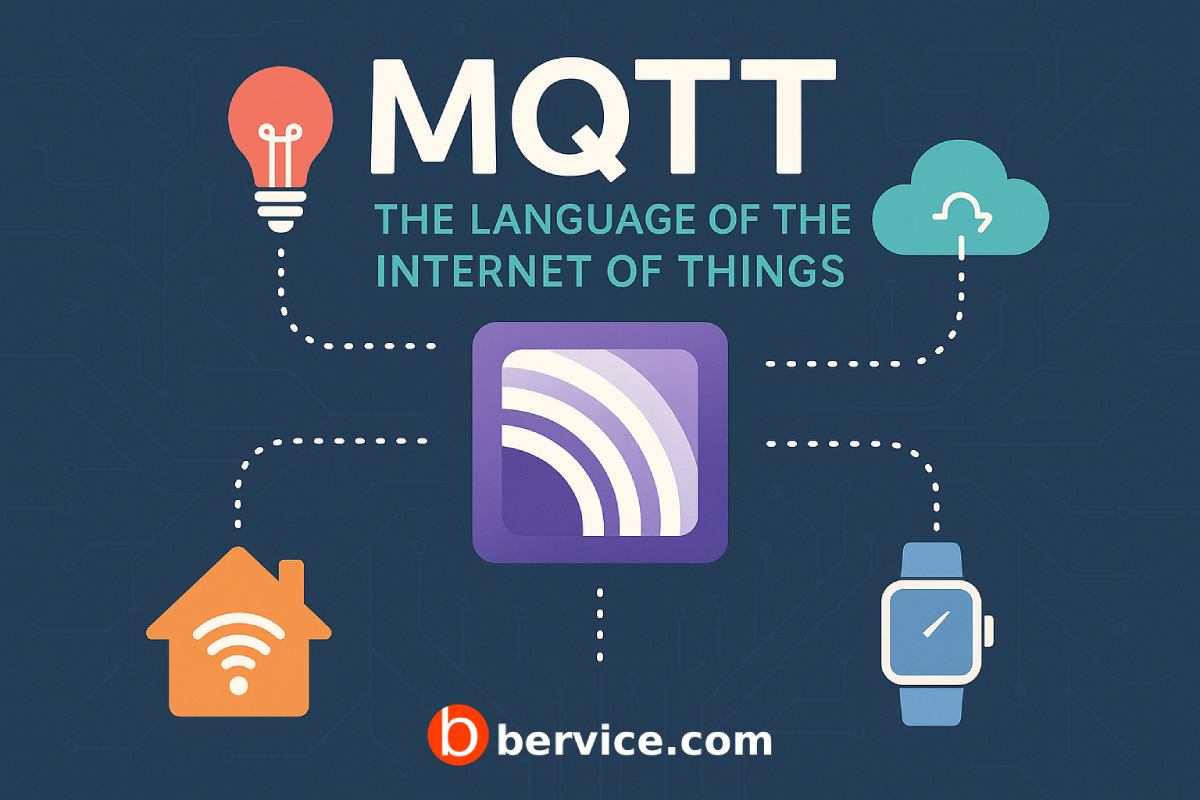
Introduction: The Need for Lightweight Communication
As the Internet of Things (IoT) continues to expand, billions of devices — from smart thermostats to industrial sensors — need a reliable and efficient way to exchange data. Traditional communication protocols are often too heavy, too power-hungry, or too complex for these small, resource-constrained devices. This is where MQTT (Message Queuing Telemetry Transport) comes in — a lightweight, flexible, and efficient messaging protocol that has become the lingua franca of IoT.
The Core Concept: Publisher–Subscriber Model
Unlike the traditional client-server approach, MQTT uses a publish/subscribe architecture that decouples message producers (publishers) from message consumers (subscribers).
- Publishers send messages to specific “topics” on an MQTT broker.
- Subscribers express interest in one or more topics and receive updates whenever new messages are published.
- The broker acts as the central hub, managing message routing between devices.
This model ensures scalability and efficiency — a sensor can broadcast temperature data to dozens of devices or dashboards without knowing their addresses or connection details. It’s a key reason MQTT dominates IoT ecosystems, from smart homes to industrial automation.
Why MQTT Excels in IoT Environments
MQTT’s design makes it uniquely suited for low-bandwidth, high-latency, or unreliable networks — typical conditions in IoT environments. Key advantages include:
- Lightweight Overhead: The protocol requires minimal header bytes, making it efficient even on slow or unstable networks.
- Quality of Service (QoS) Levels: Developers can choose from three reliability levels (0, 1, 2), balancing speed versus delivery guarantees.
- Persistent Sessions: Devices that disconnect temporarily can automatically resume communication once reconnected.
- Energy Efficiency: Perfect for battery-powered devices that need to stay online without draining resources.
In essence, MQTT enables devices to talk in real time without wasting energy or bandwidth — an essential feature for large-scale IoT systems.
The Security Challenge: MQTT Is Only as Safe as Its Implementation
Despite its elegance, MQTT does not inherently provide strong security. Out of the box, it lacks encryption and authentication, which makes it vulnerable to eavesdropping or device hijacking.
To make MQTT deployment production-grade, developers must integrate:
- TLS/SSL encryption to protect data in transit.
- Authentication and authorization layers to ensure only verified clients can publish or subscribe.
- Topic-level access control to prevent data leaks between unrelated devices or users.
- Anomaly detection systems to identify malicious publishing or flooding attacks.
Without these safeguards, an attacker could intercept MQTT messages or even control connected devices — a nightmare scenario in industrial or home automation contexts.
Real-World Applications and Use Cases
MQTT powers countless IoT systems, including:
- Smart Cities: Managing streetlights, parking systems, and pollution sensors.
- Industrial IoT (IIoT): Monitoring machines, pipelines, and factory automation systems.
- Healthcare: Transmitting patient vitals securely to remote monitoring systems.
- Smart Homes: Enabling interoperability among devices from different brands (e.g., lights, thermostats, security cameras).
- Connected Vehicles: Exchanging telemetry data between cars and cloud analytics platforms.
In all these domains, MQTT’s efficiency, flexibility, and reliability make it indispensable.
Conclusion: MQTT as the Nervous System of IoT
MQTT isn’t just another communication protocol — it’s the nervous system of modern IoT infrastructure. It allows millions of devices to communicate seamlessly, efficiently, and in real time. However, its simplicity is both its strength and its weakness. Without robust security layers such as TLS and proper authentication, the very networks it empowers can become vulnerable.
The bottom line:
MQTT is the language of IoT — powerful, elegant, and indispensable — but only when spoken securely..
Connect with us : https://linktr.ee/bervice