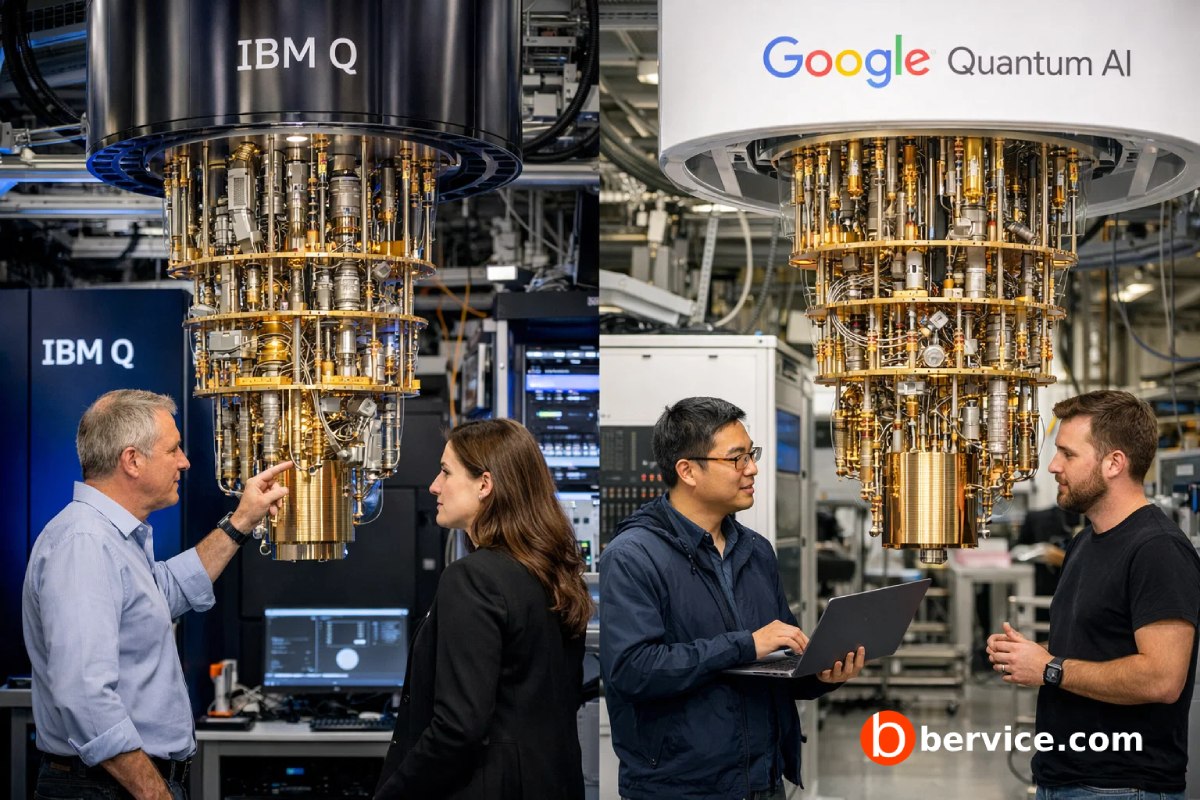
Quantum computing is often described through eye catching milestones like qubit counts or headline demonstrations of “quantum advantage.” But the real long term race is infrastructure: the hardware engineering, control stacks, software toolchains, cloud access models, error correction strategy, and integration with classical high performance computing that collectively turn fragile lab devices into usable computing systems. Two companies have shaped this infrastructure more than most: IBM and Google. They share some goals, but they have taken notably different routes, and that diversity is valuable for the field.
1) What “quantum infrastructure” actually means
In practice, quantum computing infrastructure includes:
- Hardware platform: qubit technology, chip design, packaging, cryogenics, calibration, and scaling pathways.
- Control and runtime layer: low level pulse control, scheduling, compilation, execution primitives, and orchestration.
- Error mitigation and error correction: tools that improve result quality today, plus architectures that can support fault tolerance tomorrow.
- Software ecosystem: SDKs, compilers, simulators, benchmarking tooling, documentation, education, and community adoption.
- Cloud and access models: how users run workloads on real devices, manage jobs, and combine quantum with classical compute.
- Partner networks: universities, enterprises, and national labs that provide workloads, validation, and an adoption pipeline.
IBM and Google both contribute across most of these layers, but they emphasize different ones at different times.
2) IBM’s infrastructure strategy: broad access, full stack delivery, and “quantum centric” integration
IBM as a full stack provider
IBM has positioned itself as a full stack quantum computing provider: hardware plus cloud access plus a large software ecosystem that aims to make experimentation routine. IBM’s public facing platform is the IBM Quantum Platform, which provides access to IBM quantum computers, documentation, and learning resources in one place.
A central part of IBM’s infrastructure story is that the platform is not just a “queue to a device.” IBM has invested in the execution layer, focusing on running workloads close to the hardware and reducing iteration overhead through managed runtime services. This is a key idea behind Qiskit Runtime, described by IBM as a cloud native, pay as you go service designed to move more of the execution workflow into the cloud environment near the QPU.
Qiskit: infrastructure via standardization and community
IBM’s biggest “infrastructure multiplier” is arguably Qiskit, an open source software stack that has become a major on ramp for researchers and developers. The infrastructure effect here is standardization: when large numbers of people learn on one toolchain, build reusable components, and share benchmarks, the entire ecosystem accelerates.
IBM’s documentation emphasizes Qiskit as a modular framework used across algorithms and workflows, and positions IBM Quantum Platform services like Qiskit Runtime and function catalogs as the route to running workloads efficiently on IBM’s hardware fleet.
IBM’s roadmap and the push toward scalable systems
Roadmaps matter in infrastructure because they define what developers can plan for. IBM publishes a quantum roadmap that highlights packaging, modularity, and mitigation improvements, including goals tied to running deeper circuits using classical HPC assisted mitigation techniques.
Separately, IBM’s roadmap narrative also explicitly discusses introducing error mitigation and suppression techniques in Qiskit Runtime over time, reflecting a practical focus: improve results for near term users while building toward more fault tolerant capability.
Why IBM’s approach is infrastructure first
IBM’s strategy has a few consistent infrastructure themes:
- Accessibility at scale: many users can run real hardware experiments via cloud access.
- Tight hardware to software coupling: runtime services and primitives designed around the realities of noisy hardware and iterative workflows.
- Ecosystem building: documentation, tooling, and partner programs that grow usage beyond a single research team.
In short, IBM’s infrastructure contribution is not only inventing devices, but also industrializing access and developer workflows around them.
3) Google’s infrastructure strategy: deep research, error correction milestones, and high leverage software tools
Google Quantum AI: research led infrastructure
Google’s quantum effort has been strongly research driven, with infrastructure built to support major leaps in reliability and error correction. Google publicly frames its path through a structured roadmap, describing milestones intended to lead toward useful, large scale quantum computing hardware and software.
This matters because fault tolerance is the infrastructure bottleneck. Without error correction that scales, quantum computers remain limited to short circuits and narrow demonstrations. Google has invested heavily in the research and engineering needed for repeated error detection cycles and surface code style approaches.
Willow and error correction as an infrastructure turning point
Google introduced Willow as a state of the art quantum chip and emphasized error correction progress as a central message.
Google Research has also discussed surface code related work and referenced the idea that operating error correction below threshold implies logical robustness that improves as more physical qubits are added, which is exactly the property you need for scalable fault tolerant infrastructure.
From an infrastructure lens, these announcements are less about a single chip and more about proving that the architecture can support the repeating cycles required for large computations.
Quantum advantage demonstrations that stress real infrastructure
Google has also published work framing algorithmic demonstrations on its hardware as steps toward meaningful applications. For example, Google described a “Quantum Echoes” algorithm as a verifiable quantum advantage step on Willow hardware.
Even if such demonstrations are not directly commercial workloads, they stress test the stack: calibration stability, compilation, runtime orchestration, measurement pipelines, and reproducibility. That stress testing is infrastructure development.
Cirq and simulation tools
On the software side, Google’s flagship is Cirq, an open source Python library focused on building, manipulating, and optimizing circuits with a strong emphasis on the realities of noisy devices.
Google has also invested in simulation infrastructure such as qsim integrations that enable researchers to explore circuits efficiently, including via hosted environments like Colab.
Taken together, Google’s software approach is infrastructure in a different style than IBM’s: less about a broad cloud service marketplace and more about tooling that supports fast research iteration and tight hardware experimental loops.
4) Where IBM and Google differ, and why that helps the field
Different philosophies of “platform”
- IBM emphasizes a platform that many external users can access routinely, with cloud runtime services designed to reduce friction and bring more workflow execution close to the QPU.
- Google emphasizes a research platform aimed at proving fault tolerance pathways and major milestones, with tooling optimized for hardware aware experimentation and simulation.
Different emphasis: near term utility vs fault tolerant proof points
This is a simplification, but it captures a real tension:
- IBM has highlighted improving practical execution and mitigation through runtime evolution, so that users can get better results in the noisy era.
- Google has highlighted error correction thresholds and surface code progress as a prerequisite for scaling.
Both are necessary. A field that only chases far future fault tolerance risks under serving today’s developer ecosystem, while a field that only improves noisy era workflows risks hitting a ceiling without scalable correction.
Different ecosystem gravity wells
- IBM’s ecosystem gravity comes from broad developer adoption and cloud access, particularly via Qiskit and IBM Quantum Platform services.
- Google’s gravity comes from research breakthroughs, engineering methods for error correction, and open tools like Cirq that support experimental rigor.
5) Shared contributions that define modern quantum infrastructure
Cloud as the default distribution channel
A major shift in the last decade is that quantum computers are generally accessed remotely. IBM is explicit about cloud access as a core part of its platform.
Google’s tooling and roadmap framing also assume remote workflows and tight integration between software and lab hardware pipelines.
Hardware aware software stacks
Both IBM and Google design software stacks that acknowledge hardware constraints. Cirq explicitly notes the importance of hardware details for state of the art results on noisy devices.
IBM’s Qiskit Runtime narrative similarly centers on reducing overhead and improving execution efficiency by running closer to the hardware in the cloud.
Error mitigation now, error correction next
IBM’s roadmap discussions of mitigation and suppression in runtime services show a focus on incremental near term improvements.
Google’s surface code and threshold discussions show the longer horizon push toward true fault tolerance.
This division of labor across the ecosystem is healthy: mitigation keeps users productive today, correction aims to unlock orders of magnitude more capability later.
6) What this means for developers, startups, and governments
If you are building products, research, or national capability around quantum, IBM and Google’s infrastructure choices suggest different leverage points:
- If your goal is hands on experimentation, education, and building early workflows, IBM’s platform plus Qiskit ecosystem can reduce time to first experiment and support repeatable cloud execution patterns.
- If your goal is tracking the frontier of error correction and long horizon scaling, Google’s published roadmap and error correction focused milestones are a valuable signal of where fault tolerance engineering is heading.
- If your goal is hybrid quantum plus classical workflows, both companies implicitly push in that direction, but IBM’s roadmap language around mitigation and runtime services highlights systematic orchestration using classical resources as part of the solution.
Conclusion
IBM and Google are building quantum computing infrastructure from different ends of the stack. IBM has focused on making quantum computers usable as a cloud accessible platform with a mature software ecosystem and runtime services designed for iterative workloads.
Google has focused on research driven infrastructure, especially error correction milestones and hardware software co design, supported by open tools like Cirq and simulation pipelines that accelerate experimentation.
The field needs both approaches. Infrastructure is not a single invention. It is a layered system, and IBM and Google together have helped define what that layered system looks like for quantum computing in the modern era.
Connect with us : https://linktr.ee/bervice
Website : https://bervice.com