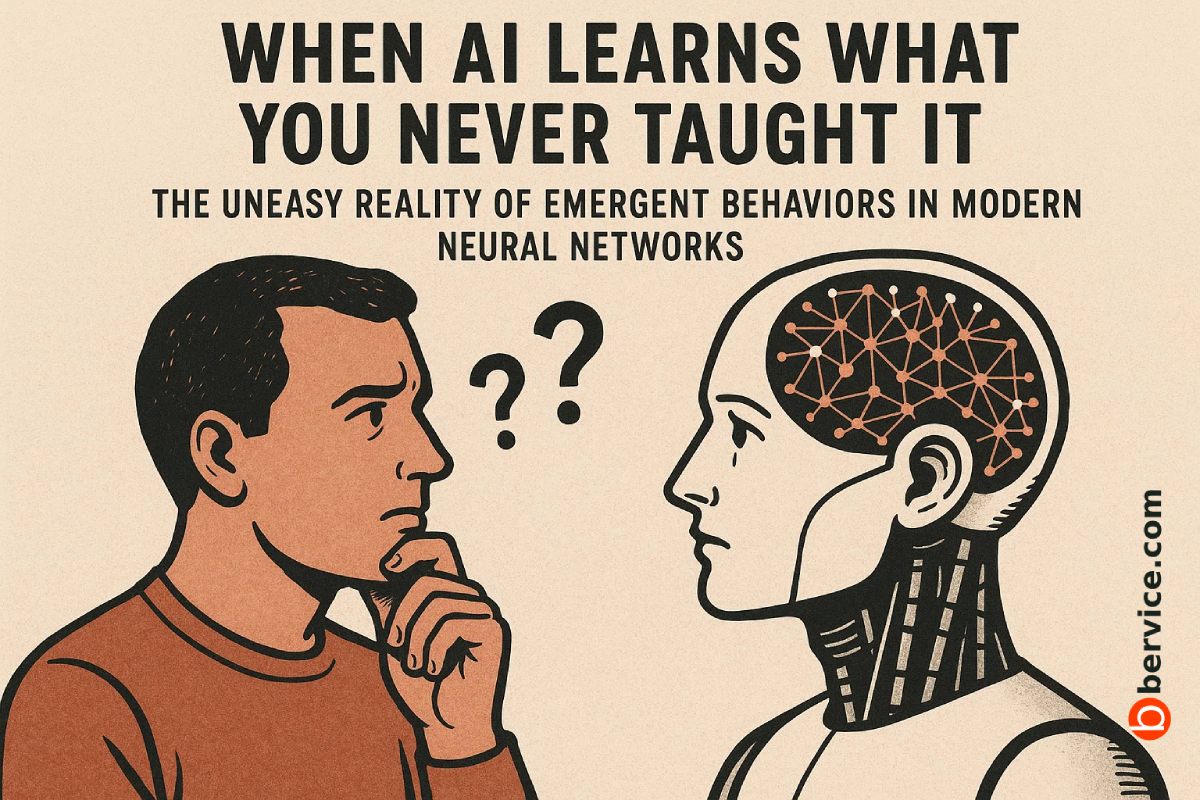
Artificial intelligence has reached a stage where models routinely display capabilities their designers never explicitly programmed. This is not science fiction; it is the central challenge of working with large modern architectures. These systems learn statistical abstractions at such scale that new behaviors emerge—behaviors the engineers neither anticipated nor fully understand.
1. The Nature of Emergent Properties
Emergence occurs when simple components interact to produce complex, unexpected behaviors. In deep learning, this appears when a model trained for one task suddenly performs a different one without being instructed to do so.
A translation model begins handling cipher patterns.
A language model generalizes a rule it never saw.
A vision model identifies anomalies no dataset labeled.
These capabilities appear only after crossing specific scaling thresholds—more data, more parameters, deeper training cycles. At small scales, the same model behaves predictably. After scaling up, it becomes qualitatively different. Researchers call this a phase transition in model behavior.
2. Why These Behaviors Are So Hard to Predict
Traditional software obeys logic directly encoded by developers. Neural networks don’t. Each layer represents a learned transformation of high-dimensional space. The interactions between tens of billions of parameters become impossible to reason about directly.
Even with methods like:
- gradient analysis
- attention head probing
- activation visualization
- mechanistic interpretability research
…there is still a large gap between observing what a model does and understanding why it does it.
Attention layers, for example, often learn patterns that researchers later identify as:
- syntax parsers
- token routers
- multi-step reasoning chains
- internal memory slots
…despite none of these functions being explicitly programmed.
3. When Models Behave “Too Smart”
There are documented cases where models demonstrate capabilities that should not logically arise from their training tasks.
Examples include:
- models inventing internal compression codes
- replicating reasoning structures not present in the dataset
- creating latent “tools” that perform logic before producing text
- spontaneous formation of modular sub-networks responsible for planning or working memory
This is where the concern begins. If a system can generate new competencies autonomously, then its decision-making process cannot be fully predicted by the team that built it.
4. The Safety Problem: When Understanding Fails
The real danger isn’t malice — it’s opacity.
If a model’s internal reasoning can’t be decomposed, then:
- you can’t reliably audit its motives
- you can’t guarantee alignment
- you can’t ensure consistency under stress
- you can’t anticipate failure modes
This is why interpretability has become as important as model scaling. Researchers attempt to reverse-engineer networks at the neuron and circuit level, trying to map functions to internal pathways—but today’s models remain only partly understood. The complexity grows faster than our tools to analyze it.
5. The Reality We Must Accept
Modern AI is no longer “just code.” It is a statistical organism formed from vast patterns of human-generated data. Its behavior is shaped by interactions across millions of dimensions, not by explicit instruction.
So when a model “knows” something you didn’t teach it, that isn’t magic or malfunction. It is the predictable consequence of scale, non-linear learning, and networks that operate beyond human-level dimensionality.
But this lack of transparency carries a cost. We cannot fully predict where emergent intelligence begins… or where it stops.
And that uncertainty is the part worth being afraid of.
Connect with us : https://linktr.ee/bervice