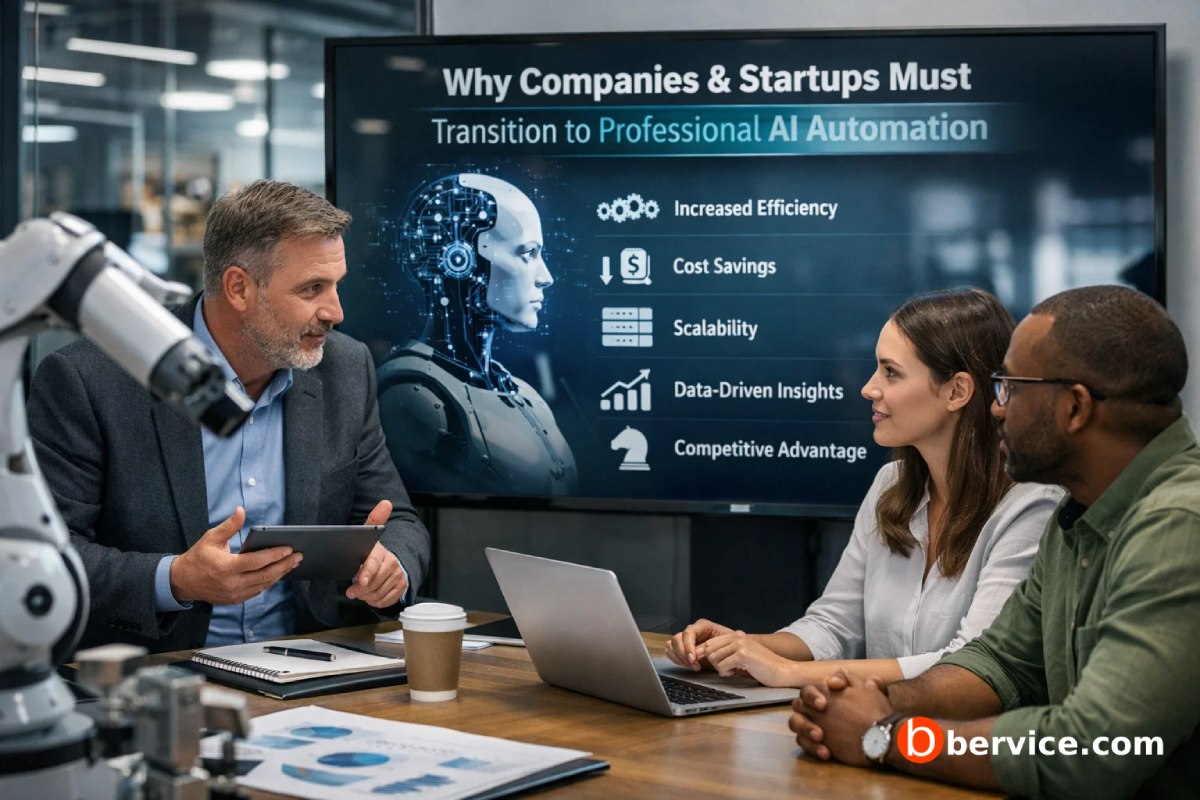
In today’s competitive and fast-moving markets, companies and startups can no longer rely on manual processes, fragmented tools, or purely human-driven decision making. As operations scale, complexity grows non-linearly, and inefficiencies quickly translate into higher costs, slower execution, and strategic blindness. Artificial Intelligence–driven automation is not merely a productivity upgrade; it represents a structural transition in how modern organizations operate, learn, and adapt.
This transition is not about replacing people with machines. Instead, it is about redesigning organizational workflows so that humans focus on judgment, creativity, and strategy, while AI systems handle repetition, pattern detection, optimization, and continuous monitoring at scale.
From Basic Automation to Professional AI Automation
Traditional automation focuses on rigid rules: if X happens, do Y. While useful, this approach breaks down when environments change or data becomes noisy and unstructured. Professional AI automation goes further by introducing systems that can learn from data, adapt to new patterns, and improve their performance over time.
Professional AI automation typically combines machine learning models, decision engines, orchestration layers, and feedback loops. These components work together to not only execute tasks automatically, but also to reason about outcomes, detect anomalies, and suggest or trigger corrective actions without constant human intervention.
Identifying Automation-Ready Processes
The first practical step toward AI automation is identifying processes that are suitable for it. These usually share several characteristics: they are repetitive, data-intensive, time-consuming, or prone to human error. Examples include customer support triage, financial reconciliation, fraud detection, lead qualification, compliance checks, infrastructure monitoring, and internal reporting.
However, automation should not start with isolated tasks. The real value emerges when entire workflows are mapped end-to-end. By understanding how data flows across departments, companies can identify bottlenecks, duplication, and decision points where AI can have the highest leverage.
Building the Data Foundation
AI automation is only as effective as the data that feeds it. Many organizations fail at automation because their data is fragmented, inconsistent, or inaccessible. A successful transition requires deliberate investment in data pipelines, standardized schemas, and reliable data sources.
This often involves integrating operational tools such as CRM systems, project management platforms, financial software, and communication channels into a unified data layer. Clean, well-structured data enables AI systems to observe the organization accurately and make decisions that reflect reality rather than assumptions.
Designing AI-Driven Decision Layers
At the core of professional automation lies decision intelligence. Instead of hard-coded rules, AI models analyze historical and real-time data to recommend or execute actions. For example, an AI system may prioritize customer tickets based on predicted churn risk, or dynamically allocate resources based on workload forecasts.
Crucially, these decision layers should be transparent and auditable. Businesses need to understand why an AI system made a specific choice, especially in regulated or high-risk environments. Explainability and traceability are therefore essential design principles, not optional features.
Human-in-the-Loop as a Strategic Asset
A common misconception is that automation should remove humans entirely from workflows. In practice, the most resilient systems are those that incorporate human-in-the-loop mechanisms. AI handles the bulk of execution, while humans supervise edge cases, validate high-impact decisions, and provide corrective feedback.
This feedback becomes training data, allowing the AI system to improve continuously. Over time, the organization benefits from a compounding effect: better models, fewer exceptions, and higher trust in automated decisions.
Orchestration and System Integration
Professional AI automation is not a collection of disconnected scripts. It requires orchestration across systems, services, and teams. Workflow engines and event-driven architectures allow AI agents to trigger actions across multiple tools, coordinate dependencies, and respond to changes in real time.
For startups, this orchestration provides leverage without large headcount growth. For enterprises, it creates consistency and governance across complex organizational structures. In both cases, automation becomes a core operational layer rather than a side project.
Measuring Impact and Managing Risk
Transitioning to AI automation must be guided by measurable outcomes. Key metrics include time saved, cost reduction, error rates, customer satisfaction, and decision latency. Continuous monitoring ensures that automation delivers real business value rather than theoretical efficiency.
At the same time, risks must be actively managed. These include model drift, biased data, security vulnerabilities, and over-automation of sensitive decisions. Clear boundaries, regular audits, and fallback mechanisms are essential to maintain control and resilience.
Cultural and Organizational Transformation
Perhaps the most overlooked aspect of AI automation is culture. Successful adoption requires teams to trust data, collaborate with intelligent systems, and shift away from manual control as a default mindset. Leadership plays a critical role in framing automation as an enabler rather than a threat.
Training, transparency, and gradual rollout help reduce resistance and build confidence. When employees see AI systems reducing friction and amplifying their impact, adoption becomes organic rather than forced.
Conclusion
The transition to professional AI automation is not a one-time technical upgrade. It is a strategic evolution in how companies and startups operate, decide, and scale. Organizations that embrace this shift gain not only efficiency, but also clarity, adaptability, and long-term resilience.
In an environment defined by uncertainty and speed, AI automation becomes the nervous system of modern businesses, continuously sensing, learning, and responding. Those who invest early and thoughtfully will define the next generation of competitive advantage.
Connect with us : https://linktr.ee/bervice
Website : https://bervice.com