Introduction
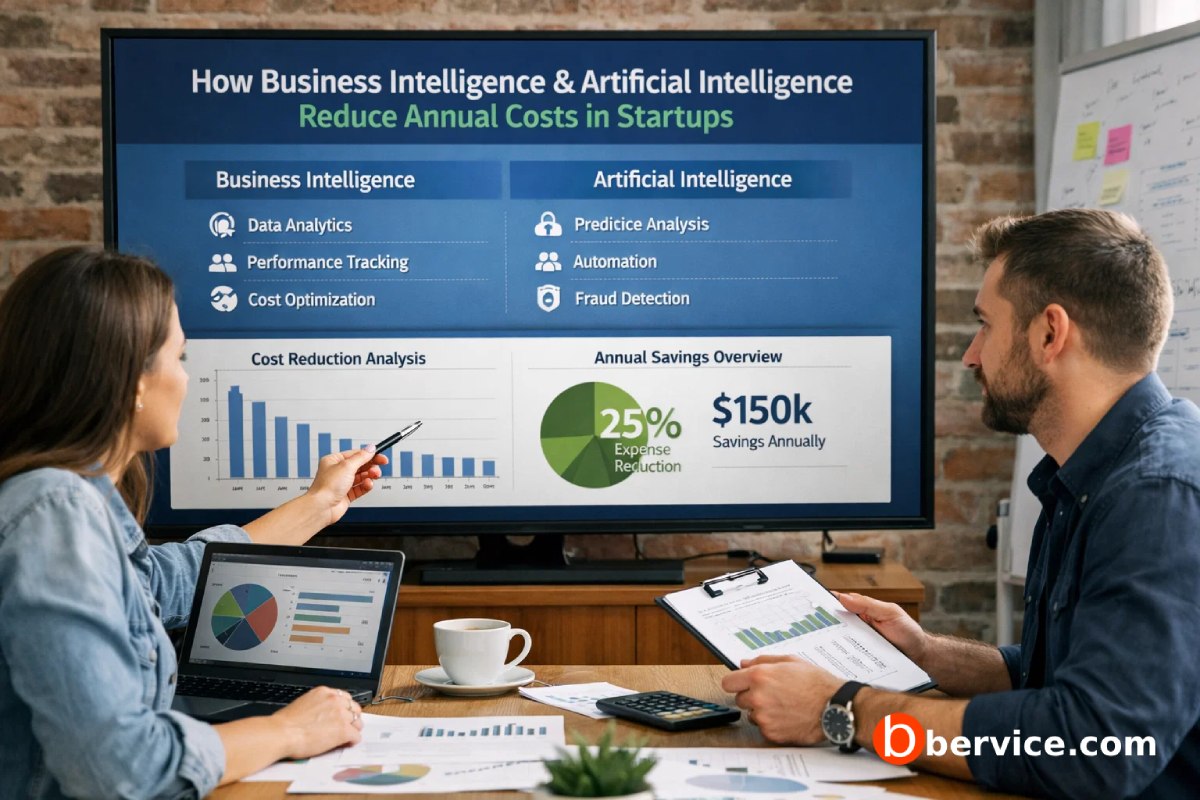
Startups operate under constant pressure to optimize resources while scaling efficiently. Limited budgets, uncertain markets, and the need for rapid iteration make cost management a critical success factor. In this environment, combining Business Intelligence (BI) and Artificial Intelligence (AI) creates a powerful framework for reducing unnecessary expenses while improving decision quality. Rather than relying on intuition or fragmented data, startups can leverage these technologies to systematically identify inefficiencies and automate cost-heavy processes.
Understanding Business Intelligence in Cost Optimization
Business Intelligence focuses on collecting, organizing, and visualizing data to support better decision-making. For startups, BI systems transform raw operational data into actionable insights.
Through dashboards, reports, and analytics, founders can track:
- Customer acquisition costs
- Operational expenses
- Revenue streams
- Product performance metrics
The primary cost-saving value of BI lies in visibility. Many startups lose money not because of bad strategy, but because they lack clear insight into where resources are being consumed. BI exposes hidden inefficiencies such as underperforming marketing channels, redundant tools, or unprofitable customer segments.
The Role of Artificial Intelligence in Cost Reduction
While BI explains what is happening, AI focuses on what should happen next. AI systems analyze patterns, predict outcomes, and automate decisions.
AI contributes to cost reduction through:
- Predictive analytics: Forecasting demand, churn, or revenue trends
- Process automation: Replacing repetitive manual tasks
- Anomaly detection: Identifying unusual spending or system inefficiencies
- Optimization algorithms: Improving pricing, logistics, and resource allocation
For example, AI can predict which users are likely to churn, allowing startups to focus retention efforts only where necessary, reducing wasted marketing spend.
The Synergy Between BI and AI
Individually, BI and AI are valuable. Combined, they become significantly more powerful.
- BI provides structured, reliable data
- AI uses that data to generate predictions and automated actions
This synergy creates a closed decision loop:
- Data is collected and visualized (BI)
- Patterns and predictions are generated (AI)
- Actions are recommended or automated (AI)
- Results are tracked and refined (BI)
This continuous loop minimizes trial-and-error costs and accelerates learning cycles, which is critical for startups operating in uncertain environments.
Reducing Operational Costs
One of the most direct impacts of BI and AI is the reduction of operational overhead.
- Automation of routine tasks: Customer support chatbots, automated reporting, and workflow automation reduce the need for large teams
- Resource allocation optimization: AI ensures that infrastructure, staff time, and tools are used efficiently
- Process standardization: BI identifies bottlenecks, while AI suggests improvements
For instance, instead of hiring additional staff for data analysis, startups can deploy automated dashboards and AI-driven insights, significantly lowering payroll expenses.
Improving Marketing Efficiency
Marketing is often one of the largest expenses for startups, and also one of the most inefficient when not data-driven.
BI helps identify:
- Which channels generate real ROI
- Which campaigns underperform
- Customer segmentation patterns
AI enhances this by:
- Predicting high-value customers
- Personalizing campaigns
- Optimizing ad spend in real time
This combination reduces wasted budget on ineffective campaigns and focuses spending on strategies that deliver measurable returns.
Enhancing Product Development Efficiency
Startups frequently overspend on building features that users do not need. BI and AI reduce this risk.
- BI analyzes user behavior and feature usage
- AI predicts which features will drive engagement or retention
By aligning product development with actual user demand, startups avoid unnecessary engineering costs and reduce time spent on low-impact features.
Reducing Infrastructure and Technology Costs
Modern startups rely heavily on cloud infrastructure, which can become expensive if not managed properly.
- BI tools monitor usage patterns and cost distribution
- AI systems optimize resource allocation dynamically
Examples include:
- Scaling servers based on predicted demand
- Identifying idle resources
- Recommending cost-efficient configurations
This prevents over-provisioning and reduces cloud expenses significantly.
Risk Reduction and Financial Forecasting
Poor financial planning is a major source of cost overruns in startups. BI and AI improve forecasting accuracy.
- BI provides historical financial insights
- AI models predict future scenarios based on trends
This allows startups to:
- Anticipate cash flow gaps
- Adjust spending proactively
- Avoid emergency funding or costly last-minute decisions
Reducing financial uncertainty directly translates into cost savings.
Building a Data-Driven Culture
Beyond tools and technology, the integration of BI and AI fosters a culture of evidence-based decision-making.
Instead of relying on assumptions, teams:
- Validate ideas with data
- Measure outcomes continuously
- Iterate based on real feedback
This reduces costly mistakes, shortens development cycles, and improves overall efficiency.
Challenges and Considerations
While the benefits are clear, implementation is not without challenges.
- Poor data quality can lead to incorrect insights
- Over-reliance on automation may reduce human oversight
- Initial setup costs for BI and AI systems can be high
Startups must approach implementation carefully, ensuring that:
- Data pipelines are reliable
- Models are validated regularly
- Human decision-makers remain involved in critical processes
Conclusion
The combination of Business Intelligence and Artificial Intelligence provides startups with a structured, scalable way to reduce annual costs. BI delivers clarity, while AI enables action. Together, they transform raw data into a continuous optimization engine.
For startups, the goal is not simply to cut costs, but to spend intelligently. By identifying inefficiencies, automating operations, and predicting future outcomes, BI and AI allow startups to operate leaner, move faster, and allocate resources where they generate the highest value.
In an environment where every decision impacts survival, this combination is no longer optional—it is becoming a foundational requirement for sustainable growth.
Connect with us : https://linktr.ee/bervice
Website : https://bervice.com