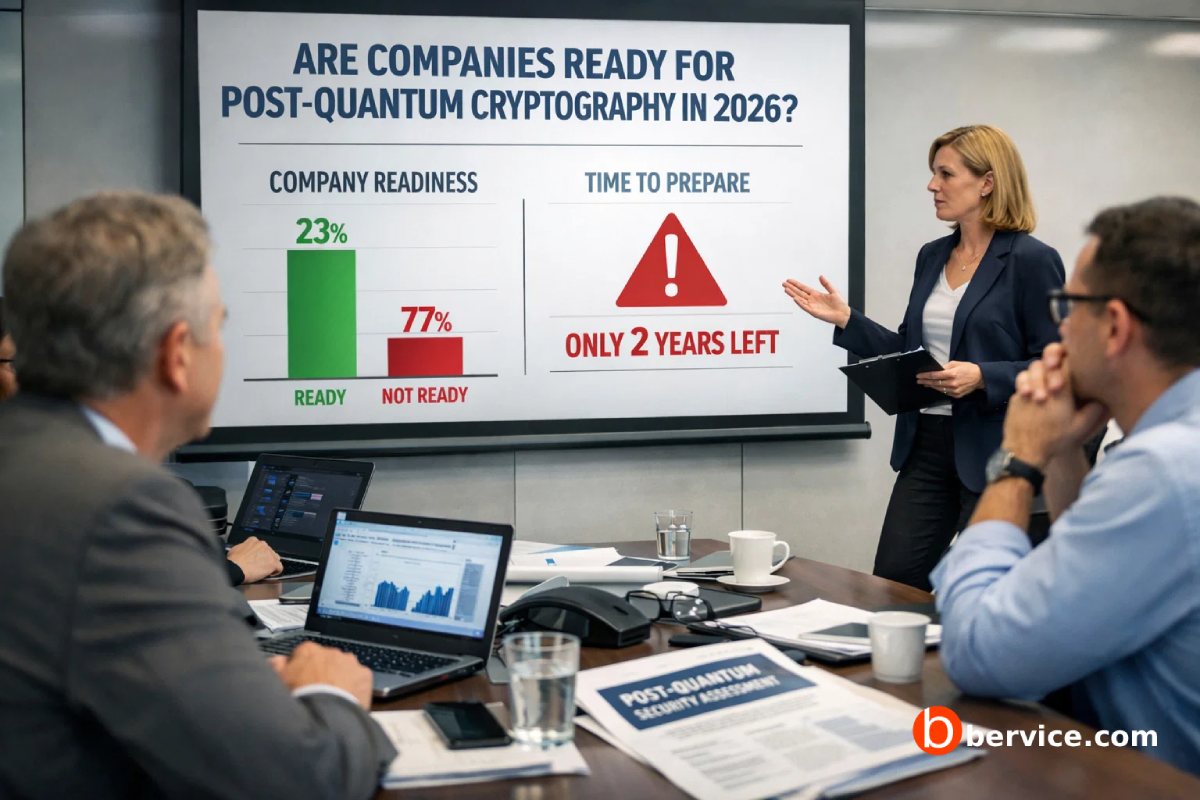
In early 2026, many organizations are aware of post quantum cryptography, but most are not fully transitioned. The common situation is: planning has started, pilots are happening, and inventories are being built, while broad production rollout is still limited to specific parts of the stack like web traffic at large CDNs or selected cloud key management features.
Two big reasons drive urgency:
- Standards are now real, not hypothetical. NIST published its first finalized PQC standards in August 2024: ML KEM for key establishment and ML DSA plus SLH DSA for signatures.
- Governments have set migration expectations and timelines. For example, US federal guidance requires agencies to inventory cryptography and plan migration, and NSA CNSA 2.0 sets “support and prefer” milestones in the 2025 to 2027 range for several technology categories.
So the honest answer for 2026 is: “Some are ready in specific places, most are not end to end ready yet.”
What PQC is and why ordinary people should care
Today, much of the internet relies on public key cryptography like RSA and ECC to do two jobs:
- Establish a secure connection, like when your browser connects to a website.
- Prove identity and integrity, like software updates that are signed, or certificates that prove a site is real.
Large enough quantum computers are expected to break many of these widely used methods. The risk is not only future break ins. A practical threat model is “harvest now, decrypt later,” where attackers collect encrypted traffic today and store it until they can decrypt it later with quantum capability. That matters for data that must remain private for many years: health records, identity documents, long term contracts, private messages, and corporate secrets.
PQC is a set of new cryptographic methods designed to resist known quantum attacks, while still working on normal computers. NIST’s new standards are the anchor that vendors and enterprises can safely build around.
What is actually happening on the internet right now
A key pattern in 2025 and 2026 is hybrid deployment. Instead of switching everything overnight, systems combine a classical method and a PQ method together so that security holds even if one side later fails. Cloudflare, for example, describes broad deployment of hybrid TLS key agreement using X25519 plus ML KEM 768. This is a practical path because it reduces risk and preserves compatibility while ecosystems mature.
Cloud providers are also enabling PQ options in managed security services, for example PQ key encapsulation mechanisms in Cloud KMS in preview, which helps customers start testing and planning without building everything themselves.
Are businesses “prepared” in 2026: a realistic checklist
Most organizations fall into one of these buckets:
- Not started: still using RSA and ECC everywhere, no inventory, no plan.
- Early planning: learning, vendor discussions, basic risk assessment.
- Inventory underway: mapping where crypto exists, which is the hard part.
- Pilots: testing hybrid TLS, PQ capable VPN, PQ signatures for software signing, or PQ ready key management.
- Production in selected areas: usually edge traffic, specific high value apps, or regulated environments.
Government guidance strongly pushes the inventory and planning phases first. US OMB M 23 02 is explicitly focused on identifying and inventorying cryptography and preparing for migration.
CISA also published strategy focused on automated discovery and inventory tooling for PQC migration, highlighting how important visibility is before change.
NSA CNSA 2.0 shows concrete target years for “support and prefer” PQ ready algorithms across categories like browsers and servers, cloud services, networking equipment, and operating systems.
What actions you should offer as a PQC provider in 2026
If you want to sell PQC enablement to organizations, your most valuable offering is not just an algorithm swap. It is a safe migration program that reduces business risk.
1. Crypto discovery and inventory as a product
Offer tooling and a service that answers:
- Where do you use RSA or ECC
- Where are certificates issued and validated
- Which applications pin keys or rely on old libraries
- Where are long lived secrets stored
- Which vendors and devices are in the path
This is aligned with how government programs structure the work, because you cannot migrate what you cannot see.
Deliverable: a “cryptography bill of materials” with owners, systems, dependencies, and upgrade paths.
2. Data longevity and threat modeling workshops
Make it understandable for non technical leadership:
- Which data must stay private for 5, 10, 20 years
- Which communications are high risk if recorded today
- Which business processes depend on signatures: software updates, legal approvals, device identity
Deliverable: a ranked risk register and a decision on where to start first.
3. Hybrid first roadmap and pilots
In 2026, hybrid is usually the safest practical path for large systems.
Offer pilots in these areas:
- Web and API traffic: hybrid TLS where supported at CDN or gateway level
- Key management: PQ options in managed KMS where available
- Software and firmware signing modernization, which NSA highlights as an early transition area in its roadmap
Deliverable: pilot results with performance impact, compatibility notes, and a rollout plan.
4. Vendor and supply chain readiness program
Most enterprises depend on appliances, HSMs, VPNs, IAM platforms, PKI vendors, and cloud services.
Offer a readiness assessment:
- Which vendors support NIST standardized algorithms now
- Which offer roadmap dates
- Which products require replacement
Use external roadmaps like CNSA 2.0 to pressure test timelines for network equipment and platforms.
Deliverable: vendor gap analysis and procurement language templates.
5. Migration engineering, not just consulting
Customers will pay for implementation help:
- Updating libraries and crypto providers
- PKI modernization: certificate lifecycles, algorithm agility, automation
- Secure rollout controls: canary, rollback, monitoring, incident handling
- Compliance documentation: policies, procedures, evidence
Deliverable: working production changes, plus documentation that auditors and security teams can accept.
6. Communication kit for executives and end users
Since you asked for public understanding: prepare a plain language package the customer can publish internally and externally:
- What the quantum threat is in simple terms
- What is changing and what is not changing
- Why the transition takes years
- What users might notice: updates, new security settings, certificate changes, sometimes slightly larger handshake traffic in early hybrid deployments
Deliverable: one page FAQ, a short slide, and a crisis free narrative.
How this will likely play out in the next few years
A realistic trajectory many organizations will follow:
- 2024 to 2026: standards and pilots accelerate, inventory becomes mandatory in regulated environments
- 2026 to 2029: broader hybrid rollouts in network entry points and key systems, increased vendor support, PKI upgrades
- 2030 plus: larger scale replacement of legacy devices and deep infrastructure, with government timelines pushing “exclusive use” in specific domains over the early 2030s
This is consistent with the long timelines shown in CNSA 2.0 and the structured approach in federal migration guidance.
A short message for the general public
You do not need to change how you browse the internet tomorrow. But you should expect the world to quietly upgrade security the way it did when we moved from old SSL to modern TLS. The biggest practical risk is long term privacy: information captured today could become readable later if it is protected by older cryptography. PQC is the planned upgrade path, and 2026 is the period where serious migration work shifts from theory to large scale preparation and early deployments.
If you want, I can turn this into a polished, publication ready article with a headline, intro hook, and a short FAQ section at the end, still fully general audience and non technical.
Connect with us : https://linktr.ee/bervice
Website : https://bervice.com