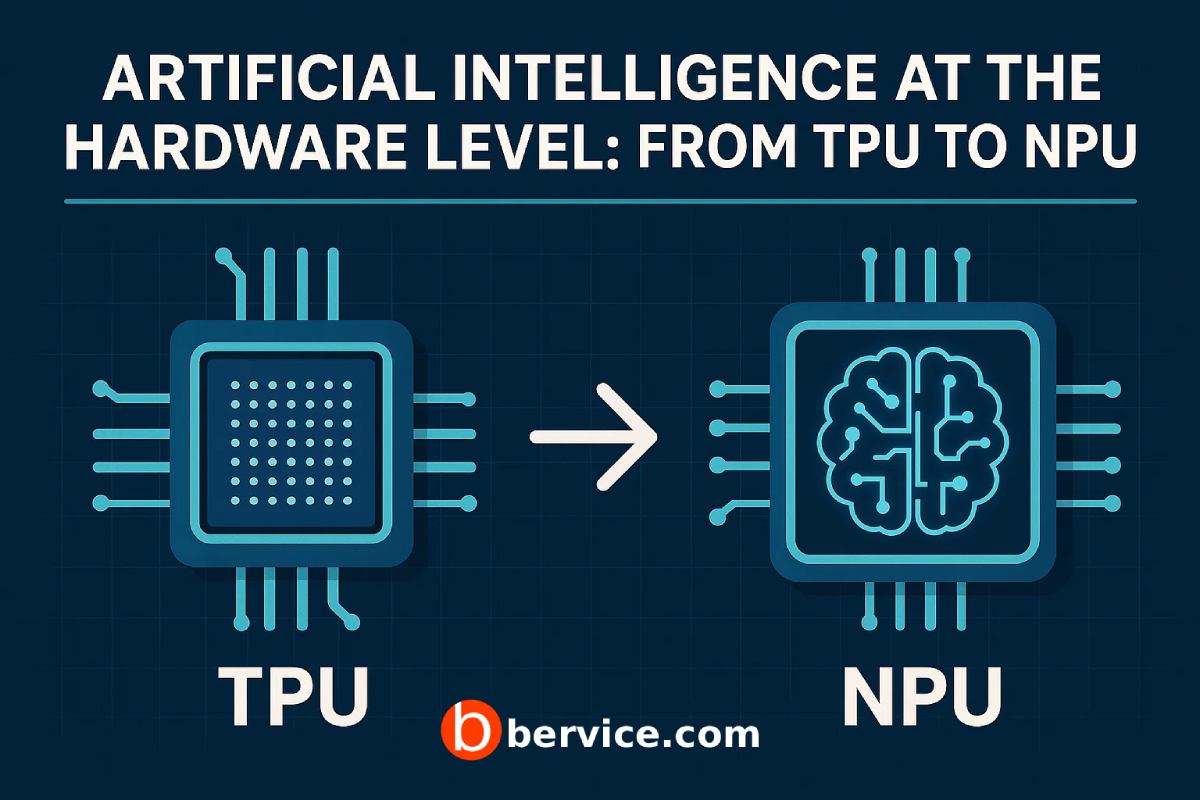
The Shift Beyond CPUs and GPUs
For years, artificial intelligence workloads relied primarily on central processing units (CPUs) and graphics processing units (GPUs). While GPUs revolutionized deep learning with their parallel processing capabilities, they were still general-purpose chips — not built specifically for AI. As models grew larger and more complex, the need for dedicated AI hardware became clear. This need gave birth to a new generation of processors designed specifically for neural computations: TPUs and NPUs.
TPU: Google’s Neural Powerhouse
Tensor Processing Units (TPUs), developed by Google, are custom-built chips optimized for the matrix multiplications at the heart of neural network operations. TPUs deliver massive computational throughput for training and inference while consuming far less energy compared to GPUs. Their architecture is tightly integrated with Google Cloud AI and TensorFlow, enabling scalable machine learning at industrial levels — from large-scale image recognition to real-time natural language processing. Simply put, TPUs redefine how fast and efficiently AI models can learn.
NPU: Bringing AI to the Edge
While TPUs power data centers, Neural Processing Units (NPUs) bring AI closer to the user — right into smartphones, cameras, and IoT devices. Found in chipsets like Apple’s A-series, Qualcomm’s Snapdragon, and Huawei’s Kirin, NPUs handle on-device machine learning tasks such as image enhancement, speech recognition, and face detection. The advantage? Speed, privacy, and reduced reliance on the cloud. Instead of sending data to servers, your phone can analyze and optimize it instantly, making AI more personal and responsive.
The Future: Specialized and Integrated Intelligence
AI hardware is no longer a supporting act — it’s the engine driving the next technological revolution. We’re moving toward a world where custom silicon is embedded in everything from self-driving cars to wearable health monitors. Future chips will combine TPU-level performance with NPU-level efficiency, blurring the lines between cloud and edge computing. As AI models become multimodal and energy-hungry, hardware specialization will determine who leads the race in innovation.
Connect with us : https://linktr.ee/bervice