Introduction
Organizations today are under constant pressure to operate faster, leaner, and more efficiently while still maintaining high-quality decision-making and employee experience. Human Resources teams and middle managers often sit at the center of this tension. They are responsible for coordination, evaluation, communication, and execution, yet much of their time is consumed by repetitive, manual, and fragmented tasks.
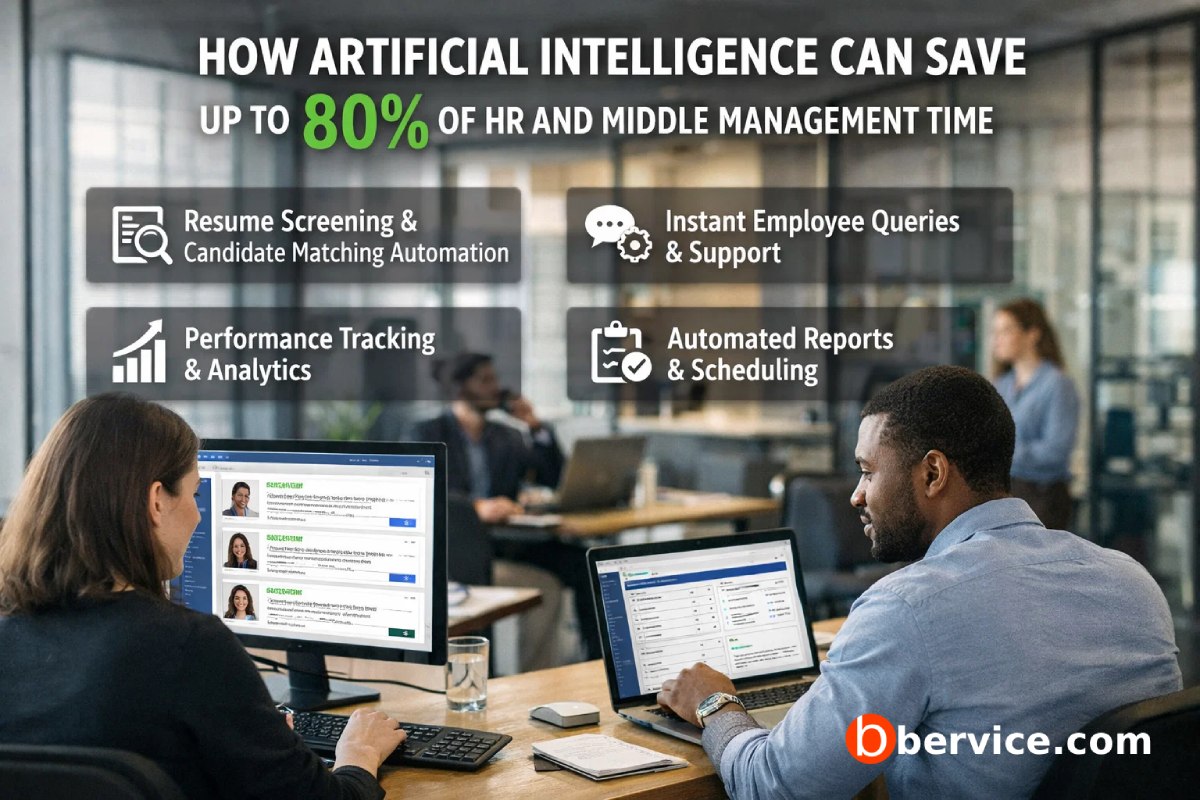
Artificial Intelligence is increasingly positioned as a solution to this inefficiency. Not by replacing human judgment, but by restructuring how work is processed, prioritized, and executed. Under realistic conditions, AI can significantly reduce time spent on operational overhead, in some cases approaching 80%. This figure is not universal and depends on implementation quality, system integration, and organizational readiness. However, the mechanisms through which this time reduction occurs are clear and measurable.
1. Automation of Repetitive Administrative Tasks
A large portion of HR and middle management work consists of predictable, rule-based activities. These include scheduling interviews, filtering resumes, updating records, generating reports, and responding to standard employee inquiries.
AI systems can handle these tasks continuously and with minimal supervision. For example:
- Resume screening tools can analyze thousands of applications in minutes
- Chatbots can answer frequently asked employee questions instantly
- Automated scheduling systems can coordinate interviews without back-and-forth emails
The impact is not just speed, but cognitive relief. Managers are no longer required to context-switch between strategic thinking and administrative execution.
2. Intelligent Candidate Screening and Hiring Decisions
Traditional hiring processes are time-intensive and often inconsistent. HR teams manually review resumes, compare candidates, and attempt to assess fit based on limited signals.
AI changes this by:
- Extracting structured skill data from unstructured resumes
- Matching candidates to role requirements using predefined criteria
- Ranking applicants based on relevance and predicted performance indicators
This reduces the initial screening workload dramatically. However, it is important to note that AI-based hiring systems can introduce bias if trained on flawed historical data. Therefore, human oversight remains essential.
3. Automated Performance Monitoring and Reporting
Middle managers spend a significant amount of time tracking performance, preparing reports, and aligning team output with organizational goals.
AI-powered analytics systems can:
- Continuously monitor key performance indicators
- Generate real-time dashboards and summaries
- Identify anomalies, delays, or performance risks early
Instead of manually compiling weekly or monthly reports, managers receive structured insights automatically. This shifts their role from data collection to decision-making.
4. Streamlining Internal Communication
Communication overhead is one of the most underestimated time drains in organizations. Emails, meetings, follow-ups, and status updates consume a large portion of managerial time.
AI can reduce this by:
- Summarizing meetings and extracting action items
- Prioritizing messages based on relevance
- Automatically generating status updates from project data
This does not eliminate communication, but it compresses it. Information becomes more structured, searchable, and actionable.
5. Decision Support and Predictive Insights
Managers often make decisions based on incomplete or delayed information. Gathering the necessary data can take hours or days.
AI systems can:
- Aggregate data from multiple sources
- Provide predictive insights such as employee turnover risk or project delays
- Suggest possible actions based on historical patterns
This reduces the time required to move from problem identification to decision execution. However, reliance on AI recommendations without validation can introduce risks, especially in complex or high-stakes scenarios.
6. Personalized Employee Experience at Scale
HR teams are responsible for onboarding, training, and supporting employees. Personalizing these experiences traditionally requires significant manual effort.
AI enables:
- Adaptive learning paths based on employee skills and progress
- Automated onboarding workflows tailored to roles
- Continuous feedback systems that track engagement and satisfaction
This reduces the need for repetitive manual coordination while improving consistency across the organization.
7. Reduction of Meeting Dependency
Many organizations rely heavily on meetings to maintain alignment. Middle managers, in particular, spend a large portion of their time in recurring meetings.
AI reduces this dependency by:
- Providing real-time visibility into project status
- Automatically updating shared dashboards
- Highlighting issues without requiring synchronous discussion
As a result, fewer meetings are needed, and those that remain become more focused and outcome-driven.
8. Knowledge Management and Retrieval
A common inefficiency in organizations is the time spent searching for information. Policies, past decisions, and project data are often scattered across multiple systems.
AI-powered knowledge systems can:
- Index and structure organizational knowledge
- Provide instant answers to complex queries
- Surface relevant documents and past decisions
This eliminates redundant questions and reduces dependency on specific individuals for information.
Constraints and Considerations
While the potential for time savings is significant, the “80%” figure should be interpreted carefully. Several factors influence the actual impact:
- Data Quality: Poor or inconsistent data limits AI effectiveness
- System Integration: Disconnected tools reduce automation potential
- Change Management: Employees must adapt to new workflows
- Risk and Compliance: Sensitive decisions require human oversight
In some environments, the reduction may be closer to 30–50%, especially during early adoption مراحل. Higher gains typically require mature systems and well-defined processes.
Conclusion
Artificial Intelligence does not eliminate the need for HR professionals or middle managers. Instead, it redefines their role. By automating routine tasks, structuring information, and accelerating decision-making, AI allows them to focus on higher-value activities such as strategy, leadership, and problem-solving.
The real advantage is not just time saved, but attention reclaimed. Organizations that successfully integrate AI into their operational workflows can shift from reactive management to proactive, insight-driven leadership.
Connect with us : https://linktr.ee/bervice
Website : https://bervice.com