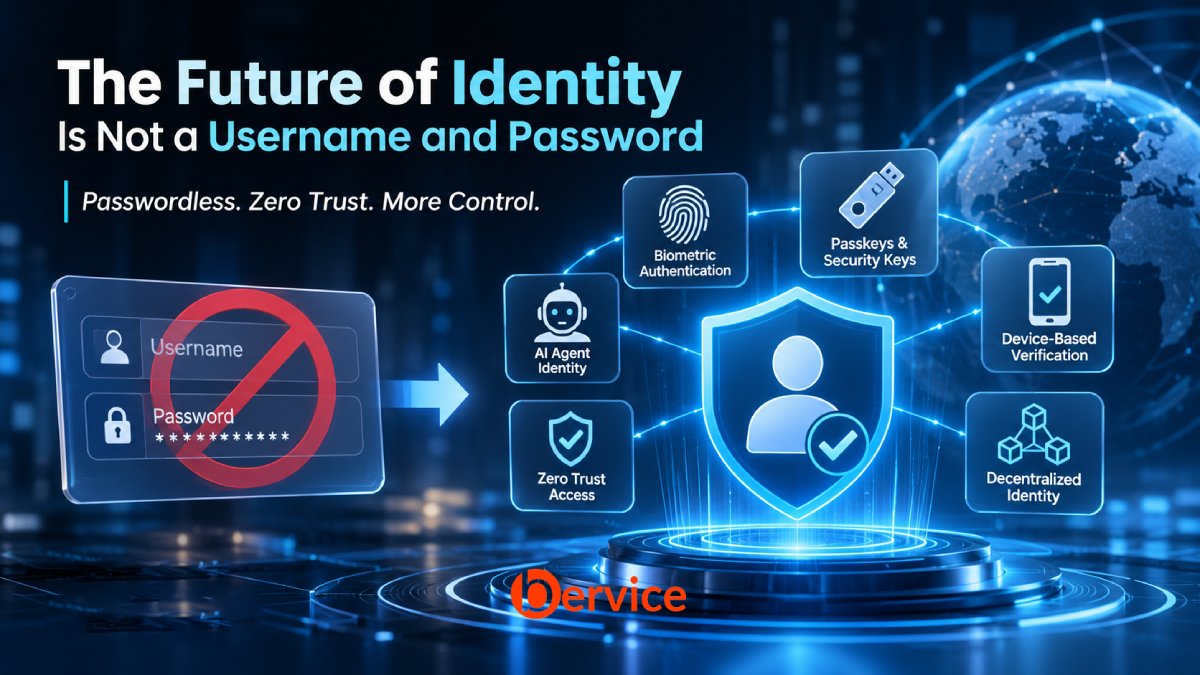
Why the Next Generation of Authentication Must Go Beyond Traditional Login Systems
BERVICE | Cybersecurity · Digital Identity · Privacy · Future of Technology
Introduction: The Password Era Is Coming to an End
For decades, usernames and passwords have been the foundation of digital identity. Almost every online interaction, from accessing a bank account to managing business infrastructure, begins with the same familiar process: enter a username, provide a password, and gain access.
It is a system that has supported the growth of the internet, but it was never designed to handle the complexity of today’s digital world.
Modern users interact with dozens, sometimes hundreds, of digital services. Businesses operate across cloud platforms, remote devices, internal networks, automated systems, and third-party applications. Artificial intelligence is introducing new ways for software agents to access information and perform actions on behalf of humans.
Meanwhile, cybercriminals are becoming increasingly sophisticated. Phishing attacks, credential theft, password reuse, social engineering, and automated account attacks continue to expose the weaknesses of traditional authentication.
The problem is no longer simply whether someone knows the correct password.
The real question is:
How can a digital system reliably determine who or what is requesting access, whether that identity can be trusted, and whether the requested action should be permitted?
The future of digital identity will require a fundamentally different approach. One that moves beyond static credentials and toward stronger, context-aware, privacy-conscious, and continuously verifiable authentication.
1. The Problem With Traditional Authentication
The traditional authentication model relies heavily on something a person knows: a password.
Unfortunately, passwords have several structural weaknesses.
Credential theft: Attackers can obtain passwords through phishing websites, malicious software, data breaches, or social engineering.
Password reuse: Users frequently reuse passwords across multiple platforms. A breach in one service can therefore compromise several unrelated accounts.
Human limitations: People are expected to create, remember, update, and securely manage an increasing number of credentials.
Weak recovery mechanisms: Even when an account has strong authentication, poorly designed password-reset and account-recovery processes can become an alternative route for attackers.
Static trust: Once authentication succeeds, many systems continue to trust the established session without sufficiently considering changes in device security, location, behaviour, or access risk.
Adding another password or sending a one-time verification code does not necessarily solve these problems.
In fact, the National Institute of Standards and Technology (NIST) explains that manually entered one-time codes are not considered phishing-resistant because attackers can relay them through fraudulent websites.
The fundamental issue is that traditional authentication attempts to protect access using information that can be copied, stolen, or manipulated.
The future requires something stronger.
2. From Passwords to Cryptographic Identity
One of the most important developments in modern authentication is the transition from password-based systems to cryptographic authentication.
Instead of asking users to prove their identity by providing a shared secret, cryptographic systems allow them to demonstrate control of a private key.
This approach is commonly implemented through public-key cryptography.
A user receives a cryptographic key pair:
- Private key: Kept securely on the user’s device or protected hardware.
- Public key: Registered with the service and used to verify authentication requests.
When a user attempts to sign in, the system generates a challenge. The user’s device signs that challenge using the private key.
The service verifies the signature using the corresponding public key.
The private key never needs to be transmitted to the service.
This changes the security model significantly.
An attacker who steals a database containing public keys cannot simply use those keys to authenticate as legitimate users.
It also makes phishing considerably more difficult when properly implemented.
The goal is no longer to protect a password from being stolen. It is to make authentication possible without exposing a reusable secret in the first place.
3. Passkeys: The Beginning of Passwordless Authentication
A practical example of cryptographic identity
Passkeys are among the most important steps toward a passwordless internet.
Built on FIDO2 and WebAuthn standards, passkeys use public-key cryptography to authenticate users without requiring traditional passwords.
Instead of remembering a password, users can authenticate through:
- Fingerprint recognition.
- Facial recognition.
- A device PIN.
- A physical security key.
- Other supported device-based verification methods.
The biometric information generally remains on the user’s device. The website or application receives cryptographic proof of authentication rather than the user’s fingerprint or facial data.
Passkeys also offer protection against many common phishing attacks because authentication is cryptographically associated with the legitimate website or service.
However, passkeys are not a universal solution to every identity problem.
Device loss, account recovery, credential synchronization, compromised endpoints, and implementation weaknesses still need careful consideration.
Organizations must also understand the differences between synchronized passkeys and device-bound credentials. These approaches have different security and recovery characteristics.
Nevertheless, passkeys demonstrate an important shift:
The future of authentication does not require users to repeatedly reveal something they know. It requires secure proof that they control something trusted.
4. Identity Must Become More Than Authentication
There is an important distinction between identity, authentication, and authorization.
These three concepts are often treated as interchangeable, but they solve different problems.
| Concept | Main question |
|---|---|
| Identity | Who or what is requesting access? |
| Authentication | Can the requester prove control of the claimed identity? |
| Authorization | What is the requester allowed to do? |
Traditional login systems often combine these concepts into a relatively simple process.
A user enters credentials, passes verification, and receives access to an account.
But modern digital environments are much more complicated.
Consider an employee accessing a company’s financial infrastructure.
Knowing that the person successfully logged in is not enough.
The system should also understand:
- Is this an authorized employee?
- Is the device trusted and properly secured?
- Does this person have permission to access financial information?
- Is the requested action consistent with their responsibilities?
- Does the action require additional verification?
- Has the employee’s access recently changed?
A modern identity system must connect authentication with access policies, permissions, and security context.
This is where identity becomes an essential part of Zero Trust architecture.
Instead of automatically trusting a user because they have successfully logged in, systems should evaluate access based on identity, device security, permissions, and the sensitivity of the requested resource.
5. Continuous Authentication: Trust Should Not Be Permanent
One successful login should not automatically establish unlimited trust for the entire duration of a session.
Imagine an employee who signs into a business system from a trusted laptop.
A few minutes later, an unusual access request originates from a different environment, or the account attempts to perform an action outside its normal permissions.
Should the system continue granting access simply because the initial login was successful?
Future authentication systems will increasingly use contextual and risk-based security signals to make access decisions throughout a session.
These signals may include:
- Device integrity and security status.
- Network and session characteristics.
- Unusual login patterns.
- Changes in access behaviour.
- Sensitivity of the requested operation.
- Authentication history and recent security events.
Depending on the risk, the system may allow access, request additional verification, restrict an operation, or terminate a session.
This approach is often associated with continuous authentication and adaptive access control.
However, there is an important distinction: behavioural and contextual signals should support authentication decisions, not automatically replace strong cryptographic authentication.
They can also introduce privacy concerns if organizations collect excessive behavioural or location data.
The objective should be stronger security with minimal unnecessary monitoring.
6. The Next Identity Challenge: Artificial Intelligence and Autonomous Agents
The expansion of artificial intelligence introduces an entirely new challenge for digital identity.
For decades, authentication systems were primarily designed around human users.
But increasingly, software agents can perform tasks that previously required direct human interaction.
AI agents can:
- Access internal company documents.
- Communicate with external services.
- Execute software operations.
- Retrieve information from databases.
- Manage workflows.
- Initiate transactions through connected applications.
This raises a critical question:
How do we authenticate a machine acting on behalf of a human or an organization?
A conventional username and password is not an appropriate long-term identity model for autonomous systems.
Every AI agent should have a verifiable identity and clearly defined permissions.
A secure architecture should distinguish between:
- Human identity: The person who owns or authorizes the activity.
- Agent identity: The specific AI agent performing the operation.
- Delegated authority: The permissions granted to that agent.
- Execution context: The environment and resources in which the agent operates.
- Accountability: A verifiable record of what the agent did and under whose authority.
For example, an AI agent might be authorized to read financial reports but not transfer funds.
Even if the agent has successfully authenticated, that does not mean it should have unrestricted access to every business resource.
Organizations will need systems that support machine identities, short-lived credentials, delegated permissions, secure secrets management, and auditable actions.
The future of digital identity will therefore involve protecting not only people, but also the software systems acting on their behalf.
7. Decentralized Identity and Verifiable Credentials
Another major development is the movement toward decentralized identity.
Today, digital identities are frequently controlled by centralized platforms.
Users depend on service providers to create accounts, maintain identity records, and determine how identity information is shared.
This model creates several challenges:
- Dependence on centralized identity providers.
- Large databases containing sensitive personal information.
- Limited user control over personal information.
- Potential exposure through centralized data breaches.
- Difficulties transferring identity information between platforms.
Decentralized identity introduces a different approach.
Rather than requiring every platform to independently maintain all identity information, individuals can hold cryptographically verifiable credentials and selectively present evidence when necessary.
For example, imagine applying for a professional opportunity.
Instead of providing access to an entire personal profile, a candidate could present a verifiable credential confirming a specific qualification or professional achievement.
The receiving organization could verify the credential’s authenticity and issuer without necessarily accessing all the individual’s personal information.
Technologies and standards such as Decentralized Identifiers (DIDs) and Verifiable Credentials are helping establish the foundations for these systems.
However, decentralized identity does not automatically guarantee privacy, security, or trustworthiness.
A credential is only as trustworthy as its issuer, verification process, cryptographic implementation, and lifecycle management.
Revocation, expiration, recovery, issuer accountability, and interoperability remain important challenges.
The real opportunity is to give individuals greater control over how their identity information is presented and verified.
8. Privacy Must Become a Core Part of Digital Identity
As authentication systems become more sophisticated, they will inevitably process more information.
Device characteristics, behavioural patterns, biometric verification, location signals, and identity credentials can all contribute to security decisions.
But collecting more information does not automatically create a more secure system.
In fact, excessive identity data collection can create additional risks.
Every additional database containing sensitive personal information becomes a potential target.
A better approach is to design identity systems around data minimization.
This means:
- Store only the information necessary for authentication.
- Avoid collecting biometric information centrally when local verification is sufficient.
- Use cryptographic proofs instead of exposing unnecessary personal details.
- Limit access to identity-related information.
- Separate authentication records from unrelated personal data.
- Provide clear control over identity credentials and recovery mechanisms.
For businesses, this is particularly important.
A compromised password can be replaced.
A person’s biometric characteristics cannot simply be changed.
Identity architecture must therefore protect sensitive information throughout its entire lifecycle, not just during login.
Privacy should not be an additional feature of authentication. It should be part of its underlying design.
9. What Should Businesses Do to Prepare?
The transition beyond passwords will not happen overnight.
Businesses operate legacy applications, distributed infrastructure, third-party services, and systems with different authentication requirements.
Replacing everything immediately is neither practical nor necessarily safe.
Instead, organizations should adopt a gradual identity modernization strategy.
Step 1: Reduce dependence on passwords
Identify systems that support passkeys, FIDO2 security keys, and phishing-resistant multifactor authentication.
Prioritize administrator accounts, financial systems, and sensitive business infrastructure.
Step 2: Establish centralized identity governance
Create clear policies for user provisioning, access permissions, authentication requirements, and account termination.
Step 3: Introduce Zero Trust principles
Evaluate access based on identity, device security, resource sensitivity, and contextual risk rather than relying exclusively on successful login.
Step 4: Secure machine and AI identities
Ensure automated systems have individual identities, restricted permissions, and controlled access to credentials and business resources.
Step 5: Improve identity recovery
Design secure procedures for lost devices, compromised credentials, employee departures, and account recovery.
Recovery mechanisms should not become weaker entry points than the primary authentication system.
Step 6: Minimize identity data exposure
Review what personal and authentication information is collected, where it is stored, who can access it, and how long it is retained.
The goal is not simply to introduce new authentication technology.
It is to establish an identity architecture that can evolve alongside changing threats and business requirements.
10. The BERVICE Perspective: Identity Without Unnecessary Exposure
At BERVICE, we believe the future of digital security should be built around stronger verification, greater user control, and reduced dependence on centralized trust.
Digital identity is becoming one of the most important security layers of modern infrastructure.
As businesses adopt artificial intelligence, decentralized systems, remote operations, and increasingly interconnected applications, traditional authentication models will become progressively less suitable for managing access and accountability.
The next generation of identity infrastructure should be designed around several fundamental principles:
Cryptographic verification: Identity claims should be supported by strong cryptographic mechanisms rather than relying entirely on reusable credentials.
User-controlled access: Individuals and organizations should have greater control over how identity information is shared and used.
Privacy by design: Sensitive information should remain protected, with unnecessary collection and exposure minimized.
Local-first security: Where practical, sensitive identity operations and cryptographic material should remain under the control of trusted local devices rather than being unnecessarily exposed to external services.
Verifiable authorization: Systems should verify not only who is requesting access, but also what they are permitted to do.
Resilient infrastructure: Identity systems should be designed with secure recovery, strong key management, interoperability, and future cryptographic requirements in mind.
We believe digital security should not depend on trusting a single login screen, a centralized database, or a single service provider.
It should be built on verifiable foundations.
Conclusion: Your Identity Is More Than Your Login Credentials
The internet is moving toward a new identity model.
Passwords are gradually giving way to cryptographic authentication. Static sessions are evolving toward contextual access decisions. Centralized identity databases are being complemented by verifiable credentials. And the rise of AI agents is forcing organizations to rethink what it means for a digital entity to have an identity.
These developments represent more than technological improvements.
They represent a fundamental change in how digital trust is established.
In the future, accessing a system should not simply mean proving that you know a password.
It should mean demonstrating control of a trusted identity, establishing the legitimacy of the requested interaction, and verifying that the requested level of access is appropriate.
The organizations that understand this transition early will be better positioned to protect their infrastructure, their customers, and their digital assets.
Because the future of identity is not about remembering better passwords.
It is about building systems where identity can be securely verified without unnecessary exposure or blind trust.
And ultimately, the next generation of digital security will not ask only:
What’s your username and password?
It will ask:
Can your identity be verified, can your authority be trusted, and can your actions be proven?
Connect with us : https://linktr.ee/bervice
Website : https://bervice.com