Introduction
Artificial Intelligence is advancing faster than any technology in modern history. Every few months, larger and more capable foundation models emerge, equipped with trillions of parameters, broader knowledge, and increasingly sophisticated reasoning abilities.
But a critical question is beginning to reshape the future of AI:
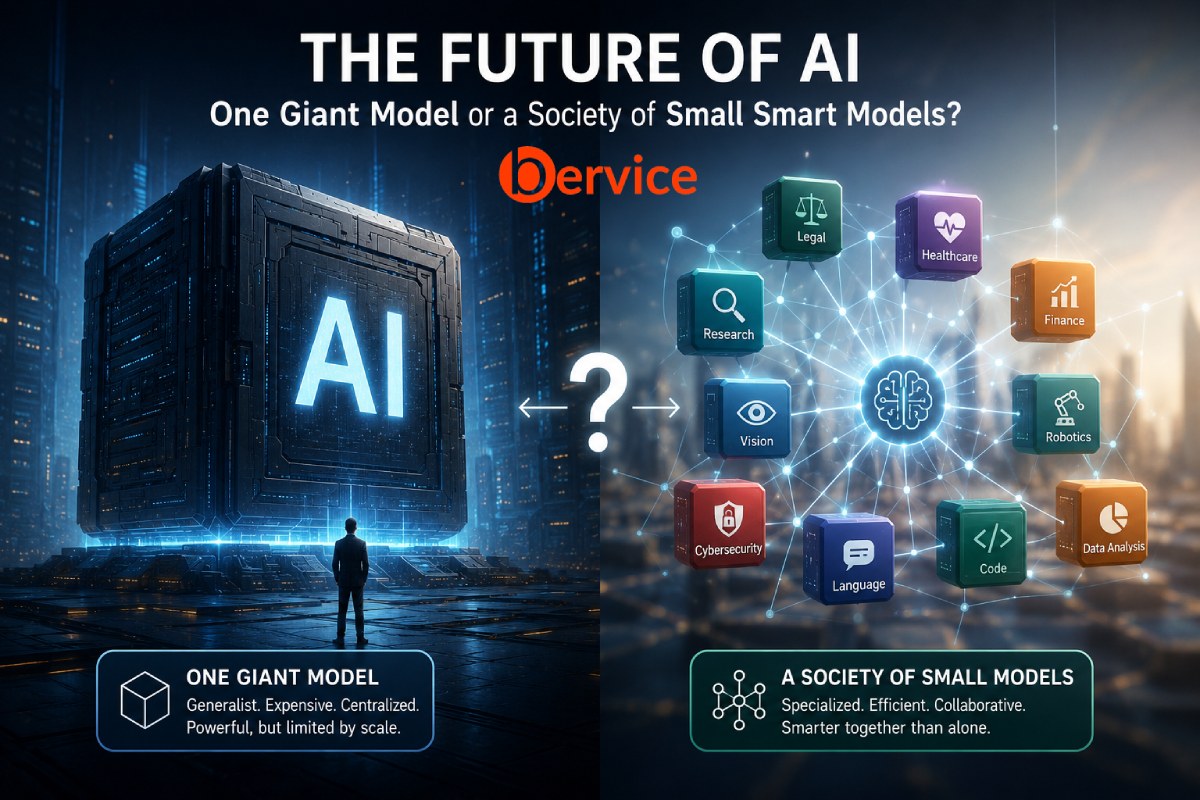
Will intelligence continue to evolve by building one enormous universal model, or will the future belong to networks of smaller specialized models working together?
The answer may define not only the architecture of AI but also the future of computing, economics, security, and even how humans collaborate with machines.
The next generation of AI may not resemble a single supercomputer. Instead, it may function more like a digital civilization.
The Era of Bigger Models
The first wave of AI progress was driven primarily by scale.
Researchers discovered that increasing three things simultaneously often produced dramatic improvements:
- More parameters
- More training data
- More computational power
This scaling law created increasingly capable foundation models capable of:
- Writing software
- Understanding images
- Translating languages
- Solving scientific problems
- Reasoning across multiple domains
The philosophy was simple:
If larger models perform better, build even larger ones.
This strategy transformed AI from narrow tools into general-purpose reasoning systems.
However, scaling is approaching practical limits.
The Cost of Giant Intelligence
Training frontier AI models now requires:
- Hundreds of thousands of GPUs
- Massive energy consumption
- Billions of dollars
- Months of continuous computation
Even after deployment, these systems remain expensive to operate.
Every user request consumes significant computational resources, even when the task is relatively simple.
As models grow larger, improvements become increasingly expensive.
The industry is beginning to experience diminishing returns.
Intelligence Is Naturally Modular
Nature offers an interesting comparison.
The human brain is not one giant processor performing every task equally.
Instead, it contains highly specialized regions responsible for:
- Vision
- Language
- Memory
- Planning
- Motor control
- Emotion
- Pattern recognition
These systems constantly communicate while remaining specialized.
Complex intelligence emerges through cooperation rather than uniformity.
This observation raises an important possibility:
Perhaps AI should evolve in the same direction.
A Society of Specialized AI Models
Instead of building one enormous model capable of everything, imagine thousands of expert models.
Each becomes exceptionally skilled at one domain.
Examples include:
- Medical diagnosis
- Software engineering
- Legal reasoning
- Scientific research
- Financial analysis
- Robotics
- Vision
- Audio processing
- Cybersecurity
- Mathematics
A coordinating AI orchestrates them.
When a problem arrives, it determines:
- Which experts are required
- How information should flow
- Which conclusions should be trusted
- How conflicting answers should be resolved
Rather than one brain doing everything, intelligence becomes collaborative.
The Rise of AI Swarms
This concept is often described as multi-agent AI.
Instead of one model solving an entire problem, multiple AI agents cooperate.
One plans.
- Another researches.
- Another verifies facts.
- Another writes code.
- Another tests the results.
- Another checks security.
Together, they produce solutions that are often stronger than those generated by a single general-purpose model.
Just as modern companies rely on teams rather than one employee, future AI systems may rely on digital organizations.
Smaller Models Are Surprisingly Powerful
Recent advances show that compact models can outperform much larger ones when optimized for specific tasks.
Advantages include:
- Faster inference
- Lower operating costs
- Reduced memory requirements
- Better privacy through local deployment
- Easier customization
- Lower energy consumption
Many businesses no longer require trillion-parameter intelligence for routine work.
A carefully trained specialized model often performs better.
Edge AI Changes Everything
Another force pushing AI toward smaller models is edge computing.
Future intelligence will increasingly live inside:
- Smartphones
- Cars
- Glasses
- Robots
- Industrial machines
- Medical equipment
- Home devices
These systems cannot rely on constant cloud access.
They require efficient local intelligence.
This makes lightweight models essential.
Rather than sending every question to one massive cloud model, devices will solve many problems independently.
The Hybrid Future
The most likely future is not choosing one approach over the other.
Instead, AI may evolve into a hierarchy.
At the top:
Large foundation models provide broad reasoning, planning, and general understanding.
Below them:
Thousands of specialized expert models execute domain-specific tasks.
Below those:
Tiny edge models perform real-time inference directly on devices.
Together, they create an ecosystem rather than a monolithic system.
Intelligence Needs Coordination More Than Size
As AI ecosystems become increasingly distributed, orchestration becomes more important than raw intelligence.
The hardest challenge may no longer be building smarter models.
Instead, it will be coordinating them effectively.
Questions become:
- Which model should answer?
- Which answer is most reliable?
- How should confidence be measured?
- How should knowledge be shared?
- How do we prevent cascading errors?
The future belongs not only to intelligent models but to intelligent coordination.
The Missing Layer: Trust
As thousands of AI systems begin collaborating, another challenge emerges.
How do we know which model to trust?
Large organizations will need mechanisms for evaluating:
- Accuracy
- Reliability
- Bias
- Security
- Provenance
- Accountability
Every AI model may eventually require a reputation layer similar to how humans build professional credibility.
Intelligence alone will no longer be enough.
Verified performance will become a competitive advantage.
This is especially true in high-stakes industries such as healthcare, finance, law, and autonomous systems.
Computing Is Becoming Collective Intelligence
The evolution of computing has followed a familiar path.
We moved from:
One computer
to
Networks of computers.
Then from:
One server
to
Cloud computing.
Now AI appears to be following the same trajectory.
The future may shift from:
One massive intelligence
to
Networks of cooperating intelligences.
Just as the Internet transformed isolated computers into a global information network, AI networks may transform isolated models into a global intelligence network.
Conclusion
The future of Artificial Intelligence is unlikely to be defined by a single colossal model that knows everything.
Instead, it will likely emerge from an ecosystem where giant foundation models, specialized expert systems, and lightweight edge models collaborate seamlessly.
The true breakthrough will not simply be creating smarter AI.
It will be creating AI that knows when to think alone, when to ask for help, and when to trust another intelligence.
In many ways, the next leap in AI will resemble humanity itself.
Not one mind becoming infinitely smarter.
But millions of specialized minds working together toward a common goal.
That may be the highest form of artificial intelligence we have yet imagined.
Connect with us : https://linktr.ee/bervice
Website : https://bervice.com