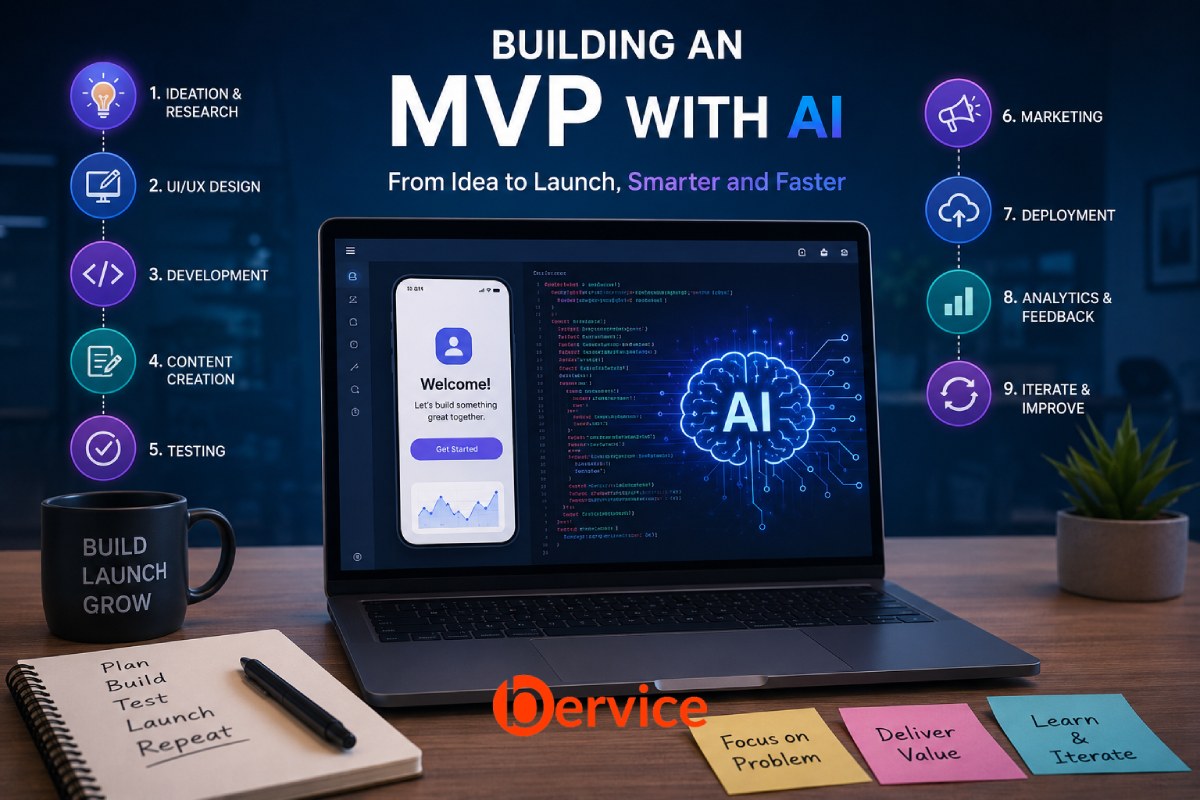
In the past, building a Minimum Viable Product (MVP) required a team of designers, frontend developers, backend engineers, marketers, QA specialists, and content creators. Even a simple product could take months to release and require a significant budget before receiving a single piece of customer feedback.
That reality is changing.
Artificial Intelligence is transforming the startup ecosystem by enabling individuals and small teams to perform the work that once required entire departments. Today’s founders can design interfaces, generate production-ready code, write marketing copy, produce videos, create documentation, test applications, and even plan product strategy using AI powered tools.
AI does not replace experience or product thinking. It accelerates execution. The companies that succeed are not necessarily those with the largest engineering teams, but those that can validate ideas faster than everyone else.
This guide explores how to build an MVP almost entirely with AI, from the first sketch to the first customer.
Step 1: Validate the Problem Before Writing Code
The biggest startup mistake has never been poor technology.
It is building something nobody needs.
Before opening a code editor, use AI as your research partner.
AI can help you:
- Analyze existing competitors
- Identify market gaps
- Generate customer personas
- Create interview questions
- Summarize industry reports
- Predict possible objections
- Brainstorm pricing models
Instead of asking:
“How do I build this?”
Ask:
“Should this exist at all?”
A week of AI assisted research can save months of unnecessary development.
Step 2: Turn Ideas into Product Specifications
Once the problem is validated, transform your concept into a structured product document.
Modern AI assistants can generate:
- Product Requirement Documents (PRDs)
- User stories
- User journeys
- Feature prioritization
- Technical architecture
- Database models
- API definitions
- Sprint planning
Rather than writing dozens of pages manually, founders can collaborate with AI to iterate quickly until every feature has a clear purpose.
The result is a roadmap that developers and AI coding assistants can follow consistently.
Step 3: Design the User Experience with AI
Design is no longer a bottleneck.
AI powered design tools can generate:
- Wireframes
- User flows
- High fidelity mockups
- Design systems
- Icons
- Illustrations
- Color palettes
- Typography recommendations
Instead of spending weeks perfecting every screen, founders can generate multiple design variations within minutes.
More importantly, AI enables rapid iteration.
You can ask:
“Make this dashboard simpler.”
“Reduce cognitive load.”
“Improve accessibility.”
“Design for mobile first.”
Every iteration becomes dramatically faster.
Step 4: Build Production Ready Code
Perhaps the most dramatic transformation is software development itself.
Modern AI coding assistants can generate:
- Frontend applications
- Backend services
- Authentication systems
- REST APIs
- GraphQL APIs
- Database migrations
- Unit tests
- Infrastructure as Code
- Docker configurations
- CI/CD pipelines
Developers are shifting from writing every line manually to reviewing, improving, and orchestrating AI generated code.
This changes the engineering workflow from:
Writing → Testing
into
Planning → Prompting → Reviewing → Improving
The engineer becomes an architect rather than a typist.
Step 5: Generate Content at Scale
Every MVP requires content.
Landing pages.
Help documentation.
Emails.
Privacy policies.
FAQs.
Release notes.
Blog posts.
Product descriptions.
Social media posts.
Instead of outsourcing content creation, AI can generate consistent messaging across every customer touchpoint while maintaining your brand voice.
Founders can launch with a professional content strategy from day one.
Step 6: Create Marketing Assets
Marketing used to begin after development.
Now it begins alongside development.
AI can generate:
- Brand names
- Logos
- Landing pages
- Ad copy
- SEO articles
- LinkedIn posts
- X (Twitter) threads
- Email campaigns
- Product videos
- Demo scripts
- Press releases
A single founder can launch with the marketing capabilities that previously required an agency.
Step 7: Test Everything with AI
Quality Assurance is another area experiencing rapid automation.
AI can help generate:
- Test scenarios
- Edge cases
- Unit tests
- Integration tests
- UI automation
- Accessibility testing
- Security checklists
- Performance recommendations
Instead of waiting until the end of development, testing becomes continuous.
AI identifies problems earlier, reducing both cost and technical debt.
Step 8: Improve Security Before Launch
Many MVPs underestimate cybersecurity.
AI can review code for:
- Common vulnerabilities
- Authentication weaknesses
- SQL injection risks
- Cross Site Scripting (XSS)
- API security issues
- Dependency vulnerabilities
- Secret exposure
- Infrastructure misconfigurations
While AI should not replace professional security reviews for high risk systems, it provides an excellent first layer of defense.
Step 9: Deploy Automatically
Launching software is no longer a manual process.
AI can assist with:
- Docker containers
- Kubernetes manifests
- GitHub Actions
- GitLab CI
- Cloud infrastructure
- Monitoring
- Logging
- Rollback strategies
- Environment configuration
Modern deployment pipelines can move code from commit to production with minimal manual intervention.
Step 10: Learn from Real Users
The MVP is not the destination.
It is the beginning.
After launch, AI helps analyze:
- Customer feedback
- Support tickets
- User interviews
- Session recordings
- Product analytics
- Churn reasons
- Feature requests
- Usage patterns
Instead of manually reviewing thousands of comments, founders can identify trends within minutes.
The product evolves based on evidence rather than assumptions.
The New AI Powered Startup Team
A modern startup no longer needs dozens of specialists on day one.
One experienced founder equipped with AI can effectively perform the work of multiple roles:
- Product Manager
- UX Designer
- Frontend Developer
- Backend Engineer
- Technical Writer
- Content Creator
- Digital Marketer
- QA Engineer
- DevOps Engineer
- Customer Support Assistant
This does not eliminate expertise.
It amplifies it.
The better your judgment, the more valuable AI becomes.
What AI Still Cannot Replace
Despite remarkable progress, AI has important limitations.
It cannot fully replace:
- Deep customer empathy
- Strategic decision making
- Long term product vision
- Leadership
- Negotiation
- Business relationships
- Ethical responsibility
- Creative intuition
- Market timing
AI generates possibilities.
Humans decide which possibilities deserve to become products.
Common Mistakes When Building with AI
Many teams misuse AI by assuming generated output is automatically correct.
Common pitfalls include:
- Blindly accepting generated code
- Ignoring security reviews
- Shipping without user validation
- Overengineering early versions
- Choosing too many AI tools
- Forgetting documentation
- Skipping usability testing
- Building features instead of solving problems
AI accelerates both good decisions and bad ones.
Strong product thinking remains the ultimate competitive advantage.
Looking Ahead
The future of MVP development is not about replacing developers.
It is about removing unnecessary friction.
Founders will spend less time writing boilerplate code and more time understanding customers. Designers will explore dozens of interface ideas instead of polishing a single concept. Marketers will launch campaigns in hours instead of weeks. Engineers will focus on architecture, reliability, and innovation rather than repetitive implementation.
The next generation of startups will not be defined by team size or funding alone. They will be defined by how effectively they combine human creativity with artificial intelligence.
Building an MVP has never been faster, more affordable, or more accessible. The winners of the AI era will not simply use AI to write code. They will use it to rethink the entire product creation process, from the first idea to the first loyal customer and beyond.
Connect with us : https://linktr.ee/bervice
Website : https://bervice.com