Introduction
Artificial Intelligence models have grown at an extraordinary pace. Modern Large Language Models (LLMs) often contain billions or even trillions of parameters, enabling remarkable reasoning, language understanding, programming, image generation, and scientific assistance. However, these capabilities come at a significant computational cost.
Running a large AI model traditionally requires enormous amounts of GPU memory, powerful processors, and substantial energy consumption. This has limited advanced AI to cloud infrastructure owned by large technology companies.
Quantization has fundamentally changed this landscape.
Today, quantized AI models allow users to run powerful language models on personal computers, laptops, smartphones, embedded devices, industrial edge systems, and even Raspberry Pi-class hardware. They reduce memory usage dramatically while maintaining most of the original model’s intelligence.
This article explores what quantized AI models are, how they are created, how they work internally, their advantages and limitations, and why they are becoming one of the most important technologies in modern AI deployment.
What Is a Quantized AI Model?
A quantized AI model is a version of an existing neural network whose numerical weights have been converted into lower precision representations.
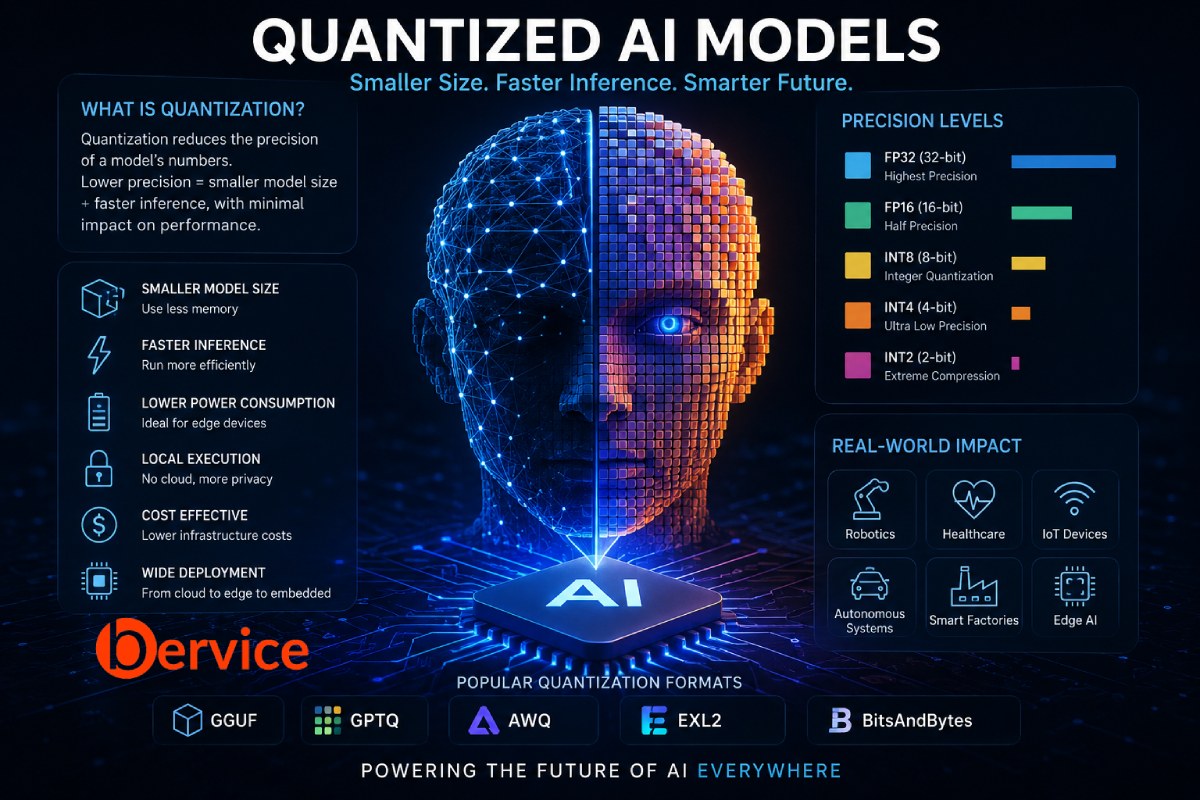
Instead of storing every weight as a 32-bit floating-point number (FP32), the model stores them using fewer bits, such as:
- FP16 (16-bit floating point)
- BF16 (Brain Floating Point)
- INT8 (8-bit integer)
- INT4 (4-bit integer)
- INT3
- INT2
- Mixed precision formats
Because each parameter occupies fewer bits, the model becomes significantly smaller and faster.
Think of it like compressing a high-resolution image.
The image still looks nearly identical, but it requires much less storage space.
Quantization performs a similar transformation for neural network parameters.
Why Are AI Models So Large?
Every AI model learns billions of numerical values called weights.
For example:
- 7 billion parameter model
- 13 billion parameter model
- 32 billion parameter model
- 70 billion parameter model
- 405 billion parameter model
If every parameter uses 32 bits:
7B parameters × 4 bytes ≈ 28 GB
After FP16:
≈14 GB
After INT8:
≈7 GB
After INT4:
≈3.5 GB
The reduction is enormous.
This is why quantization makes local AI practical.
Understanding Precision
Computers represent numbers using different precisions.
FP32
Standard floating point.
Highest accuracy.
Largest memory footprint.
Example:
3.14159274
FP16
Half precision floating point.
Almost identical performance for inference.
Uses half the memory.
INT8
Numbers become integers.
Instead of storing:
0.2384938
The system stores:
61
along with scaling information that reconstructs the approximate original value.
INT4
Only sixteen possible values exist.
Although this sounds extremely restrictive, modern AI models are surprisingly tolerant of such approximations.
This is one of the biggest discoveries in AI engineering during recent years.
How Quantization Works
Quantization transforms floating-point values into lower precision numbers.
Original weights:
0.73
0.41
−1.82
2.34
After quantization:
11
7
−29
37
A scale value is stored:
Real Value ≈ Integer × Scale
Instead of storing every precise decimal number, the model stores compact integers plus scaling factors.
During inference, hardware reconstructs approximate values on demand.
Types of Quantization
1. Post Training Quantization (PTQ)
This is the most common method.
The model is fully trained first.
Only afterward is it compressed.
Advantages:
- Very fast
- No retraining required
- Simple deployment
- Widely supported
Most downloadable LLMs use PTQ.
2. Quantization Aware Training (QAT)
The model is trained while simulating quantization.
During learning, the neural network adapts to low precision.
Advantages:
- Better accuracy
- Lower quality loss
- More stable INT4 models
Disadvantages:
- Longer training
- Higher computational cost
3. Dynamic Quantization
Weights are quantized.
Activations remain dynamic.
Often used in CPU inference.
4. Static Quantization
Both weights and activations are quantized.
Usually provides better performance.
Requires calibration data.
Common Quantization Formats
Modern AI communities have developed specialized formats optimized for different hardware.
Popular examples include:
GGUF
Optimized for local LLM inference.
Works exceptionally well with llama.cpp.
Supports many quantization levels.
Examples:
Q2_K
Q3_K
Q4_K_M
Q5_K_M
Q6_K
Q8_0
GPTQ
Designed primarily for GPU inference.
Fast.
Very popular for NVIDIA GPUs.
AWQ
Activation-aware quantization.
Maintains excellent model quality.
Excellent for edge inference.
EXL2
Designed for ExLlama.
Extremely fast GPU inference.
Excellent memory efficiency.
BitsAndBytes
Popular within Hugging Face.
Supports:
8-bit
4-bit
NF4
Double Quantization
How Are Quantized Models Created?
The process usually follows these stages.
Step 1
Train the original model.
This requires:
Thousands of GPUs
Weeks or months of computation
Massive datasets
Step 2
Export model weights.
Typically FP16 or BF16.
Step 3
Calibration
Representative datasets estimate which weights are most sensitive.
Step 4
Apply quantization algorithm.
Weights are compressed.
Scaling factors are calculated.
Errors are minimized.
Step 5
Validate
Benchmarks compare:
Reasoning
Coding
Mathematics
Language
Knowledge
Safety
The quantized model is accepted if accuracy remains sufficiently close to the original.
Why Do Quantized Models Still Work So Well?
This surprises many people.
The answer lies in redundancy.
Neural networks contain enormous redundancy.
Many parameters contribute only slightly to the final prediction.
Even when thousands or millions of values are approximated, the overall computation changes very little.
Modern transformers are remarkably tolerant of small numerical errors.
This property makes quantization possible.
Advantages of Quantized Models
Lower Memory Usage
The biggest benefit.
A model that required 32 GB may fit into only 8 GB.
Faster Inference
Less memory transfer.
More cache efficiency.
Higher throughput.
Lower Energy Consumption
Less data movement.
Reduced power draw.
Ideal for mobile AI.
Local Execution
No cloud dependency.
Better privacy.
Offline capability.
Lower Cost
Smaller infrastructure.
Fewer GPUs.
Reduced cloud expenses.
Edge Deployment
Industrial controllers
Medical devices
Robotics
Autonomous systems
IoT gateways
Construction equipment
Wearables
Smart factories
All benefit from quantized AI.
Limitations
Quantization is not perfect.
Possible disadvantages include:
Small reduction in accuracy.
More noticeable quality loss with aggressive INT2 or INT3 compression.
Occasional reasoning degradation.
Slightly weaker mathematical precision.
Potential hallucination increase in extremely compressed models.
Nevertheless, good INT4 models often preserve more than 95 to 99 percent of the original performance.
Can Quantized Models Be Fine Tuned?
Yes.
Modern methods include:
QLoRA
LoRA on 4-bit models
PEFT
These techniques allow users to train massive models using only a single consumer GPU.
This has democratized AI research.
Hardware That Supports Quantized Models
Quantized models run on a wide range of hardware.
Examples include:
Desktop CPUs
Gaming GPUs
Apple Silicon
Intel processors
AMD processors
NVIDIA GPUs
Jetson devices
Raspberry Pi
Industrial edge computers
Mobile phones
Dedicated AI accelerators
This flexibility enables AI to move beyond large data centers into real-world applications.
Real World Applications
Quantized AI powers numerous modern systems.
Examples include:
Offline chatbots
Industrial automation
PLC assistants
Autonomous robots
Healthcare devices
Factory inspection
Smart glasses
Voice assistants
Document analysis
Programming assistants
Embedded vision systems
Construction safety monitoring
Drones
Autonomous vehicles
Personal AI agents
Why Quantization Is Essential for Edge AI
Cloud AI introduces latency, bandwidth costs, privacy concerns, and dependence on internet connectivity.
Edge AI addresses these challenges by executing models directly on local devices.
Quantization is the enabling technology that makes this practical.
Instead of transmitting every request to remote servers, devices can perform intelligent reasoning locally with low latency and reduced energy consumption.
This is particularly valuable in environments where real-time responses and data privacy are critical.
The Future of Quantization
Research continues to push quantization further.
Emerging directions include:
Ultra-low-bit quantization (2-bit and 1-bit models)
Adaptive precision based on workload
Hardware-specific quantization
AI-designed quantization algorithms
Sparse plus quantized neural networks
Hybrid precision transformers
Lossless knowledge-preserving compression
As AI becomes increasingly embedded in everyday devices, quantization will play a central role in enabling efficient, scalable, and sustainable intelligence across consumer electronics, industrial systems, robotics, and edge computing platforms.
Conclusion
Quantized AI models represent one of the most significant breakthroughs in modern machine learning deployment. By converting high-precision neural network parameters into compact numerical representations, they dramatically reduce memory requirements, accelerate inference, lower energy consumption, and enable advanced AI capabilities on affordable hardware.
Their success demonstrates that intelligence does not necessarily depend on storing every parameter with maximum numerical precision. Instead, carefully engineered approximations allow sophisticated models to retain nearly all of their original performance while becoming far more accessible.
As quantization techniques continue to evolve alongside specialized AI hardware, the future of artificial intelligence will increasingly shift from centralized cloud infrastructure toward intelligent edge devices capable of delivering fast, private, and efficient AI experiences anywhere. Quantized models are not merely compressed versions of larger systems; they are the foundation of the next generation of practical, scalable, and ubiquitous artificial intelligence.
Connect with us : https://linktr.ee/bervice
Website : https://bervice.com