Introduction
Large Language Models (LLMs) have transformed the way humans interact with technology. They can write articles, generate code, answer questions, summarize documents, and assist with countless tasks. However, despite their impressive capabilities, traditional LLMs have an important limitation: they operate primarily on the information available within their training data and immediate context.
As artificial intelligence evolves, a new paradigm is emerging. Instead of relying on a single model to solve every problem, AI systems are increasingly being built around intelligent agents that can interact with external tools, services, databases, and environments. One of the most important developments enabling this evolution is the Model Context Protocol (MCP).
The combination of AI Agents and MCPs is creating systems that are significantly more capable, reliable, and useful than standalone LLMs.
The Limitation of Traditional LLMs
A standalone LLM is essentially a prediction engine. It generates the most likely next word based on patterns learned during training.
While this enables remarkable conversational abilities, several limitations remain:
Lack of Real-Time Knowledge
An LLM may not know recent events, updated regulations, or the current state of a system.
No Direct Access to External Systems
A model cannot naturally query databases, access APIs, read private documents, or perform actions in software applications unless special integrations exist.
Hallucination Risks
When information is missing, LLMs may generate answers that sound convincing but are partially or entirely incorrect.
Limited Memory
Traditional models only work within a context window and may struggle with long-running workflows.
These limitations create a gap between generating language and actually solving real-world problems.
What Are AI Agents?
An AI Agent is an intelligent system built around an LLM but enhanced with the ability to:
- Observe its environment
- Plan actions
- Use external tools
- Access knowledge sources
- Execute tasks
- Evaluate results
- Continue iterating until objectives are achieved
Instead of simply answering a question, an agent can actively work toward a goal.
For example:
A user asks:
“Find the best flight, compare hotel prices, calculate the total cost, and prepare a travel itinerary.”
A standalone LLM can describe how to do this.
An AI Agent can actually perform the steps.
The agent may:
- Search flight providers
- Compare hotels
- Check weather forecasts
- Calculate costs
- Generate a final itinerary
- Update recommendations based on new information
This transforms AI from a conversational assistant into a digital worker.
What Is MCP?
Model Context Protocol (MCP) is a standardized framework that allows AI models and agents to communicate with external systems in a consistent way.
Think of MCP as a universal connector between AI and the digital world.
Before MCP, every integration often required custom development.
A database needed one integration.
A CRM required another.
A cloud platform required another.
A document repository required another.
This created fragmentation and scalability challenges.
MCP introduces a common language that allows agents to discover and interact with tools, services, and resources more efficiently.
In many ways, MCP aims to do for AI integrations what HTTP did for the web.
How Agents Communicate with MCPs
The process generally follows several stages.
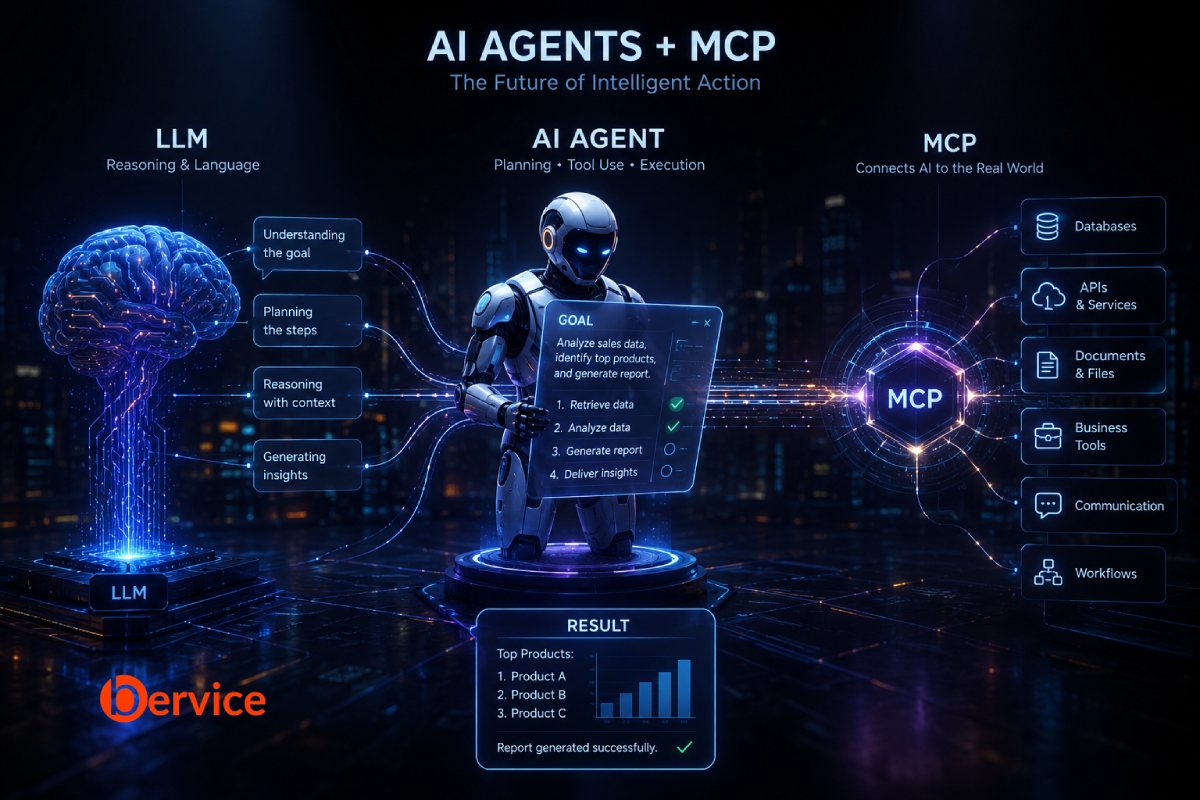
1. Understanding the Goal
The agent first interprets the user’s objective.
For example:
“Analyze our sales performance and identify the top-performing products this quarter.”
The agent recognizes that external data is required.
2. Discovering Available Resources
Through MCP, the agent can identify available tools such as:
- Databases
- Analytics platforms
- CRM systems
- Internal documents
- Business intelligence dashboards
- APIs
The agent determines which resources are relevant.
3. Retrieving Context
The agent requests information through MCP interfaces.
Instead of guessing, it retrieves actual data.
Examples include:
- Sales reports
- Customer records
- Inventory levels
- Market trends
- Financial statements
4. Reasoning on Real Data
The LLM component analyzes the retrieved information.
This dramatically improves accuracy because reasoning occurs on live data rather than assumptions.
5. Executing Actions
If authorized, the agent may perform actions such as:
- Updating records
- Sending emails
- Creating tickets
- Scheduling meetings
- Launching workflows
- Generating reports
6. Verifying Results
Advanced agents often perform self-checking.
They can compare outputs against source data, request additional information, or repeat steps when inconsistencies are detected.
This creates a feedback loop that improves reliability.
Why Agents + MCPs Outperform Standalone LLMs
Access to Live Information
Agents are no longer limited by training data.
They can retrieve the latest information directly from trusted sources.
Reduced Hallucinations
Because answers are grounded in real-world data, factual accuracy improves significantly.
Multi-Step Problem Solving
Agents can break complex objectives into smaller tasks and execute them sequentially.
Tool Usage
The ability to use calculators, databases, search engines, APIs, and software platforms extends capabilities far beyond text generation.
Persistent Workflows
Agents can manage long-running processes that would be impossible for a traditional chat session.
Action-Oriented Intelligence
Instead of merely explaining how to perform a task, agents can perform it.
This represents a major shift from knowledge generation to task completion.
A Real-World Example
Imagine a hiring platform.
A traditional LLM might answer:
“How should I evaluate candidates?”
An Agent connected through MCP could:
- Access candidate profiles
- Review verified certifications
- Analyze project portfolios
- Compare skill assessments
- Generate rankings
- Schedule interviews
- Update recruitment systems
The difference is enormous.
The LLM provides advice.
The Agent delivers outcomes.
The Future of AI Systems
The future of AI is unlikely to be dominated by isolated models.
Instead, it will consist of networks of specialized agents connected to vast ecosystems of tools, services, and data sources through protocols such as MCP.
Organizations are already moving toward architectures where:
- LLMs provide reasoning
- MCP provides connectivity
- Agents provide execution
Together, they create systems capable of handling increasingly sophisticated tasks.
This shift may be as significant as the transition from static websites to interactive web applications.
Conclusion
Large Language Models laid the foundation for modern AI, but their true potential emerges when combined with intelligent agents and Model Context Protocols.
LLMs excel at reasoning and language generation.
MCP enables structured access to the digital world.
Agents orchestrate planning, decision-making, tool usage, and execution.
The result is a new generation of AI systems that do not merely answer questions but actively solve problems, complete tasks, and interact with real-world environments.
As MCP adoption grows and agent capabilities mature, the distinction between information retrieval and intelligent action will continue to blur. The most powerful AI systems of the future will not be standalone models. They will be connected, contextual, and capable agents operating across entire digital ecosystems.
Connect with us : https://linktr.ee/bervice
Website : https://bervice.com