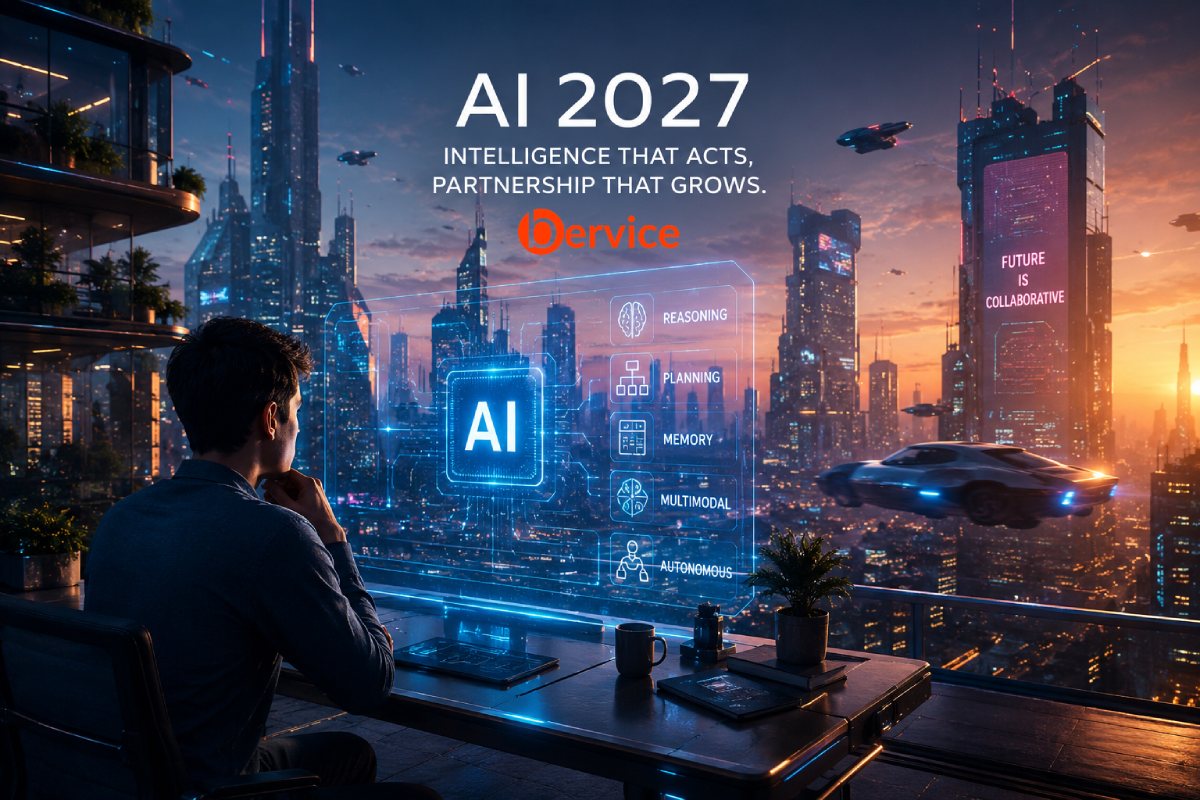
Introduction
Large Language Models (LLMs) have evolved from impressive text generators into foundational digital infrastructure. In just a few years, they have transformed software development, education, research, customer support, content creation, and business operations.
Yet today’s models are likely only an early chapter in a much larger story.
As we move toward 2027, the question is no longer whether AI will become more capable. The real question is: What direction is AI development taking, and how will LLMs reshape the relationship between humans, software, and knowledge?
The next generation of AI will not simply be larger. It will be more reliable, more autonomous, more personalized, and increasingly integrated into the physical and digital world.
The Era of Bigger Models Is Ending
For several years, AI progress was largely driven by scale.
Researchers trained larger models on larger datasets using more computing power. This approach produced remarkable improvements, but it is becoming increasingly expensive and inefficient.
By 2027, the industry is expected to focus less on raw parameter count and more on intelligence efficiency.
Future models will likely achieve superior performance through:
- Better architectures
- Advanced reasoning systems
- Specialized expert modules
- Improved memory systems
- More efficient training methods
The competition will gradually shift from “Who has the biggest model?” to “Who has the most useful and trustworthy model?”
Reasoning Will Become More Important Than Knowledge
Today’s leading models already possess enormous amounts of information.
The next challenge is not acquiring more facts. It is using existing knowledge more effectively.
Future LLMs will increasingly focus on:
- Multi-step reasoning
- Strategic planning
- Decision making
- Error correction
- Self-verification
Instead of merely predicting the next word, AI systems will spend more time validating their own conclusions before responding.
This shift may represent one of the most important developments in AI.
In many domains, users no longer need a model that knows more facts. They need a model that makes fewer mistakes.
AI Agents Will Become Mainstream
One of the strongest trends heading into 2027 is the rise of AI agents.
Current chatbots respond to prompts.
Future agents will perform tasks.
An AI agent may:
- Read emails
- Schedule meetings
- Analyze documents
- Write software
- Monitor systems
- Manage projects
- Coordinate with other agents
Rather than answering a question, the agent will pursue a goal.
For example:
Instead of asking:
“Can you create a report?”
Users may simply say:
“Monitor our sales data and send a weekly executive report.”
The AI will continuously execute the task without requiring further instructions.
This transition from conversational AI to autonomous AI may be as significant as the transition from search engines to smartphones.
Multi-Agent Systems Will Emerge
By 2027, many advanced systems may not rely on a single AI model.
Instead, multiple specialized agents will collaborate.
Imagine:
- One agent specializes in finance.
- One agent specializes in legal compliance.
- One agent specializes in software engineering.
- One agent specializes in communication.
Together they form an AI team.
This architecture allows organizations to build virtual workforces capable of handling increasingly complex projects.
The future may involve managing AI employees alongside human employees.
Long-Term Memory Will Transform User Experiences
Most AI systems today have limited memory.
Future models will remember context across months or even years.
An AI assistant may know:
- Your preferences
- Your work history
- Your projects
- Your goals
- Your communication style
- Your expertise level
This creates a fundamentally different experience.
Instead of repeatedly explaining yourself, the AI becomes a continuously improving collaborator.
The distinction between “using software” and “working with a digital colleague” may begin to disappear.
Verification Will Become a Competitive Advantage
One of the biggest problems facing AI today is hallucination.
Models can produce answers that sound convincing but are incorrect.
As AI becomes integrated into critical workflows, verification will become essential.
By 2027, leading systems will likely incorporate:
- Source validation
- Fact checking
- Citation generation
- Confidence scoring
- Independent verification layers
The most valuable AI systems may not be the smartest.
They may be the most trustworthy.
In many industries, reliability will become more important than raw intelligence.
Personalized Models Will Replace Generic Models
Today’s AI systems serve billions of users with relatively similar behavior.
Future AI may become highly personalized.
Each user could have:
- Personal memory
- Personal knowledge base
- Personal workflows
- Personal communication style
- Personal decision preferences
Over time, AI assistants may evolve into unique digital companions rather than interchangeable software products.
Two people using the same AI platform could effectively be interacting with completely different systems.
The Rise of Real-Time Multimodal Intelligence
Text is only one form of information.
Future LLMs will seamlessly combine:
- Text
- Images
- Audio
- Video
- Documents
- Sensor data
- Live internet information
An AI assistant may watch a video, listen to a meeting, analyze spreadsheets, inspect images, and generate recommendations simultaneously.
The distinction between language models and general-purpose intelligence systems will continue to blur.
AI Will Become an Operating Layer for Businesses
Today, businesses use software tools.
By 2027, many organizations may operate through AI orchestration layers.
AI could:
- Route information
- Assign tasks
- Monitor performance
- Generate reports
- Manage workflows
- Coordinate teams
In this model, software becomes the infrastructure while AI becomes the management layer.
Organizations that successfully integrate AI into their operations may achieve productivity gains that were previously impossible.
Human Roles Will Shift Rather Than Disappear
A common fear is that AI will replace humans entirely.
History suggests a more nuanced outcome.
Many tasks will become automated.
However, new responsibilities will emerge:
- AI supervision
- AI governance
- Verification
- Strategic decision making
- Creativity
- Human relationship management
The highest-value professionals may become those who can effectively direct, evaluate, and collaborate with AI systems.
The future workforce may be defined not by individual productivity, but by the ability to leverage teams of intelligent agents.
Toward 2027: The Beginning of a New Computing Paradigm
The development of LLMs is moving toward systems that are:
- More autonomous
- More reliable
- More personalized
- More multimodal
- More integrated into daily life
The most important change is not that AI will become smarter.
It is that AI will become increasingly capable of acting.
For decades, computers have been tools that waited for instructions.
The next generation of AI may become active collaborators that pursue goals, solve problems, and continuously assist humans in ways that were previously impossible.
By 2027, we may look back at today’s chatbots the same way we look at early mobile phones: groundbreaking for their time, but only a glimpse of what was coming next.
The future of AI is not simply bigger models.
It is a world where intelligence itself becomes a scalable resource.
Connect with us : https://linktr.ee/bervice
Website : https://bervice.com