Introduction
Artificial Intelligence agents are rapidly evolving from simple assistants into autonomous digital entities capable of performing complex tasks on behalf of users. Today’s agents can schedule meetings, manage emails, conduct research, analyze data, and interact with various online services. However, as their capabilities grow, so do concerns about privacy, surveillance, data ownership, and security.
The next generation of AI agents will not be defined solely by intelligence or automation. Their success will largely depend on how effectively they protect user privacy while maintaining usefulness. In a world where personal data has become one of the most valuable resources, privacy-preserving AI agents may become one of the most important technological developments of the coming decade.
The Privacy Problem with Today’s AI Agents
Most current AI systems operate through centralized cloud infrastructures. User conversations, documents, preferences, browsing history, and behavioral patterns are often processed on remote servers. While this model enables powerful computation, it also creates significant privacy concerns.
Users frequently surrender large amounts of personal information without fully understanding how it is stored, analyzed, or shared. Centralized systems create attractive targets for cybercriminals, data brokers, and even state-level surveillance programs. As AI agents gain access to calendars, emails, financial accounts, health records, and smart home devices, the risks become even greater.
The future demands a fundamentally different architecture.
The Rise of Personal AI Agents
Future AI agents will increasingly function as personal digital representatives rather than cloud-based services.
Instead of sending every interaction to a centralized server, a user’s primary AI agent will operate locally on personal devices such as smartphones, laptops, home servers, or private edge-computing hardware.
This shift offers several advantages:
- User data remains under direct control.
- Sensitive information rarely leaves the device.
- Attack surfaces are dramatically reduced.
- Data ownership becomes clear and enforceable.
Rather than users adapting to platforms, platforms will adapt to user-owned agents.
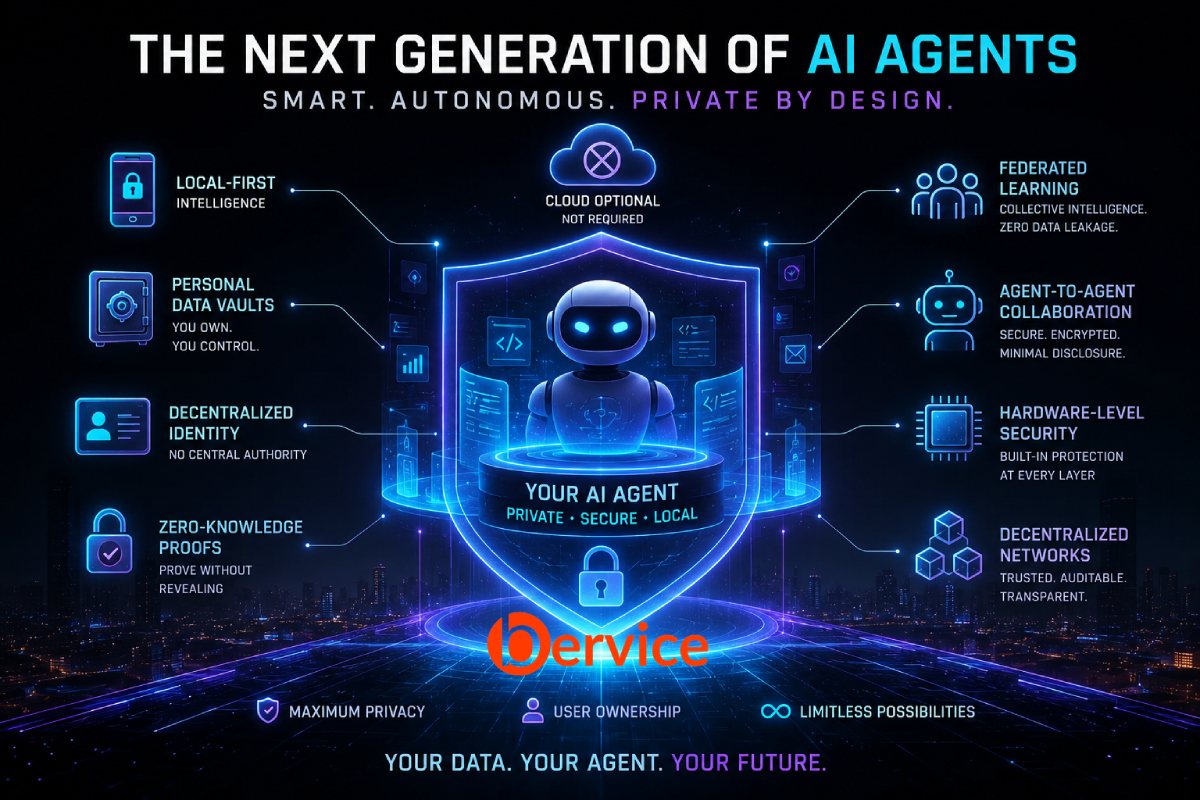
Local-First Intelligence
One of the most significant trends will be the movement toward Local-First AI.
Advances in model compression, specialized AI chips, and efficient architectures are making it possible to run powerful language models directly on consumer hardware. Future agents may perform most reasoning, planning, memory management, and decision-making locally.
Cloud resources would only be used when absolutely necessary.
In such systems:
- Conversations remain private.
- Personal memories stay on-device.
- Sensitive documents never leave local storage.
- Offline functionality becomes possible.
The cloud becomes an optional enhancement rather than a mandatory dependency.
Multi-Agent Privacy Ecosystems
Future AI systems will likely consist of multiple specialized agents working together.
Imagine a personal ecosystem containing:
- A financial agent
- A healthcare agent
- A legal agent
- A communication agent
- A research agent
Rather than sharing all information globally, each agent would operate within strict permission boundaries.
For example, a healthcare agent would never gain access to financial records unless explicitly authorized. Similarly, a research agent could perform internet searches without exposing personal medical data.
This compartmentalized design mirrors modern cybersecurity principles and significantly limits the impact of potential breaches.
Zero-Knowledge Communication
One of the most promising technologies for privacy-preserving agents is Zero-Knowledge Proofs.
Future agents may prove information without revealing the underlying data.
Examples include:
- Proving age without revealing birthdate.
- Proving income eligibility without exposing bank records.
- Verifying identity without transmitting personal documents.
- Demonstrating ownership without revealing assets.
By combining AI agents with cryptographic verification systems, users could interact with digital services while exposing minimal information.
This represents a major shift away from the current model of excessive data collection.
Personal Data Vaults
The future may replace centralized user accounts with encrypted personal data vaults.
Instead of every service storing separate copies of personal information, users would maintain a single encrypted vault controlled entirely by them.
AI agents would act as secure gatekeepers.
When an application requests information, the agent evaluates:
- Who is requesting it?
- Why is it needed?
- What is the minimum necessary disclosure?
- How long should access be granted?
This approach dramatically reduces data duplication across the internet and minimizes exposure during breaches.
Decentralized Identity Systems
Passwords and centralized identity providers may gradually disappear.
Future agents could manage decentralized identities built on cryptographic credentials.
Users would possess portable identities that work across platforms without surrendering personal information to a central authority.
Benefits include:
- Reduced identity theft.
- Elimination of password reuse.
- Greater user ownership.
- Improved resistance to large-scale data leaks.
AI agents would continuously monitor identity usage and detect suspicious activity before damage occurs.
Federated Learning and Collective Intelligence
One challenge for privacy-focused AI is improving models without collecting user data.
Federated learning provides a solution.
Instead of uploading raw information, local agents train on-device. Only anonymous model improvements are shared.
This allows millions of agents to collectively improve intelligence while preserving privacy.
The result is a system where:
- Knowledge grows globally.
- Data remains local.
- Personal information is never centralized.
This may become one of the foundational technologies behind future AI ecosystems.
Agent-to-Agent Negotiation
The future internet may increasingly consist of agents interacting with other agents.
Your AI agent could negotiate directly with:
- Banking agents
- Shopping agents
- Travel agents
- Healthcare agents
- Government service agents
Rather than exposing user information to multiple websites, agents would exchange only the necessary credentials and permissions.
Users would interact primarily with their trusted personal agent, dramatically reducing privacy risks.
Privacy-Aware Memory Systems
Modern AI systems often struggle with balancing memory and privacy.
Future agents will likely use layered memory architectures.
These may include:
Temporary Memory
Used for short-term tasks and automatically deleted.
Personal Memory
Stored locally and encrypted.
Shared Memory
Explicitly approved by users for collaboration.
Anonymous Collective Memory
Used to improve models without identifying individuals.
Users would gain fine-grained control over what is remembered, forgotten, shared, or deleted.
Hardware-Level Privacy Protection
Software alone cannot guarantee privacy.
Future devices may include dedicated AI security processors responsible for:
- Encryption management
- Secure model execution
- Identity verification
- Permission enforcement
Sensitive computations could occur within isolated hardware environments inaccessible even to operating systems.
This would significantly strengthen protection against malware and advanced attacks.
The Role of Blockchain and Decentralized Networks
Blockchain technologies may provide trust infrastructure rather than data storage.
Future agents could use decentralized networks to:
- Verify identities
- Record permissions
- Manage digital ownership
- Audit access requests
Importantly, personal information would remain encrypted and off-chain.
The blockchain would serve as a verification layer rather than a repository of private data.
Challenges Ahead
Despite these advancements, significant challenges remain.
Future privacy-focused agents must address:
- Model security vulnerabilities.
- Adversarial attacks.
- Hardware trust issues.
- Regulatory compliance.
- Agent impersonation.
- Ethical decision-making.
- User consent management.
Balancing convenience, intelligence, and privacy will remain one of the most difficult engineering problems of the AI era.
Conclusion
The next generation of AI agents will likely move away from today’s centralized, data-hungry architectures toward user-owned, privacy-preserving ecosystems. Local-first computing, decentralized identities, encrypted personal data vaults, federated learning, zero-knowledge cryptography, and secure multi-agent collaboration will form the foundation of this transformation.
The ultimate goal is not merely to create smarter agents. It is to create agents that act as trusted guardians of user data rather than collectors of it.
In the future, the most successful AI agents may not be those that know the most about their users, but those that can accomplish the most while learning the least. Privacy will no longer be a feature. It will become a fundamental design principle of intelligent systems.
Connect with us : https://linktr.ee/bervice
Website : https://bervice.com