From Beginner Concepts to Advanced Architecture
Artificial Intelligence is rapidly evolving from simple chatbots into fully autonomous systems capable of reasoning, planning, coding, searching, analyzing documents, controlling software, and interacting with real-world services. One of the technologies helping enable this transformation is the rise of MCP Servers.
For many people, MCP sounds highly technical and difficult to understand. However, the core idea is actually simple:
MCP Servers allow AI models to safely connect with tools, software, databases, APIs, and external systems in a structured and controlled way.
This article explains MCP Servers from beginner level to advanced professional architecture.
What Is an MCP Server?
An MCP Server is a system that allows an AI model to communicate with external tools and services using a standardized protocol.
Think of it like this:
- The AI model is the “brain”
- The MCP Server is the “bridge”
- External systems are the “hands and eyes”
Without MCP, an AI model mostly works only with text inside its own context window.
With MCP, the AI can:
- Read files
- Search databases
- Access APIs
- Use business tools
- Execute workflows
- Analyze repositories
- Interact with calendars, CRMs, and messaging systems
- Trigger automations
In simple terms:
MCP turns AI from a passive chatbot into an active software operator.
Why MCP Servers Became Important
Early AI assistants had a major limitation:
They could answer questions, but they could not actually do things.
For example:
- They could explain how to create a GitHub issue
- But they could not create the issue themselves
- They could describe how to query a database
- But they could not run the query
- They could help write emails
- But they could not access inboxes safely
As AI systems became more powerful, companies needed a secure and standardized method for AI-to-tool communication.
This is where MCP architecture became valuable.
The Core Idea Behind MCP
At its heart, MCP creates a structured communication layer between:
- AI Models
- External Tools
- Data Sources
- Applications
- Security Systems
Instead of giving direct unrestricted access to systems, MCP defines:
- What tools exist
- What actions are allowed
- What schemas are used
- What permissions exist
- What outputs should look like
This dramatically improves:
- Safety
- Reliability
- Scalability
- Interoperability
- Governance
A Simple Real-World Analogy
Imagine an AI assistant working inside a company.
Without MCP:
- The AI is locked inside a room with books.
With MCP:
- The AI gains access to:
- Slack
- Gmail
- GitHub
- Databases
- Calendars
- APIs
- Cloud infrastructure
But importantly:
The AI does not receive unlimited raw access.
Instead, MCP acts like a receptionist and security gate.
The AI must request actions through structured interfaces.
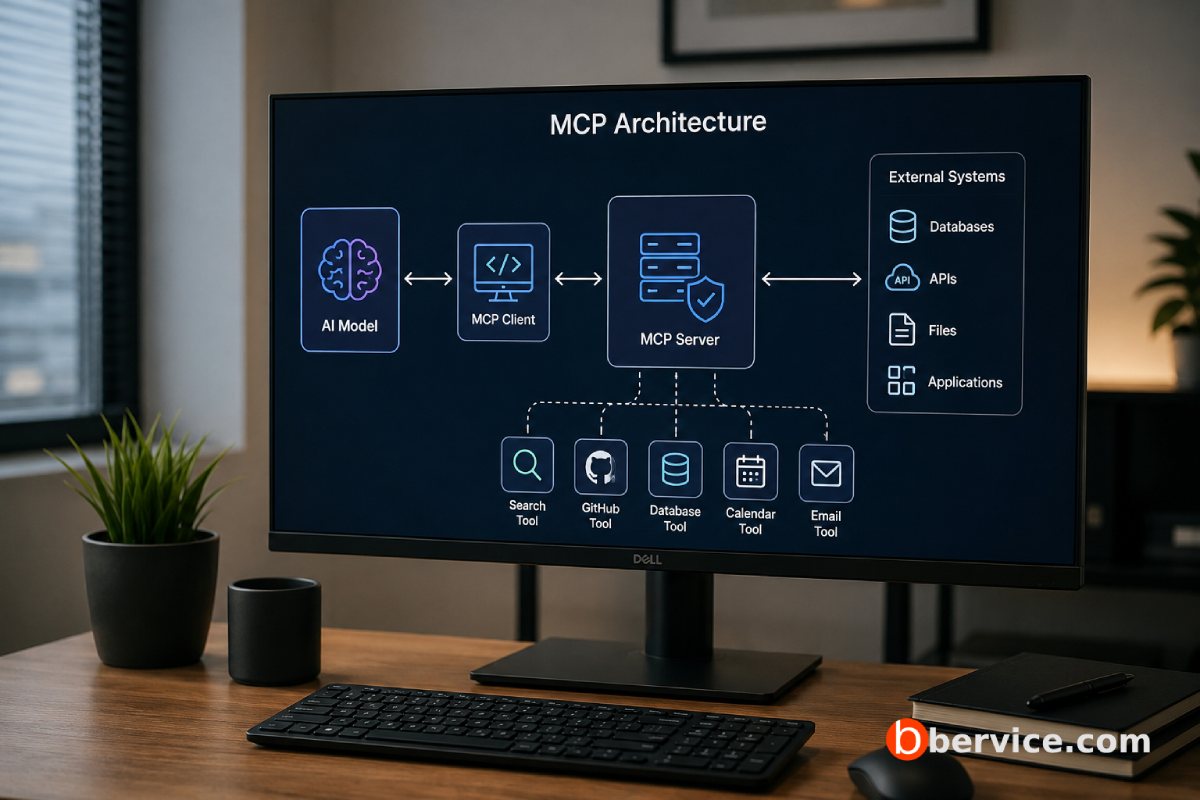
Basic Components of an MCP System
An MCP ecosystem usually contains several components.
1. AI Model
This could be an LLM such as:
- OpenAI GPT models
- Anthropic Claude
- Google Gemini
- Open-source local models
The model handles reasoning and decision-making.
2. MCP Client
The MCP client is responsible for communication between the AI and MCP Server.
It sends:
- Tool requests
- Parameters
- Context
- Structured queries
And receives:
- Responses
- Data
- Tool outputs
- Status messages
3. MCP Server
The server exposes capabilities to the AI.
Examples:
- File access
- GitHub actions
- Database queries
- Calendar management
- Browser automation
- Cloud infrastructure commands
The MCP Server defines exactly how these operations work.
4. Tools
Each tool represents a capability.
Examples:
- SearchTool
- GitHubTool
- SQLTool
- SlackTool
- CalendarTool
- BrowserTool
Every tool includes:
- Input schema
- Output schema
- Permission rules
- Error handling
Why Standardization Matters
Before MCP-like systems, every AI integration was custom-built.
That created problems:
- Different formats
- Inconsistent permissions
- Security risks
- Difficult maintenance
- Poor interoperability
MCP introduces consistency.
An AI can theoretically connect to many different systems using a shared structure.
This is similar to how:
- HTTP standardized the web
- USB standardized hardware connectivity
- REST standardized APIs
MCP aims to standardize AI-to-system interaction.
How MCP Works Step by Step
Let’s walk through a practical example.
Suppose a CEO asks an AI assistant:
“Show me all critical GitHub issues opened this week.”
Step 1: User Request
The user sends the message.
Step 2: AI Reasoning
The model determines:
- GitHub access is required
- Issue filtering is required
- Date filtering is required
Step 3: MCP Tool Discovery
The AI asks the MCP Server:
“What GitHub tools are available?”
The MCP Server responds with tool definitions.
Step 4: Structured Tool Call
The AI generates a structured request like:
{
  "tool": "github.search_issues",
  "repo": "company/project",
  "label": "critical",
  "since": "7_days"
}
Step 5: Tool Execution
The MCP Server executes the operation securely.
Step 6: Result Delivery
The server returns structured data.
Step 7: AI Interpretation
The model summarizes the results for the user.
MCP vs Traditional APIs
Many beginners ask:
“Is MCP just another API?”
Not exactly.
Traditional APIs are usually designed for humans or applications.
MCP systems are designed specifically for AI agents.
That means they focus heavily on:
- Context-awareness
- Tool discovery
- Structured reasoning
- Permission isolation
- AI-friendly schemas
- Multi-step workflows
MCP is more like an orchestration layer for AI systems.
MCP and AI Agents
MCP Servers became especially important with the rise of AI Agents.
An AI Agent is an AI system capable of:
- Planning
- Executing tasks
- Using tools
- Monitoring outcomes
- Iterating automatically
Agents require reliable access to tools.
MCP provides that infrastructure.
Without MCP-like architectures, agents become chaotic and unsafe.
Security in MCP Systems
Security is one of the biggest reasons MCP architecture matters.
Imagine giving an AI unrestricted shell access.
That could become dangerous very quickly.
MCP systems reduce risks through:
Permission Isolation
Each tool only exposes allowed operations.
Authentication Layers
OAuth, API keys, tokens, and scoped credentials control access.
Sandboxing
Operations may execute in isolated environments.
Audit Logs
Every tool action can be logged and reviewed.
Policy Enforcement
Admins can restrict:
- File access
- Commands
- Databases
- External communications
MCP in Enterprise AI
Large companies increasingly use MCP-like systems internally.
Common enterprise use cases include:
Executive Intelligence
AI analyzes:
- Slack discussions
- Emails
- GitHub activity
- Jira tickets
- Calendar events
Then produces operational summaries.
Engineering Operations
AI assistants can:
- Review PRs
- Analyze deployments
- Detect incidents
- Track technical debt
- Monitor infrastructure
Knowledge Management
AI can search:
- Internal documentation
- PDFs
- Databases
- Wikis
- Research systems
Automation Pipelines
AI can orchestrate workflows across multiple departments.
MCP and Local AI
One of the most exciting areas is local AI infrastructure.
Many organizations do not want sensitive company data sent to public AI clouds.
Local MCP architectures allow:
- Local LLMs
- Local databases
- Private tools
- On-premise infrastructure
This improves:
- Privacy
- Compliance
- Data sovereignty
- Security
Especially in industries like:
- Finance
- Healthcare
- Government
- Defense
- Enterprise SaaS
Advanced MCP Concepts
As systems grow larger, MCP architectures become more sophisticated.
Multi-Agent MCP Systems
Instead of one AI agent, organizations may use multiple specialized agents.
Examples:
- Finance Agent
- Security Agent
- Engineering Agent
- HR Agent
- Research Agent
Each agent may access different MCP tools.
Dynamic Tool Discovery
Advanced MCP Servers allow tools to appear dynamically.
The AI can learn available capabilities at runtime.
This enables adaptive systems.
Context-Aware Permissioning
Modern systems may change permissions based on:
- User identity
- Risk level
- Current workflow
- Organization policies
Event-Driven MCP Architecture
Instead of waiting for prompts, systems may react to events.
Example:
- GitHub deployment fails
- MCP emits event
- AI investigates automatically
- AI creates incident summary
- AI alerts engineering teams
MCP and Knowledge Graphs
Advanced enterprise systems combine MCP with knowledge graphs.
This allows AI to understand relationships between:
- People
- Tasks
- Repositories
- Topics
- Decisions
- Risks
- Systems
This creates far more intelligent operational reasoning.
Common Technologies Used with MCP
MCP ecosystems often integrate with:
Databases
- PostgreSQL
- MongoDB
- Redis
- Elasticsearch
Communication Platforms
- Slack
- Discord
- Telegram
- Gmail
Development Platforms
- GitHub
- GitLab
- CI/CD systems
Cloud Infrastructure
- AWS
- Azure
- Google Cloud
AI Frameworks
- LangChain
- LangGraph
- Agent frameworks
- Workflow orchestration systems
Challenges of MCP Systems
Despite their power, MCP architectures also introduce challenges.
Complexity
Large MCP ecosystems become difficult to manage.
Security Risks
Improper permissions can expose sensitive systems.
Tool Reliability
AI agents depend heavily on tool quality.
Context Explosion
Too many tools may overwhelm reasoning systems.
Governance
Organizations need policies controlling AI behavior.
The Future of MCP Servers
MCP-like architectures are likely to become foundational infrastructure for AI-native companies.
In the future, many software systems may expose AI-native interfaces by default.
Instead of humans manually clicking dashboards:
- AI agents will coordinate systems
- AI will analyze operations continuously
- AI will automate business workflows
- AI will monitor infrastructure in real time
MCP Servers are a major step toward that future.
Beginner Learning Path for MCP
If you want to learn MCP practically:
Beginner Stage
Learn:
- APIs
- JSON
- HTTP
- Authentication
- Basic AI prompting
Intermediate Stage
Learn:
- Tool calling
- AI agents
- LangChain/LangGraph
- Workflow orchestration
- Database integration
Advanced Stage
Learn:
- Distributed systems
- Security architecture
- Event-driven systems
- Multi-agent orchestration
- Knowledge graphs
- AI governance
Final Thoughts
MCP Servers represent an important evolution in Artificial Intelligence infrastructure.
They transform AI from:
“A model that talks”
into:
“A system that can safely operate within real digital environments.”
For beginners, MCP may initially sound complicated.
But fundamentally, the idea is simple:
AI needs structured bridges to interact with the real world safely and intelligently.
As AI agents become more capable, MCP architectures will likely become as important to AI systems as APIs became to the internet era.
The future of AI is not just smarter models.
It is smarter connections between models, tools, data, and real-world operations.
Connect with us : https://linktr.ee/bervice
Website : https://bervice.com