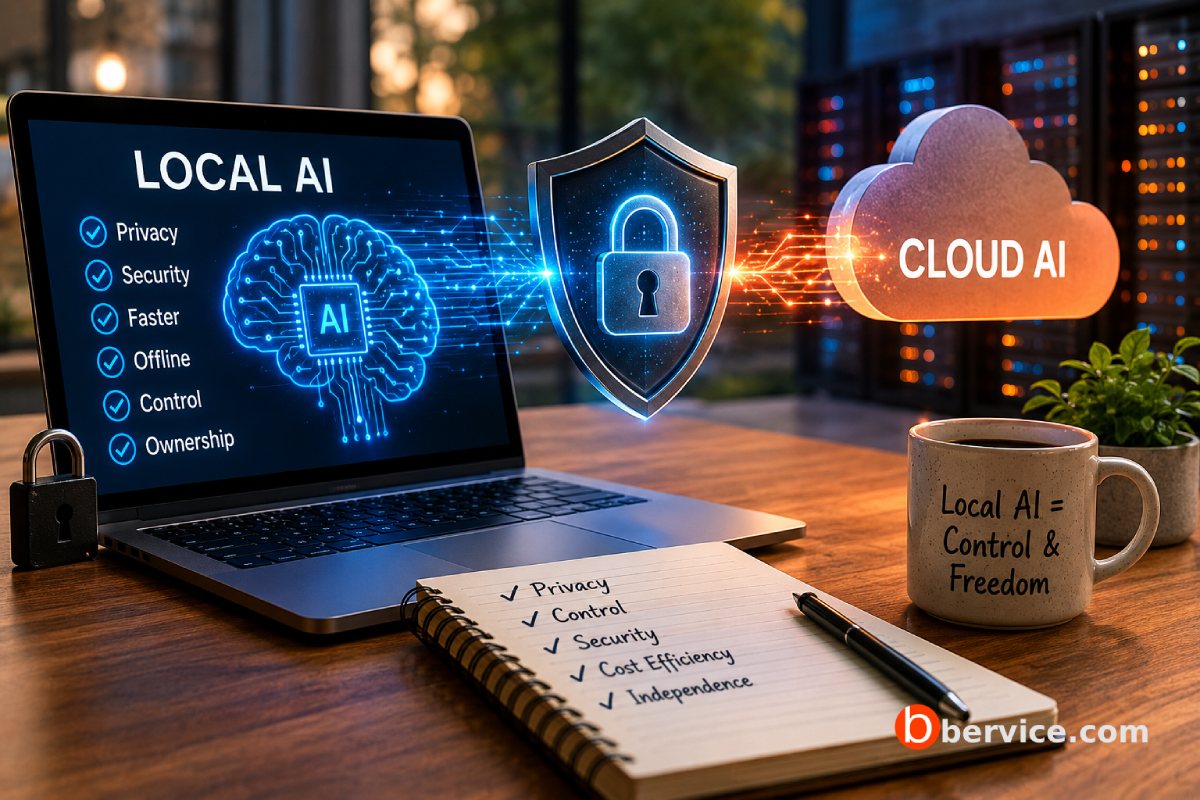
Introduction
Artificial intelligence is becoming a core layer of modern software, business operations, and personal productivity. Most people experience AI through cloud-based platforms, where data is sent to remote servers, processed by large models, and returned as answers, recommendations, summaries, or automated actions.
Cloud AI has clear advantages: it is easy to access, powerful, scalable, and constantly updated. However, it also creates important concerns around privacy, cost, dependency, latency, data control, and regulatory compliance. This is why local AI is becoming more important.
Local AI means running AI models directly on a user’s device, company server, private data center, edge device, or internal infrastructure instead of relying fully on external cloud providers. It can be used on laptops, desktops, mobile devices, industrial machines, company servers, or private GPU clusters.
The future of AI will likely not be purely local or purely cloud-based. It will be hybrid. But understanding the advantages of local AI is essential for companies, developers, and users who want more control over their data and digital intelligence.
1. Stronger Data Privacy
One of the biggest advantages of local AI is privacy. In a cloud-based system, user data usually needs to leave the device or company environment and travel to an external server. Even if the provider has strong security policies, the data still moves outside the user’s direct control.
With local AI, sensitive information can stay inside the device or private infrastructure. This is especially important for:
- Healthcare data
- Legal documents
- Financial records
- Company strategy
- Customer information
- Source code
- Internal messages
- Personal files
- Government or defense-related data
For example, a company may want to analyze internal Slack messages, emails, contracts, code repositories, and meeting notes. Sending all of this information to an external AI provider may create serious privacy and compliance risks. A local AI system can process this data without exposing it to third-party infrastructure.
Privacy is not only about hiding data. It is about control. Local AI gives users and organizations more control over what is processed, where it is stored, and who can access it.
2. Better Security Control
Cloud AI depends on external infrastructure. Even if the cloud provider is secure, the organization must trust the provider’s security model, access policies, data handling practices, and internal controls.
Local AI allows organizations to design their own security architecture. They can decide:
- Where the model runs
- Who can access it
- How logs are stored
- Whether data is encrypted
- Which systems can connect to it
- How long data is retained
- Which departments can use which features
This is very important for companies with strict security requirements. A local AI deployment can be placed behind internal firewalls, connected only to approved systems, and monitored by the company’s own security team.
Of course, local AI is not automatically secure. Poor local setup can still be dangerous. But the advantage is that the organization has direct control over the security environment instead of depending entirely on a third party.
3. Reduced Dependency on External Providers
Cloud-based AI creates dependency. If a company builds its product or workflow entirely around one AI provider, it becomes exposed to that provider’s pricing, API limits, policy changes, downtime, and product decisions.
For example, a cloud AI provider may:
- Increase prices
- Change model behavior
- Remove a feature
- Limit access to certain regions
- Modify API rules
- Introduce stricter content policies
- Experience outages
- Change data usage terms
Local AI reduces this dependency. Organizations can run open-source or privately hosted models and maintain more control over their AI stack.
This does not mean cloud AI should be avoided. Cloud models can still be very useful, especially for high-performance tasks. But local AI gives companies a strategic fallback and reduces vendor lock-in.
4. Lower Long-Term Cost for High-Volume Use
Cloud AI is convenient, but usage-based pricing can become expensive at scale. Every request, token, image, audio file, or document analysis may create a recurring cost.
For small usage, cloud AI may be cheaper. But for companies processing large volumes of internal data, customer support tickets, documents, logs, code, or messages, local AI can become more cost-effective over time.
Local AI has upfront costs, such as:
- Hardware
- GPU servers
- Setup time
- Model optimization
- Maintenance
- Technical staff
However, once the infrastructure is running, the marginal cost of each additional request can be much lower than repeated cloud API calls.
This is especially valuable for businesses that need continuous AI processing, such as:
- Document analysis platforms
- Customer service automation
- Internal knowledge search
- Code review systems
- Data extraction pipelines
- Real-time monitoring systems
- AI assistants for employees
For high-volume and predictable workloads, local AI can provide better cost control.
5. Lower Latency and Faster Response
Cloud AI requires data to travel from the user’s device to a remote server and back. This creates latency, especially when network quality is poor or the server is geographically far away.
Local AI can respond faster because the processing happens closer to the user or directly on the device. This is useful for real-time applications such as:
- Voice assistants
- Robotics
- Autonomous systems
- Industrial monitoring
- Medical devices
- Security cameras
- Offline translation
- Real-time coding assistants
- Augmented reality systems
In many real-world environments, milliseconds matter. A robot, drone, factory sensor, or medical device cannot always wait for a cloud response. Local AI enables faster decision-making at the edge.
6. Offline Availability
Cloud AI requires internet access. If the connection is lost, the AI system may stop working. This is a major weakness in areas with unreliable networks or in use cases where connectivity cannot be guaranteed.
Local AI can work offline. This is valuable for:
- Remote locations
- Ships and aircraft
- Construction sites
- Farms
- Military environments
- Disaster response
- Field research
- Factories with restricted networks
- Privacy-sensitive offices
Offline AI makes intelligent systems more resilient. A local model can continue answering questions, analyzing data, or assisting users even when the internet is unavailable.
This is one of the strongest advantages of local AI for mission-critical environments.
7. Better Compliance and Data Sovereignty
Many industries and countries have strict rules about where data can be stored and processed. Cloud AI may create legal and compliance challenges if data is sent across borders or handled by third-party providers.
Local AI can help organizations comply with data sovereignty requirements by keeping data inside a specific country, company, or regulated environment.
This is especially relevant for:
- Healthcare
- Banking
- Insurance
- Government
- Education
- Legal services
- Critical infrastructure
- Enterprise software
For example, a healthcare organization may need to ensure that patient data never leaves its internal systems. A local AI model can analyze medical records while keeping the data inside the approved infrastructure.
Compliance does not automatically become easy with local AI, but local deployment gives organizations more control over regulatory boundaries.
8. More Customization and Model Control
Cloud AI providers usually expose models through APIs. The user can adjust prompts, parameters, and sometimes fine-tuning options, but the core model remains controlled by the provider.
Local AI gives developers and companies deeper control. They can:
- Choose the model
- Fine-tune it on internal data
- Optimize it for specific hardware
- Modify inference settings
- Control system prompts
- Build custom safety layers
- Integrate it deeply with internal tools
- Use specialized models for different departments
This is very useful when a company needs AI that understands its own domain, vocabulary, workflows, documents, and business logic.
For example, a legal firm may want a local model trained or adapted for contract review. A software company may want an internal coding assistant that understands its private codebase. A manufacturing company may want an AI model specialized in machine maintenance data.
Local AI allows deeper specialization.
9. Protection of Intellectual Property
Companies often hold sensitive intellectual property, such as source code, product plans, formulas, designs, research documents, client lists, pricing models, and business strategies.
Using cloud AI for this information can create risk if the company does not fully understand the provider’s data policies or if employees paste sensitive data into public AI tools.
Local AI helps reduce this risk. Employees can use AI assistance without sending intellectual property outside the company environment.
This is one reason many businesses are becoming interested in private AI assistants. They want the productivity benefits of AI without exposing their internal knowledge.
For companies, the real value is not only the AI model. It is the combination of the model with private business knowledge. Protecting that knowledge is critical.
10. More Predictable Governance
AI governance means setting rules for how AI is used, monitored, audited, and controlled inside an organization.
With cloud AI, governance depends partly on the provider’s platform. With local AI, companies can build their own governance layer around the model.
They can define:
- Which data sources the AI can access
- Which users can ask sensitive questions
- Which outputs need approval
- Which actions require human confirmation
- How conversations are logged
- How decisions are audited
- Which models are allowed for which tasks
This matters because AI is moving from simple chat into real operational decision-making. Companies need to know not only what the AI says, but why it had access to certain information and what action it took.
Local AI can be integrated into internal governance systems more tightly than external cloud tools.
11. Better Fit for Edge Computing
Many AI use cases happen outside traditional office or cloud environments. Edge computing means processing data close to where it is created.
Local AI is highly useful for edge scenarios, such as:
- Smart cameras
- IoT devices
- Agricultural sensors
- Autonomous vehicles
- Retail analytics
- Factory equipment
- Wearable devices
- Smart homes
- Energy systems
Sending all edge data to the cloud is often expensive, slow, and risky. Local AI can filter, summarize, detect, or act on data before anything is sent to a central server.
For example, a security camera does not need to upload every second of video to the cloud. A local model can detect unusual activity and only send relevant events.
This reduces bandwidth, improves privacy, and makes systems more efficient.
12. Greater Resilience and Business Continuity
Cloud services can experience outages. Network connections can fail. APIs can become unavailable. If a business depends fully on cloud AI, these failures can interrupt operations.
Local AI improves resilience because critical AI functions can continue running inside the organization’s own environment.
This is important for:
- Hospitals
- Factories
- Logistics companies
- Security operations
- Financial institutions
- Emergency services
- Critical infrastructure
A hybrid system can use cloud AI when available but fall back to local AI when needed. This creates a more robust architecture.
In serious business environments, resilience is not optional. It is part of risk management.
13. Better User Trust
Users are becoming more aware of data privacy. Many people do not want their personal files, messages, financial information, or business documents sent to unknown servers.
Local AI can increase trust because it gives users a clear promise: your data stays on your device or inside your organization.
This can become a competitive advantage. A company that offers local-first AI may be more attractive to privacy-conscious users, enterprises, law firms, healthcare providers, and security-sensitive industries.
Trust is not built only by having a good model. It is built by having a responsible architecture.
14. The Limitations of Local AI
Local AI has many advantages, but it is not perfect. It also has limitations.
First, local models may be less powerful than the largest cloud models. The most advanced models usually require massive infrastructure that individual users or smaller companies cannot easily run.
Second, local AI requires hardware. Running strong models may need GPUs, memory, storage, and technical setup.
Third, maintenance can be complex. Models need updates, optimization, monitoring, and security patches.
Fourth, local AI may require specialized engineering knowledge. Not every company has the team needed to deploy and manage it properly.
Fifth, some use cases still benefit from cloud AI, especially tasks requiring very large models, real-time updates, massive context windows, or heavy multimodal processing.
So the question is not “local AI or cloud AI forever?” The better question is: which parts of the AI system should be local, which parts should be cloud-based, and which parts should be hybrid?
15. The Best Future Is Hybrid AI
The most practical future is hybrid AI. In a hybrid architecture, sensitive data and frequent internal tasks can be handled locally, while cloud AI can be used for more complex or less sensitive tasks.
A company might use local AI for:
- Internal document search
- Private code analysis
- Employee assistant tools
- Customer data processing
- Offline workflows
- Sensitive decision support
And cloud AI for:
- Very advanced reasoning
- Large-scale model access
- Public content generation
- Heavy multimodal processing
- External data research
- Temporary high-compute workloads
This gives the organization the best of both worlds: privacy and control from local AI, plus power and flexibility from cloud AI.
The strongest AI strategy is not about choosing one side blindly. It is about designing the right architecture for the right risk level.
Conclusion
Local AI offers major advantages over fully cloud-based AI. It improves privacy, security control, compliance, latency, offline access, cost predictability, customization, resilience, and protection of intellectual property.
Cloud AI will continue to be important because it provides access to the most powerful models and removes infrastructure complexity. But as AI becomes more deeply connected to business operations, personal data, internal communications, and critical decisions, local AI will become increasingly valuable.
- For individuals, local AI means more privacy and independence.
- For companies, it means stronger control over data, systems, and strategy.
- For governments and regulated industries, it means better sovereignty and compliance.
- For developers, it means deeper customization and freedom from vendor lock-in.
The future of AI will not be only in the cloud. It will also run on our devices, inside companies, near sensors, within private servers, and across secure local networks.
In the next generation of software, intelligence will not only be accessed remotely. It will become part of the local environment itself.
Connect with us : https://linktr.ee/bervice
Website : https://bervice.com