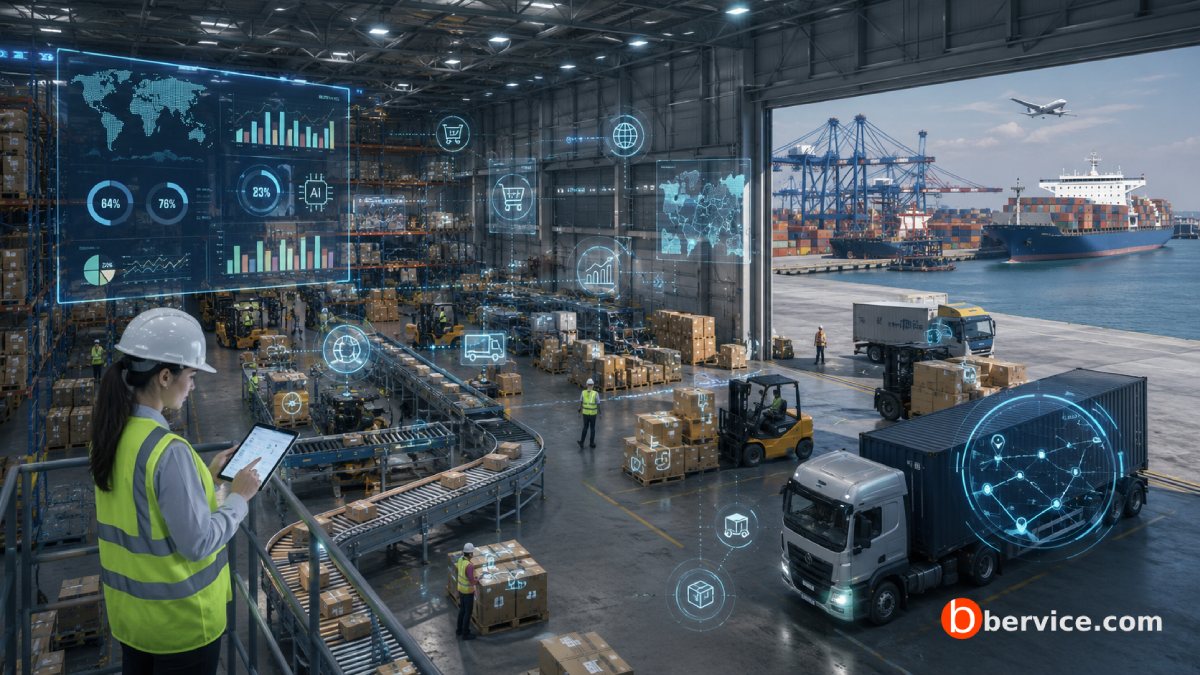
1. Introduction: Why Supply Chains Need AI
Supply chains are no longer simple systems of moving products from one place to another. They are complex networks of suppliers, factories, warehouses, logistics providers, distributors, retailers, and customers. Every small delay, price change, shortage, or demand shift can affect the entire chain.
Artificial Intelligence can help supply chain industries become faster, smarter, and more resilient. Instead of relying only on historical reports or manual decisions, companies can use AI to predict problems, optimize operations, reduce costs, and improve visibility across the whole supply chain.
In modern business, supply chain performance directly affects profitability, customer satisfaction, and competitiveness. Companies that use AI effectively can respond faster to market changes, avoid unnecessary waste, and make better decisions based on real-time data.
2. AI for Demand Forecasting
One of the most important uses of AI in supply chains is demand forecasting. Traditional forecasting often depends on past sales data and basic statistical models. However, customer demand can change quickly because of seasonality, economic conditions, social media trends, weather, competitor activity, or global events.
AI can analyze many data sources at the same time and identify patterns that humans may miss. For example, an AI system can study historical sales, online search trends, local events, weather data, and market behavior to predict future demand more accurately.
Better demand forecasting helps companies avoid two major problems: overstocking and stockouts. Overstocking increases storage costs and waste, while stockouts lead to lost sales and unhappy customers. AI helps companies keep the right amount of inventory at the right time.
3. AI for Inventory Optimization
Inventory management is a critical part of supply chain operations. Keeping too much inventory locks money inside warehouses. Keeping too little inventory creates delays and customer dissatisfaction. AI can help companies find the best balance.
AI systems can monitor stock levels, sales speed, supplier lead times, and demand changes. Based on this data, they can recommend when to reorder, how much to order, and where inventory should be stored.
For example, a retail company with multiple warehouses can use AI to decide which warehouse should hold more of a specific product. If demand is increasing in one region, AI can recommend moving inventory closer to that region before the shortage happens.
This makes inventory more dynamic, responsive, and cost-efficient.
4. AI for Supplier Management
Suppliers are one of the most important parts of every supply chain. A delay from one supplier can affect production, delivery, and customer experience. AI can help companies evaluate suppliers more intelligently.
AI can analyze supplier performance based on delivery time, product quality, price stability, communication speed, and risk factors. It can identify which suppliers are reliable and which suppliers may create future problems.
AI can also help detect supplier risks early. For example, if a supplier is located in a region affected by political instability, extreme weather, or financial issues, the AI system can alert managers before the disruption becomes serious.
This allows companies to build stronger supplier networks and reduce dependency on weak or risky suppliers.
5. AI for Logistics and Route Optimization
Transportation is one of the most expensive parts of the supply chain. Fuel costs, driver availability, traffic, delivery windows, vehicle capacity, and weather conditions all affect logistics performance.
AI can optimize delivery routes by analyzing real-time traffic, road conditions, fuel consumption, delivery priorities, and vehicle capacity. This helps companies reduce transportation costs and improve delivery speed.
For example, a logistics company can use AI to automatically choose the most efficient route for each truck. If there is traffic or road closure, the system can adjust the route in real time.
AI can also help with load optimization. It can decide how to pack goods into trucks or containers in a way that reduces empty space and maximizes efficiency.
6. AI for Warehouse Automation
Warehouses are becoming more intelligent with the help of AI. In traditional warehouses, many tasks are manual, repetitive, and time-consuming. AI can improve warehouse operations through automation, robotics, computer vision, and predictive analytics.
AI-powered warehouse systems can help with picking, packing, sorting, stock counting, and space optimization. Robots can move products inside the warehouse, while AI decides the best paths and priorities.
Computer vision can identify damaged products, read labels, count items, and detect safety issues. AI can also analyze warehouse layout and recommend better storage arrangements to reduce movement time.
The result is faster order fulfillment, lower labor pressure, fewer errors, and better use of warehouse space.
7. AI for Predictive Maintenance
Supply chains depend on machines, vehicles, production lines, conveyor belts, forklifts, and refrigeration systems. If one important machine fails, it can stop production or delay shipments.
AI can support predictive maintenance by analyzing sensor data from machines and equipment. It can detect unusual vibration, temperature changes, pressure changes, or performance drops before a breakdown happens.
Instead of waiting for equipment to fail, companies can repair or replace parts at the right time. This reduces downtime, prevents emergency repair costs, and keeps supply chain operations stable.
Predictive maintenance is especially useful in manufacturing, cold chain logistics, food supply chains, automotive production, and large distribution centers.
8. AI for Risk Management and Disruption Prediction
Modern supply chains face many risks: natural disasters, port delays, supplier bankruptcy, cyberattacks, fuel price changes, political conflicts, and sudden demand spikes. Many companies only react after the problem has already happened.
AI can help companies move from reactive risk management to proactive risk management. It can monitor news, weather, supplier data, shipping updates, financial indicators, and geopolitical signals to detect potential disruptions.
For example, if AI detects that a major shipping route may be affected by a storm or port congestion, it can recommend alternative routes, suppliers, or inventory strategies.
This helps companies become more resilient and prepared.
9. AI for Cost Reduction
Supply chain costs come from many areas: purchasing, storage, transportation, labor, energy, waste, delays, and returns. AI can identify hidden inefficiencies that are difficult to find manually.
For example, AI can detect that a company is using a more expensive shipping method than necessary, storing too much slow-moving inventory, or ordering from a supplier with unstable delivery performance.
AI does not only reduce cost by automation. It reduces cost by improving decision-making. Better decisions across purchasing, planning, logistics, and inventory can create large financial savings over time.
10. AI for Quality Control
Quality problems can damage customer trust and increase returns, refunds, and waste. AI can improve quality control by detecting defects faster and more accurately.
In manufacturing and packaging, computer vision systems can inspect products on production lines. They can identify scratches, missing parts, incorrect labels, broken packaging, or shape differences.
AI can also analyze quality data across suppliers and production batches. If one supplier or material batch creates more defects, the system can detect the pattern early.
This helps companies improve product quality, reduce waste, and protect brand reputation.
11. AI for Sustainability
Sustainability is becoming a major priority in supply chain management. Companies are under pressure to reduce waste, energy consumption, emissions, and inefficient transportation.
AI can help supply chains become more sustainable by optimizing routes, reducing empty truck space, improving inventory accuracy, and lowering unnecessary production.
For example, AI can reduce food waste by predicting demand more accurately. It can help manufacturers use less energy by optimizing production schedules. It can also help logistics companies reduce emissions by planning better routes.
AI can support both business efficiency and environmental responsibility.
12. AI for Real-Time Supply Chain Visibility
Many companies still do not have a clear real-time view of their supply chain. Data may be spread across different systems, departments, suppliers, and logistics platforms.
AI can connect and analyze data from ERP systems, warehouse systems, transportation systems, supplier platforms, IoT sensors, and customer orders. This gives managers a clearer view of what is happening across the supply chain.
Instead of waiting for weekly or monthly reports, decision-makers can see real-time alerts, predictions, and recommendations.
For example, AI can show which orders are at risk of delay, which warehouses are under pressure, which suppliers are late, and which products may soon run out.
13. AI for Customer Experience
Supply chains directly affect customer experience. Customers expect fast delivery, accurate tracking, product availability, and reliable service. AI can help companies meet these expectations.
AI can predict delivery times more accurately, recommend alternative products when inventory is low, and automatically notify customers about delays.
Chatbots and AI assistants can also answer customer questions about order status, returns, delivery options, and product availability.
When supply chains become more intelligent, customers experience fewer delays, better communication, and more reliable service.
14. AI for Procurement and Purchasing
Procurement teams need to choose suppliers, negotiate prices, manage contracts, and control purchasing risks. AI can support procurement by analyzing supplier prices, market trends, contract terms, and purchase history.
AI can recommend the best time to buy materials, identify price increases early, and compare supplier offers. It can also help detect unusual spending patterns or contract risks.
For large companies, AI can review thousands of purchase orders and invoices to find errors, duplicate payments, or unnecessary expenses.
This makes procurement more strategic and less dependent on manual review.
15. AI for Planning and Decision Support
Supply chain managers make many decisions every day. They need to decide what to produce, where to store inventory, how to respond to delays, which supplier to use, and how to allocate resources.
AI can act as a decision-support system. It can simulate different scenarios and show the likely result of each option.
For example, a company can ask:
- “What happens if demand increases by 20% next month?”
- “What happens if our main supplier is delayed by two weeks?”
- “What happens if fuel prices increase?”
AI can model these scenarios and help managers choose the best response.
16. AI Agents in Supply Chain Operations
A more advanced use of AI is AI agents. These are systems that can monitor data, detect issues, recommend actions, and sometimes perform tasks automatically.
For example, an AI agent in a supply chain system could:
- Monitor supplier delays
- Check inventory levels
- Compare shipping options
- Create alerts for managers
- Recommend alternative suppliers
- Generate weekly performance reports
In the future, AI agents may become operational assistants for supply chain teams. They will not replace managers completely, but they can reduce repetitive work and help humans focus on strategic decisions.
17. The Role of Human Experts
AI should not be seen as a complete replacement for human expertise. Supply chains involve relationships, negotiations, regulations, local knowledge, and practical judgment. Human experts are still essential.
The best model is AI plus human decision-making. AI can process large amounts of data and detect patterns quickly. Humans can evaluate context, ethics, business priorities, and exceptions.
For example, AI may recommend changing a supplier because of cost or delay risk. But a human manager may know that the supplier has long-term strategic value or unique quality advantages.
AI provides intelligence. Humans provide judgment.
18. Challenges of Using AI in Supply Chains
Although AI has strong potential, implementation is not always easy. Many companies face challenges such as poor data quality, old software systems, lack of integration, cybersecurity risks, and employee resistance.
AI depends on reliable data. If the data is incomplete, outdated, or inaccurate, the AI system may produce poor recommendations.
Another challenge is trust. Managers may not immediately trust AI decisions, especially in high-risk operations. Companies need transparent AI systems that explain why they make certain recommendations.
Successful AI adoption requires clean data, clear goals, employee training, system integration, and strong governance.
19. How Companies Should Start
Companies do not need to transform the entire supply chain at once. A practical approach is to start with one high-value problem.
For example, a company can begin with:
- Demand forecasting
- Inventory optimization
- Route planning
- Supplier risk monitoring
- Warehouse automation
- Predictive maintenance
The best starting point is usually the area where the company has enough data and a clear business problem. After proving value in one area, the company can expand AI step by step.
AI adoption should be treated as a business transformation, not just a technology project.
20. Conclusion: AI as the Intelligence Layer of Supply Chains
Artificial Intelligence can help supply chain industries become more predictive, efficient, resilient, and sustainable. It can improve forecasting, inventory, logistics, procurement, warehouse operations, supplier management, quality control, and customer experience.
The real power of AI is not only automation. Its deeper value is visibility and decision intelligence. AI helps companies understand what is happening, why it is happening, what may happen next, and what action should be taken.
In the future, the most competitive supply chains will not only be the cheapest or fastest. They will be the smartest. Companies that combine AI, real-time data, and human expertise will be better prepared for uncertainty, disruption, and growth.
Connect with us : https://linktr.ee/bervice
Website : https://bervice.com