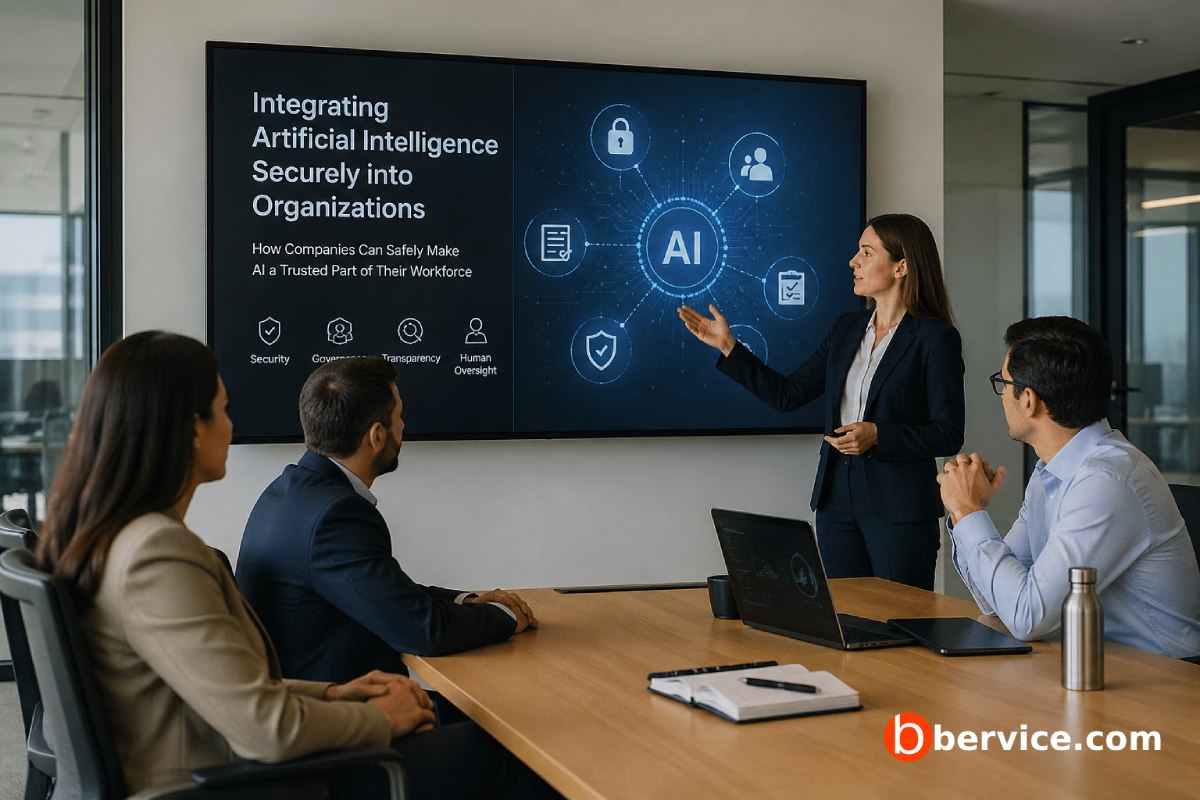
How Companies Can Safely Make AI a Trusted Part of Their Workforce
1. Introduction: AI as a Corporate Citizen
Artificial Intelligence is no longer just a tool, it is becoming an operational layer inside modern organizations. From automating workflows to supporting executive decision-making, AI is increasingly embedded in daily business processes. However, integrating AI into a company is not simply a technical upgrade. It is a structural, security, and governance challenge.
For AI to become a trusted “member” of an organization, it must operate within strict boundaries of security, privacy, accountability, and control.
2. Defining the Role of AI Inside the Organization
Before any technical implementation, companies must clearly define what role AI will play. There are multiple possible models:
- Assistant Role: Supporting employees in tasks like writing, coding, or analysis
- Operator Role: Executing predefined workflows such as customer support or data processing
- Advisor Role: Providing recommendations for business decisions
- Autonomous Agent Role: Acting independently within controlled environments
Each role carries different levels of risk. The more autonomy AI has, the stronger the governance and security requirements must be.
3. Data Governance: The Foundation of Secure AI
AI systems are only as safe as the data they access. One of the biggest risks in enterprise AI adoption is uncontrolled data exposure.
Organizations must establish:
- Data Classification Systems (public, internal, confidential, highly sensitive)
- Access Control Layers (role-based or attribute-based access)
- Data Minimization Policies (AI only sees what it absolutely needs)
- Audit Trails (every interaction is logged and traceable)
Without these controls, AI can unintentionally leak sensitive company information or create compliance risks.
4. Local vs Cloud AI: Choosing the Right Architecture
One of the most critical decisions is where AI runs.
Cloud-Based AI
- Easier to deploy and scale
- Access to powerful models
- Risk: data leaves the organization
Local (On-Premise) AI
- Full control over data
- Strong privacy guarantees
- Higher infrastructure and maintenance cost
Many advanced organizations are moving toward hybrid models, where sensitive operations run locally while non-sensitive tasks leverage cloud capabilities.
5. Security Architecture: Treat AI as a High-Risk System
AI should be treated similarly to a privileged system, not a normal application.
Key security practices include:
- Sandboxing AI environments to prevent unauthorized system access
- Strict API gateways controlling all inputs and outputs
- Prompt filtering and validation to prevent injection attacks
- Model output validation layers to detect unsafe or incorrect responses
AI is vulnerable to new attack vectors such as prompt injection, data poisoning, and adversarial inputs. These risks must be explicitly addressed.
6. Identity and Access Management for AI
AI systems should have their own identity inside the organization, just like employees.
This includes:
- Unique service accounts
- Scoped permissions (least privilege principle)
- Activity monitoring and anomaly detection
- Revocation mechanisms if misuse is detected
Treating AI as an identity rather than a tool enables better control and accountability.
7. Human-in-the-Loop Governance
Fully autonomous AI in critical systems is still risky. A safer approach is human-in-the-loop (HITL) governance.
- AI generates outputs or decisions
- Humans review and approve critical actions
- Feedback is used to improve the system
This reduces the risk of errors, bias, and unintended consequences, especially in finance, legal, or operational decisions.
8. Building Trust Through Transparency
For AI to be accepted inside a company, employees must trust it.
This requires:
- Explainability: AI should justify its outputs
- Traceability: decisions must be linked to data sources
- Clear limitations: users must know what AI cannot do
Lack of transparency leads to over-reliance or complete rejection, both of which are dangerous.
9. Continuous Monitoring and Risk Detection
AI is not a “deploy and forget” system. It evolves, interacts, and can drift over time.
Organizations must implement:
- Real-time monitoring of AI behavior
- Performance and accuracy tracking
- Risk detection systems (e.g., unusual outputs or patterns)
- Periodic audits and red-teaming
Without continuous oversight, even a well-designed system can become unsafe.
10. Organizational Readiness and Culture
The biggest barrier to secure AI adoption is not technology, but culture.
Companies must:
- Train employees on how to use AI safely
- Define clear policies for acceptable use
- Align leadership on AI governance strategy
- Encourage critical thinking, not blind trust in AI
AI should augment human intelligence, not replace judgment.
11. Legal, Compliance, and Ethical Considerations
Depending on the industry, organizations must comply with regulations related to:
- Data privacy (GDPR, etc.)
- Financial compliance
- Intellectual property
- AI ethics and bias
Ignoring these aspects can lead to legal exposure and reputational damage.
12. Conclusion: From Tool to Trusted Entity
Integrating AI securely into an organization is not about plugging in a model. It is about designing a controlled environment where AI can operate safely, transparently, and effectively.
The companies that succeed will be those that:
- Treat AI as a governed system, not a shortcut
- Build strong data and security foundations
- Maintain human oversight
- Continuously monitor and improve
In the end, AI becomes a true “member” of the company only when it operates under the same expectations of accountability, trust, and responsibility as any human employee.
Connect with us : https://linktr.ee/bervice
Website : https://bervice.com