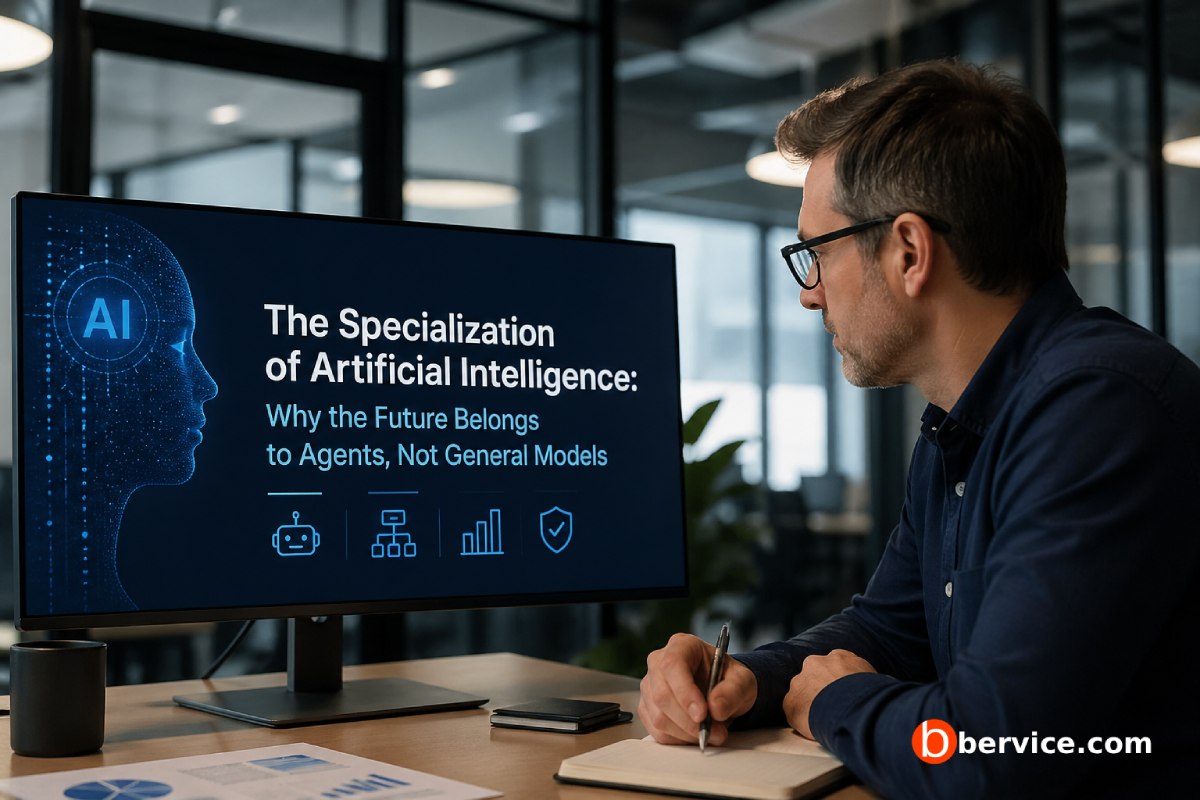
From General Intelligence to Specialized Capability
For years, the dominant vision of artificial intelligence has been centered around the idea of a single, powerful model capable of doing everything. From writing code to analyzing data, answering questions, and even making decisions, general-purpose AI models have been positioned as universal tools. However, in real-world business environments, this “one model for all tasks” approach is increasingly proving to be inefficient, expensive, and difficult to control.
The reality is that most organizational workflows are not generic. They are structured, domain-specific, and often require deep contextual understanding. As a result, AI is naturally evolving toward specialization, where systems are designed to perform specific functions exceptionally well rather than performing many tasks moderately.
Why General Models Fall Short in Companies
General AI models are powerful, but they come with limitations that become more visible at scale. They require large amounts of context to operate effectively, can produce inconsistent outputs, and often lack alignment with specific business processes. In enterprise environments, these shortcomings translate into real costs: inefficiency, unpredictability, and increased need for human oversight.
Moreover, general models struggle with continuity. They do not inherently “remember” workflows, company structures, or evolving states unless carefully engineered. This makes them less suitable for operational systems where consistency, traceability, and reliability are critical.
The Rise of AI Agents as Specialized Workers
AI agents represent a shift from passive tools to active participants in workflows. Unlike general models that wait for prompts, agents are designed to operate within defined roles, execute tasks autonomously, and interact with systems and data continuously.
Each agent can be specialized for a specific function. For example, one agent may monitor financial transactions, another may analyze customer feedback, while another tracks engineering productivity. Instead of relying on a single model to handle everything, companies deploy multiple agents, each optimized for a narrow domain.
This mirrors how human organizations work. Companies do not hire one employee to handle all responsibilities; they build teams of specialists. AI is now following the same pattern.
Operational Efficiency Through Agent-Based Systems
When AI is implemented as a network of specialized agents, productivity increases significantly. Each agent operates with a clear objective, defined inputs, and measurable outputs. This reduces ambiguity and allows for more predictable performance.
Agent-based systems can also run continuously without fatigue. They can monitor events in real time, detect anomalies, trigger actions, and provide insights without requiring constant human input. This transforms AI from a reactive tool into a proactive operational layer.
In such systems, orchestration becomes key. A central coordination layer can manage multiple agents, ensuring they collaborate effectively and do not operate in isolation. This creates a cohesive system where intelligence is distributed but aligned.
Better Control, Security, and Trust
One of the major advantages of specialized agents is control. Since each agent has a defined scope, it is easier to audit its behavior, enforce constraints, and ensure compliance. This is particularly important in sensitive environments such as finance, healthcare, or enterprise data systems.
Security also improves because agents can be isolated. Instead of giving a single model access to everything, permissions can be distributed across agents based on their roles. This reduces the risk surface and enhances trust in AI systems.
Furthermore, debugging and improvement become more manageable. If an issue arises, it can be traced back to a specific agent rather than a monolithic system.
The Shift from Tools to Infrastructure
AI is no longer just a feature embedded in applications. It is becoming a foundational layer of business infrastructure. In this new paradigm, agents are not optional add-ons but core components that power daily operations.
Companies that adopt this mindset move from using AI occasionally to relying on it continuously. Agents become part of the organization’s “digital workforce,” handling repetitive, analytical, and monitoring tasks at scale.
This transition is similar to the evolution of cloud computing. What started as a tool for specific use cases eventually became the backbone of modern digital systems. AI agents are on a similar trajectory.
Real-World Applications Across Industries
The impact of specialized AI agents can be seen across multiple industries. In finance, agents can detect fraudulent transactions and manage risk in real time. In software development, they can review code, track bugs, and monitor deployment pipelines. In customer support, agents can analyze conversations, categorize issues, and suggest responses.
In operations, agents can track workflows, identify bottlenecks, and recommend optimizations. In HR, they can evaluate candidate skills, monitor performance signals, and assist in decision-making processes.
The key is not the complexity of the model, but the clarity of the role. A well-defined agent often outperforms a general model in real-world tasks.
Challenges and Considerations
Despite their advantages, agent-based systems are not without challenges. Designing effective agents requires a deep understanding of workflows and data structures. Poorly defined agents can create fragmentation instead of efficiency.
There is also the challenge of orchestration. Managing multiple agents requires robust coordination mechanisms to prevent conflicts and ensure consistency. Without proper design, systems can become complex and difficult to maintain.
Additionally, measuring the performance of agents requires new metrics. Traditional KPIs may not fully capture the value created by autonomous systems.
Conclusion: The Future Is Modular, Not Monolithic
The future of artificial intelligence in companies is not about building a single model that does everything. It is about creating modular systems composed of specialized agents that work together.
This approach aligns more closely with how real organizations operate. It offers better performance, greater control, and higher scalability. Most importantly, it transforms AI from a general-purpose assistant into a structured, reliable, and integral part of business operations.
Companies that recognize this shift early and begin integrating AI agents into their workflows will gain a significant advantage. They will not only increase productivity but also build systems that are more adaptive, resilient, and aligned with the complexity of the real world.
Connect with us : https://linktr.ee/bervice
Website : https://bervice.com