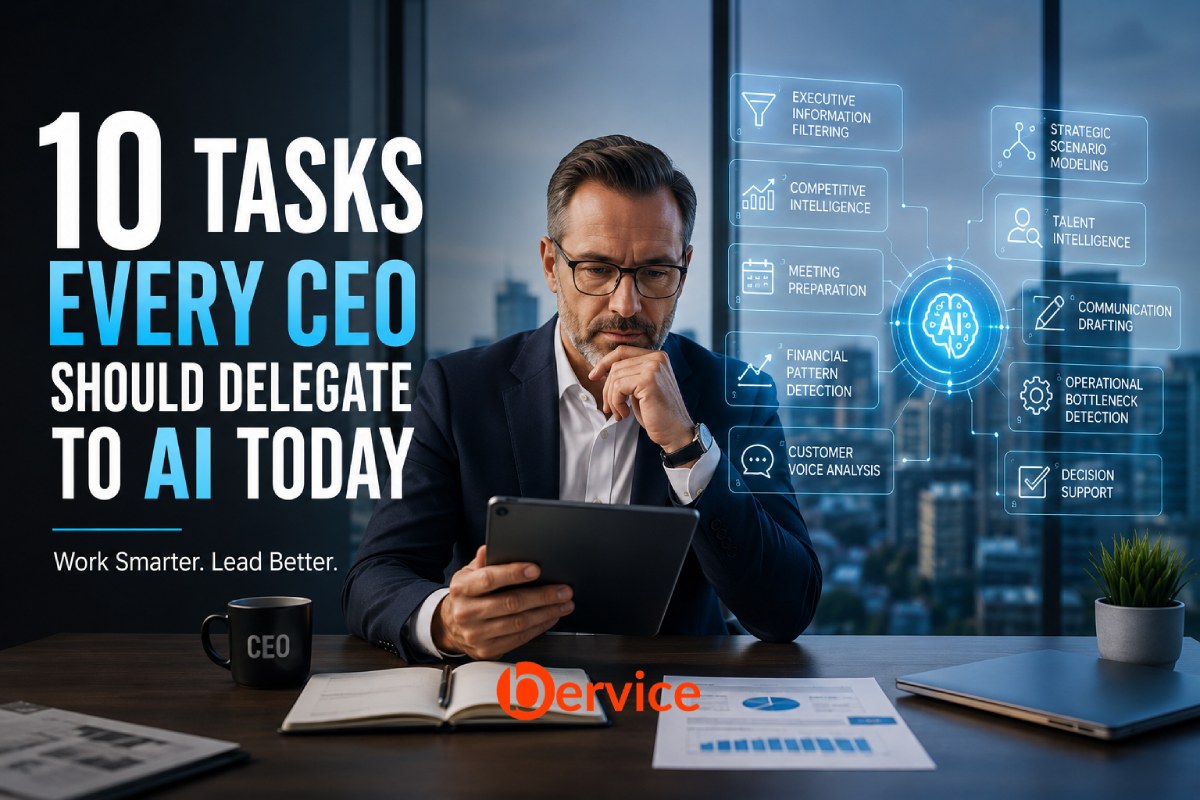
The New Leadership Playbook for the Age of Intelligent Organizations
For decades, the role of a CEO has been defined by one scarce resource: attention. Every day, leaders are forced to decide where to spend their time while drowning in meetings, reports, emails, market changes, and endless operational decisions.
Artificial Intelligence changes that equation.
The companies that will dominate the next decade are not necessarily those with the biggest budgets or the largest teams. They will be the organizations whose leaders understand a simple principle:
AI should not replace executives. It should remove everything that prevents executives from thinking like executives.
The modern CEO’s greatest competitive advantage is no longer working harder. It is delegating intelligently.
Here are ten responsibilities that every CEO should hand over to AI starting today.
1. Executive Information Filtering
Most CEOs consume hundreds of pieces of information every day.
Internal reports.
Slack messages.
Financial dashboards.
Customer feedback.
Market news.
Competitor announcements.
The overwhelming majority is noise.
AI can continuously collect information from every department, rank it by importance, summarize key developments, highlight anomalies, and deliver a concise executive briefing every morning.
Instead of spending an hour reading updates, CEOs can spend ten minutes making decisions.
Leadership should consume insights, not raw data.
2. Competitive Intelligence
Markets change every hour.
New competitors launch products.
Pricing changes overnight.
Partnerships emerge.
Hiring trends reveal strategic priorities.
Monitoring these developments manually is impossible.
AI can continuously track competitors, summarize product launches, detect pricing changes, monitor hiring activity, analyze public filings, and identify emerging threats long before they become obvious.
Instead of reacting to competition, CEOs begin anticipating it.
3. Meeting Preparation
Executives often enter meetings carrying fragmented information.
AI can prepare complete briefing packages within minutes.
These packages can include:
- Previous discussions
- Open action items
- Financial context
- Stakeholder profiles
- Recent communications
- Risks
- Recommended talking points
Instead of preparing for meetings, CEOs prepare for decisions.
4. Financial Pattern Detection
Finance teams already produce dashboards.
AI explains them.
Rather than showing revenue dropped by 4%, AI can identify likely causes:
- Customer segment shifts
- Seasonal effects
- Marketing inefficiencies
- Supply chain bottlenecks
- Product mix changes
Even more valuable, AI can detect unusual patterns before humans notice them.
Executives no longer wait for monthly reports to discover problems.
5. Customer Voice Analysis
Thousands of customer opinions exist across:
- Support tickets
- Reviews
- Social media
- Sales calls
- Surveys
- Community discussions
Humans cannot read all of them.
AI can aggregate millions of comments, identify recurring frustrations, discover hidden opportunities, measure sentiment trends, and prioritize issues by business impact.
Instead of listening to the loudest customers, CEOs hear the collective voice of all customers.
6. Strategic Scenario Modeling
Every major decision involves uncertainty.
Should the company expand?
Acquire a competitor?
Reduce prices?
Launch internationally?
Hire aggressively?
AI can simulate multiple scenarios using historical performance, market conditions, financial assumptions, and external economic indicators.
It doesn’t predict the future.
It helps leaders understand possible futures.
That transforms strategy from intuition into informed judgment.
7. Talent Intelligence
Hiring is one of the most expensive executive decisions.
AI can continuously analyze:
- Hiring pipelines
- Employee performance trends
- Skill gaps
- Internal mobility
- Retention risks
- Workforce planning
Instead of reacting after valuable employees leave, CEOs can identify organizational risks months earlier.
Talent management becomes predictive instead of reactive.
8. Communication Drafting
Executives spend countless hours writing:
- Emails
- Investor updates
- Board reports
- Company announcements
- Customer letters
- Speeches
AI can generate high quality first drafts in seconds while adapting tone for employees, investors, partners, regulators, or customers.
The CEO remains the final editor.
AI eliminates the blank page.
9. Operational Bottleneck Detection
Growing companies accumulate invisible friction.
Projects slow down.
Approvals stack up.
Departments become disconnected.
AI can monitor workflows across the organization, identify delays, detect recurring bottlenecks, and recommend process improvements.
Instead of discovering inefficiencies during quarterly reviews, leaders can remove them continuously.
Operational excellence becomes an ongoing process rather than a periodic initiative.
10. Decision Support
The CEO’s job is not to know every answer.
It is to ask better questions.
AI can assemble relevant data from across the business, compare historical decisions, summarize expert opinions, evaluate tradeoffs, estimate risks, and present multiple decision paths.
It doesn’t replace executive judgment.
It strengthens it.
The best CEOs will not become dependent on AI.
They will become dramatically more informed before making critical decisions.
What CEOs Should Never Delegate
As AI becomes increasingly capable, an important distinction emerges.
Execution can be automated.
Leadership cannot.
AI should never own:
- Vision
- Company values
- Ethical judgment
- Human trust
- Final accountability
- Culture building
- Difficult conversations
- Long term purpose
Employees follow leaders.
Not algorithms.
Customers build relationships with companies.
Not software.
Boards appoint CEOs.
Not AI systems.
The Future CEO
The CEO of the past managed information.
The CEO of the future manages intelligence.
This shift is subtle but profound.
Instead of searching for answers, leaders will curate questions.
Instead of gathering data, they will evaluate possibilities.
Instead of supervising every operational detail, they will focus on innovation, people, partnerships, and long term direction.
AI will quietly become the invisible executive assistant, analyst, researcher, strategist, and operations advisor working twenty four hours a day.
The organizations that embrace this transformation first will not simply operate more efficiently.
They will think faster.
Learn faster.
Adapt faster.
And in an economy where speed increasingly determines success, that may become the ultimate competitive advantage.
Conclusion
Artificial Intelligence is not another software upgrade.
It represents a new operating model for leadership.
The question is no longer whether CEOs should use AI.
The real question is whether they are still spending valuable executive time on work that machines can already perform better, faster, and at virtually unlimited scale.
The leaders who recognize this shift today will free themselves to focus on what has always defined exceptional leadership:
Making bold decisions, inspiring people, and building the future.
Connect with us : https://linktr.ee/bervice
Website : https://bervice.com