Introduction
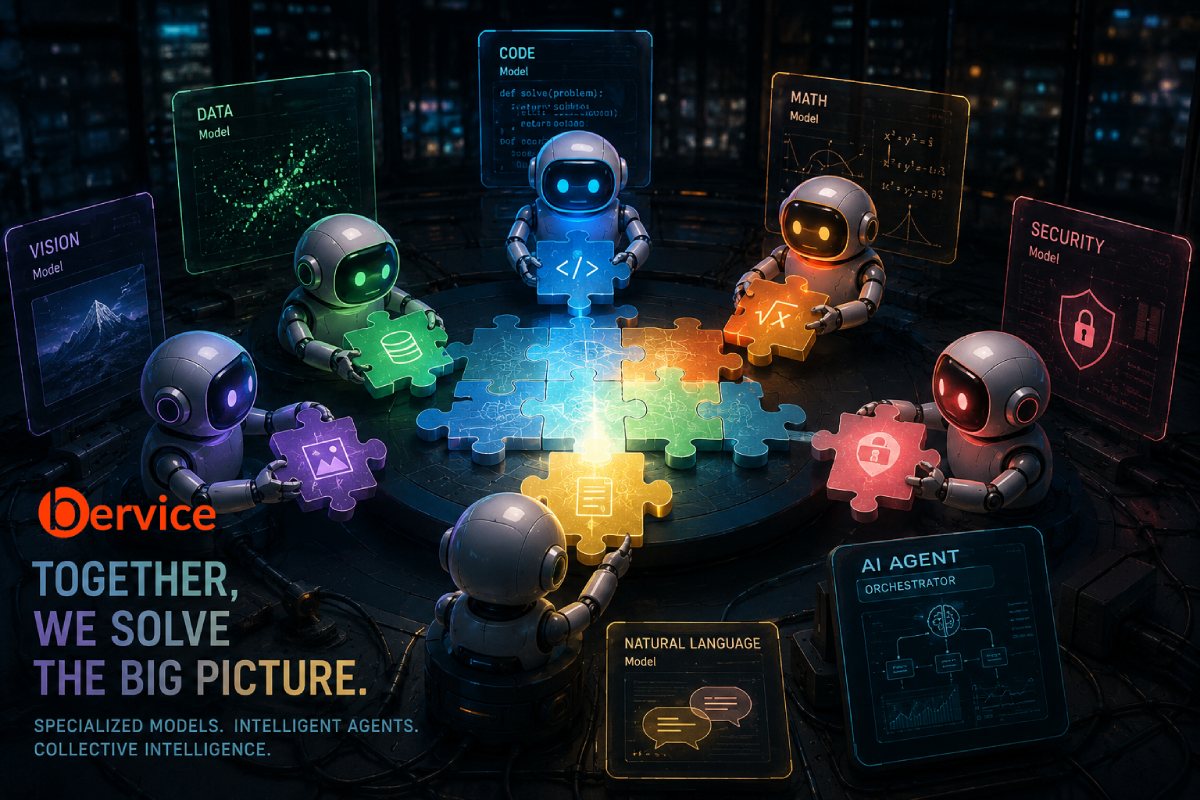
The future of artificial intelligence is not necessarily a world dominated by a single massive model. Instead, a more scalable, efficient, and intelligent future may emerge from thousands of specialized AI models working together like puzzle pieces. This concept is becoming increasingly important as organizations seek privacy, lower costs, faster performance, and greater control over their AI infrastructure.
Local AI models, running on private servers, edge devices, personal computers, or enterprise infrastructure, can be connected through intelligent agent systems. These agents act as coordinators, allowing multiple AI models to collaborate, exchange information, and solve complex tasks that would be difficult for any single model to handle alone.
This architecture represents a shift from monolithic AI toward distributed intelligence.
The Limitations of a Single AI Model
Large language models are impressive, but they face several challenges:
- High computational costs
- Massive memory requirements
- Limited specialization
- Context window restrictions
- Single points of failure
- Data privacy concerns
No matter how advanced a model becomes, it cannot be the best at every task simultaneously.
For example:
- A coding model may outperform a general model in software engineering.
- A legal model may provide more accurate compliance analysis.
- A medical model may understand healthcare terminology better.
- A vision model may process images more efficiently.
Rather than forcing one model to do everything, it is often more efficient to allow specialized models to cooperate.
The Puzzle Piece Analogy
Imagine a large puzzle containing thousands of pieces.
Each piece alone provides only a small part of the picture.
When properly connected, the complete image emerges.
Local AI ecosystems work in a similar way:
- Model A specializes in coding.
- Model B specializes in mathematics.
- Model C specializes in reasoning.
- Model D specializes in image understanding.
- Model E specializes in cybersecurity.
- Model F specializes in database querying.
Individually they have limitations.
Together they become a powerful distributed intelligence network.
What Are AI Agents?
Agents are software entities capable of:
- Receiving tasks
- Making decisions
- Calling tools
- Communicating with other agents
- Delegating subtasks
- Combining results
Instead of solving every problem directly, an agent determines which model is best suited for each part of the problem.
Think of an agent as a project manager coordinating a team of experts.
Multi-Agent Architecture
A modern local AI ecosystem typically contains multiple layers.
Layer 1: User Request
A user submits a task:
“Build a secure decentralized password manager using post-quantum cryptography.”
Layer 2: Orchestrator Agent
The orchestrator analyzes the request and breaks it into smaller tasks.
Example:
- Architecture design
- Cryptography selection
- Database planning
- User interface generation
- Security review
- Documentation writing
Layer 3: Specialist Agents
Each task is sent to a specialized agent.
Examples:
Security Agent
- Threat modeling
- Vulnerability analysis
Cryptography Agent
- PQC algorithm selection
- Key management design
Coding Agent
- Rust implementation
- API generation
UI Agent
- Frontend creation
- UX recommendations
Documentation Agent
- Technical documentation
- User guides
Layer 4: Aggregation Agent
Results from all agents are collected and merged into a final response.
The user experiences a single intelligent system, while dozens of models may have collaborated behind the scenes.
Communication Between Models
For AI puzzle pieces to work together, they need communication protocols.
Several approaches are emerging:
Structured JSON Messages
Agents exchange data in structured formats.
Example:
{
  "task": "analyze_security",
  "project": "password_manager",
  "requirements": [
    "post_quantum",
    "local_storage"
  ]
}
Shared Memory Systems
Agents write and read information from a shared memory database.
Examples:
- Redis
- PostgreSQL
- Vector Databases
- Knowledge Graphs
Event-Based Communication
Agents communicate through events.
Examples:
- RabbitMQ
- Kafka
- NATS
- Redis Streams
This allows asynchronous collaboration across large AI networks.
The Role of Model Context Protocols
Future AI ecosystems require standardized communication.
Emerging protocols aim to provide:
- Shared memory access
- Tool discovery
- Agent interoperability
- Resource management
- Permission controls
These standards will allow models from different vendors and architectures to cooperate seamlessly.
A coding model from one company could collaborate with a vision model from another without requiring custom integration.
Distributed Intelligence at the Edge
One of the most exciting applications is edge AI.
Imagine:
- Smartphone AI
- Laptop AI
- Home server AI
- Vehicle AI
- IoT device AI
Each device hosts different models.
Agents coordinate tasks across the network.
Instead of sending sensitive information to cloud providers, intelligence is distributed locally while maintaining privacy.
Swarm Intelligence for AI
Nature provides a useful example.
Ant colonies have no central super-ant.
Instead:
- Individual ants perform simple tasks.
- Local interactions create complex behaviors.
- Collective intelligence emerges.
AI agent systems can function similarly.
Hundreds of lightweight local models can collaborate through simple communication rules.
The result may outperform a single giant model while consuming fewer resources.
Benefits of Local Multi-Agent AI Systems
Better Specialization
Each model focuses on what it does best.
Lower Costs
Smaller models require less hardware.
Improved Privacy
Data remains inside local infrastructure.
Higher Reliability
Failure of one model does not break the entire system.
Scalability
New agents can be added without redesigning the entire architecture.
Faster Innovation
Organizations can continuously upgrade individual components.
Real-World Example
Consider a software company developing a blockchain application.
The workflow could involve:
- Planning Agent receives requirements.
- Architecture Agent designs the system.
- Security Agent evaluates threats.
- Smart Contract Agent generates Solidity code.
- Rust Agent develops backend services.
- Frontend Agent builds interfaces.
- Testing Agent creates test cases.
- Documentation Agent writes manuals.
- Review Agent verifies quality.
Each agent uses different local models optimized for its domain.
Together they function as a virtual engineering team.
Challenges Ahead
Despite the promise, several challenges remain.
Coordination Complexity
Managing dozens or hundreds of agents can become difficult.
Context Synchronization
Agents must maintain consistent information.
Trust and Verification
Incorrect outputs from one agent can affect others.
Resource Allocation
Hardware resources must be distributed efficiently.
Security Risks
Compromised agents could spread misinformation through the network.
Robust governance mechanisms will be essential.
The Future: AI Operating Systems
The next evolution may be AI Operating Systems.
Instead of opening individual applications, users will interact with a unified agent ecosystem.
Behind the scenes:
- Thousands of specialized models
- Millions of knowledge objects
- Dynamic task routing
- Self-improving workflows
will cooperate continuously.
Users will no longer ask, “Which model should I use?”
The AI operating system will automatically assemble the correct puzzle pieces for every task.
Conclusion
The future of artificial intelligence may not belong to a single all-knowing model. Instead, it may emerge from networks of specialized local AI systems connected through intelligent agents. Just as individual puzzle pieces form a complete picture, specialized models can collaborate to create capabilities far beyond what any one model can achieve alone.
As agent frameworks, communication protocols, local hardware, and distributed AI infrastructure continue to evolve, we are moving toward a world where intelligence is modular, collaborative, private, and highly scalable. The organizations that learn to orchestrate these AI puzzle pieces effectively may define the next generation of computing.
Connect with us : https://linktr.ee/bervice
Website : https://bervice.com