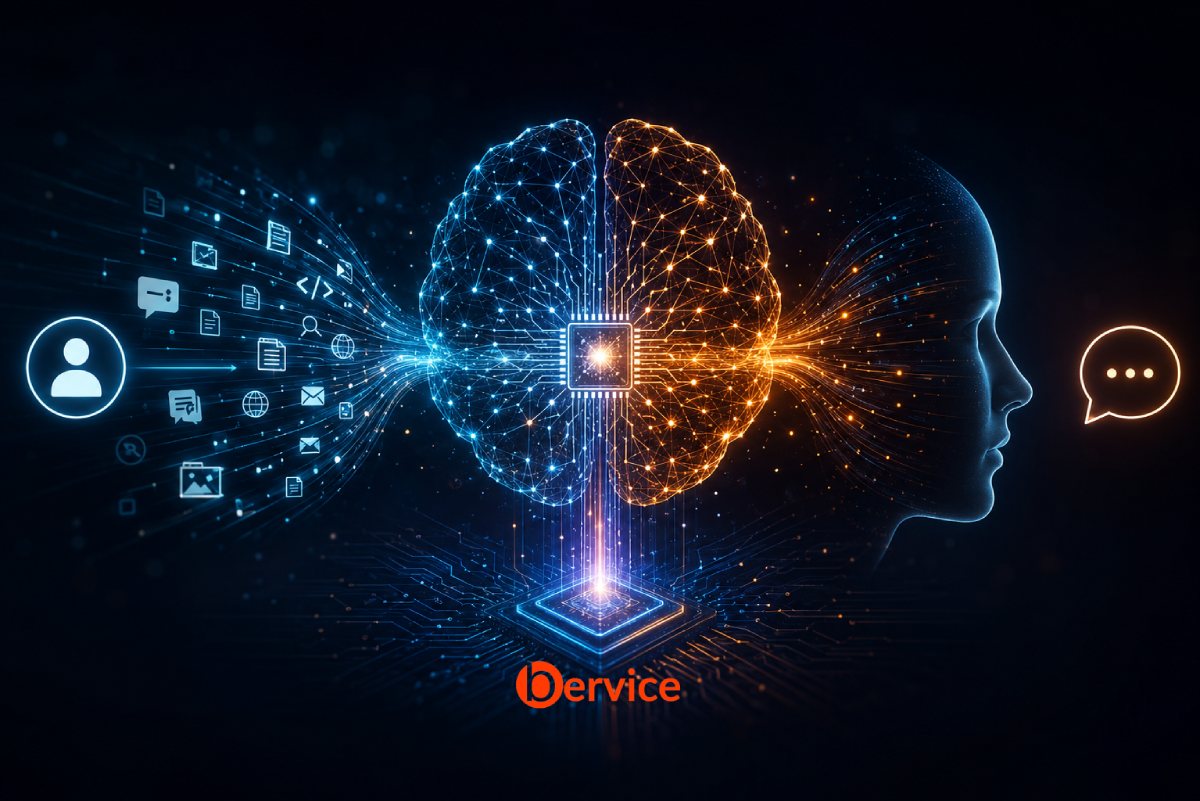
A Journey into the Depths of Large Language Models
Artificial Intelligence has become a part of everyday life. We ask questions, generate images, write code, translate languages, and even seek advice from AI systems. Yet one question remains fascinating:
How does an AI actually know what to say next?
The surprising truth is that modern AI systems such as Large Language Models (LLMs) do not “know” things in the same way humans do. They do not think, understand, or reason exactly as people do. Instead, they perform an extraordinarily sophisticated form of prediction.
To understand this process, we need to take a journey deep inside the architecture of an LLM.
The Fundamental Idea: Predicting the Next Token
At their core, LLMs are prediction machines.
When you type:
“The capital of France is…”
The model’s job is to predict the most likely next piece of text.
It might assign probabilities like:
- Paris → 99.9%
- London → 0.05%
- Berlin → 0.03%
- Tokyo → 0.02%
The model then selects the most appropriate continuation.
This process repeats over and over again, one token at a time.
A token is not necessarily a word. It may be:
- A word
- Part of a word
- A punctuation mark
- A number
- A symbol
For example:
“Artificial Intelligence is amazing.”
Could be split into:
- Artificial
- Intelligence
- is
- amazing
The model predicts each token sequentially until a complete response is generated.
The Internet as a Giant Textbook
Before an LLM can generate responses, it must be trained.
Training involves feeding the model enormous amounts of text:
- Books
- Articles
- Research papers
- Documentation
- Websites
- Conversations
- Code repositories
During training, the model repeatedly performs a simple exercise:
Hide part of a sentence and try to predict it.
For example:
The Earth revolves around the _____
The correct answer is “Sun.”
After billions or trillions of such examples, the model gradually learns statistical patterns about language, facts, logic, structure, and relationships between concepts.
It is not memorizing every sentence.
It is learning patterns.
The Birth of Neural Networks
The foundation of modern LLMs is the Artificial Neural Network.
Neural networks were inspired by the human brain, although they are vastly simpler.
A neural network consists of millions or billions of numerical parameters called weights.
Think of these weights as tiny adjustable knobs.
During training:
- Correct predictions strengthen useful connections.
- Incorrect predictions weaken them.
- The network gradually improves.
Modern LLMs contain:
- Billions of parameters
- Trillions of learned relationships
- Massive mathematical representations of language
These parameters store the model’s learned knowledge in compressed form.
Embeddings: Turning Words into Mathematics
Computers cannot understand words directly.
They understand numbers.
Therefore, every token is converted into a vector called an embedding.
For example:
“King”
may become a vector containing hundreds or thousands of numbers.
Interestingly, embeddings capture relationships:
King − Man + Woman ≈ Queen
This means the model learns semantic relationships mathematically.
Words with similar meanings end up close together in this multidimensional space.
This is one reason why LLMs can understand context rather than merely matching keywords.
The Transformer Revolution
In 2017, researchers introduced a groundbreaking architecture called the Transformer.
The paper was titled:
“The Transformer”
This architecture changed AI forever.
Nearly every major modern LLM is based on the Transformer.
Examples include:
- GPT
- Claude
- Gemini
- Llama
- Mistral
The Transformer solved one major problem:
How can a model understand long-range relationships in text?
Attention: The Secret Sauce
The most important innovation inside a Transformer is called Attention.
Attention allows the model to determine which words matter most when predicting the next token.
Consider the sentence:
The dog chased the ball because it was moving.
What does “it” refer to?
The model examines previous words and assigns different attention weights.
It learns that “it” most likely refers to “the ball.”
Attention acts like a spotlight.
The model dynamically decides:
- Which words are important
- Which words are related
- Which information should influence the next prediction
This mechanism is one of the key reasons modern AI appears intelligent.
Self-Attention: Looking at Everything Simultaneously
Older language systems processed text sequentially.
Transformers introduced Self-Attention.
Instead of reading one word at a time, the model examines relationships among all words simultaneously.
This enables:
- Better context understanding
- Faster training
- More coherent responses
- Improved reasoning capabilities
Self-Attention allows the model to build a map of the entire sentence before generating output.
Layers: The Deep Thinking Pipeline
A modern LLM consists of many layers.
Each layer performs increasingly abstract analysis.
Early layers may recognize:
- Grammar
- Word structure
- Syntax
Middle layers may recognize:
- Concepts
- Relationships
- Context
Later layers may recognize:
- Reasoning patterns
- High-level abstractions
- Intent
You can think of layers as a hierarchy:
Letters → Words → Sentences → Concepts → Knowledge → Responses
Each layer refines understanding before passing information forward.
Why Does AI Sometimes Hallucinate?
One common misconception is that AI always knows the truth.
In reality, an LLM’s primary objective is not truth.
Its objective is prediction.
If the training data contains uncertainty, contradictions, or gaps, the model may generate information that sounds plausible but is incorrect.
This phenomenon is called hallucination.
The model is essentially saying:
“Based on everything I’ve seen, this sequence of words seems likely.”
Not:
“I have verified this fact.”
This distinction is critical.
Does AI Actually Understand?
This remains one of the biggest debates in AI research.
Some researchers argue:
LLMs only perform advanced statistical prediction.
Others argue:
Complex understanding emerges naturally from large-scale prediction.
The truth may lie somewhere in between.
What is clear is that modern LLMs learn surprisingly rich internal representations of:
- Language
- Facts
- Logic
- Human behavior
- Problem-solving strategies
Whether this qualifies as true understanding is still an open question.
Why Bigger Models Perform Better
As models grow larger, they acquire new capabilities.
Researchers call this Emergent Behavior.
Examples include:
- Better reasoning
- Improved coding
- Stronger translation
- Mathematical problem solving
- Planning and analysis
These abilities often appear suddenly once a model reaches sufficient scale.
This suggests intelligence may emerge gradually from increasingly complex prediction systems.
The Future of LLMs
Today’s LLMs are only the beginning.
Future systems will combine:
- Language understanding
- Vision
- Audio
- Video
- Real-time memory
- Tool usage
- Autonomous decision making
Instead of merely predicting text, future AI may act as a universal reasoning engine capable of interacting with the digital and physical world.
Yet the fundamental principle may remain the same:
Predict what comes next.
Conclusion
Large Language Models may seem magical, but their foundation is surprisingly elegant.
They learn from vast amounts of data, convert language into mathematics, use neural networks to identify patterns, and employ Transformer architectures with Attention mechanisms to predict the most likely next token.
Every answer generated by an LLM is the result of billions of mathematical operations working together to estimate:
“What is the most probable next piece of information?”
What appears to us as intelligence is, at its core, an incredibly sophisticated prediction process.
And perhaps that raises an even deeper question:
If intelligence can emerge from prediction, how much of human thought is prediction as well?
Connect with us : https://linktr.ee/bervice
Website : https://bervice.com