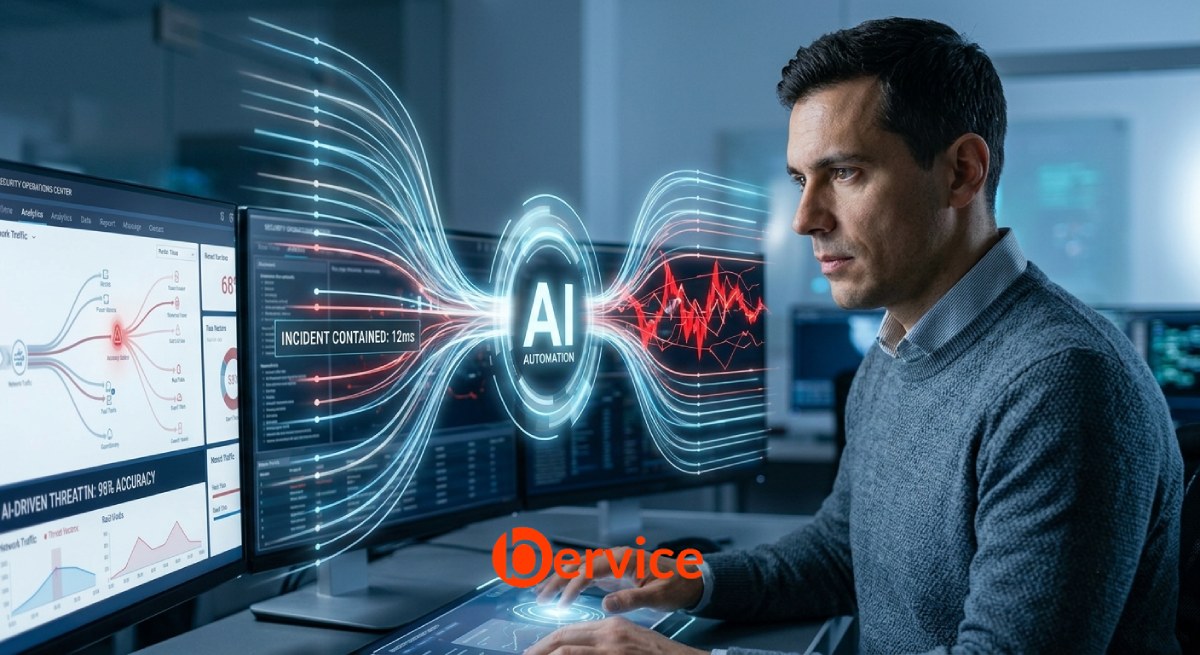
Introduction
For decades, cybersecurity has been built on a simple assumption: if organizations could build stronger walls, attackers would eventually give up. Firewalls became smarter. Antivirus software became faster. Intrusion Detection Systems became more sophisticated. Security teams invested billions in prevention.
Yet despite all these investments, cyberattacks continue to increase in both frequency and sophistication.
The reason is simple.
The nature of cyber threats has fundamentally changed.
Today’s attackers are no longer just human hackers manually probing networks. They use automation, artificial intelligence, machine learning, cloud infrastructure, and autonomous tools that can launch thousands of attacks simultaneously while adapting in real time.
Meanwhile, many organizations still rely on security architectures designed for an era when attacks were slower, simpler, and largely predictable.
This creates an imbalance.
Attackers are becoming intelligent.
Many defense systems are not.
The future of cybersecurity is no longer about replacing traditional security. It is about augmenting it with AI that can think, learn, and respond at machine speed.
The Problem with Traditional Security
Traditional cybersecurity follows predefined rules.
Examples include:
- Firewall rules
- Signature-based antivirus
- Static access policies
- Blacklists
- Manual threat hunting
- Scheduled vulnerability scans
These technologies remain essential.
But they all share one limitation:
They can only defend against what they already know.
Traditional security asks questions like:
“Is this malware signature in our database?”
“Does this IP exist on a blacklist?”
“Does this action violate an existing rule?”
Modern attackers intentionally avoid these known patterns.
- They constantly change malware signatures.
- They rotate IP addresses.
- They generate polymorphic code.
- They use stolen identities.
- They imitate legitimate users.
- They exploit zero-day vulnerabilities.
The result is obvious.
Static defenses struggle against dynamic attackers.
Modern Threats Move Faster Than Humans
Consider a modern ransomware campaign.
Within minutes, attackers may:
- Compromise an endpoint
- Escalate privileges
- Discover sensitive data
- Move laterally across the network
- Disable backups
- Encrypt hundreds of servers
By the time a human analyst notices suspicious activity, the attack may already be complete.
Traditional Security Operations Centers (SOCs) generate thousands of alerts every day.
Many analysts spend hours investigating false positives while genuine attacks quietly progress.
The challenge is no longer a lack of security tools.
It is the inability to analyze millions of events quickly enough.
Humans simply cannot process modern attack volumes in real time.
AI can.
AI Changes Security from Reactive to Adaptive
Traditional security reacts.
AI observes.
Learns.
Predicts.
And adapts.
Instead of relying solely on predefined signatures, AI models analyze behavioral patterns across enormous datasets.
Rather than asking,
“Have I seen this malware before?”
AI asks,
“Does this behavior resemble an attack?”
That difference is transformational.
For example, AI can detect:
- Impossible travel logins
- Abnormal employee behavior
- Insider threats
- Data exfiltration patterns
- Credential abuse
- Bot activity
- Privilege escalation
- Account takeover attempts
Even if the specific attack has never been observed before.
Behavior matters more than signatures.
AI Learns What “Normal” Looks Like
Every organization behaves differently.
Finance teams access different systems than engineers.
Executives travel differently than developers.
Servers communicate differently than user laptops.
Traditional security struggles to model these differences.
AI excels at it.
By continuously learning normal behavior, AI creates dynamic baselines for:
- Users
- Devices
- Applications
- Networks
- APIs
- Cloud workloads
When deviations occur, AI recognizes them immediately.
This dramatically improves anomaly detection while reducing false positives.
AI Reduces Alert Fatigue
One of the biggest challenges in cybersecurity is alert fatigue.
Security teams receive:
- Millions of logs
- Thousands of alerts
- Hundreds of incidents
Most are harmless.
Analysts become overwhelmed.
Important threats are missed.
AI helps prioritize risk.
Instead of presenting thousands of disconnected alerts, AI correlates events into a single attack narrative.
For example:
A login from another country.
Followed by unusual PowerShell activity.
Followed by abnormal database queries.
Followed by encrypted outbound traffic.
Individually, each event may appear harmless.
Together, they reveal an active breach.
AI connects those dots automatically.
AI Improves Threat Hunting
Traditional threat hunting depends heavily on human expertise.
Analysts manually search logs looking for suspicious behavior.
AI dramatically expands these capabilities.
Machine learning can continuously analyze:
- Network traffic
- Endpoint telemetry
- Cloud logs
- Identity events
- Email behavior
- Authentication history
Across billions of events simultaneously.
Instead of waiting for indicators of compromise, AI discovers subtle attack patterns humans might never notice.
AI Enables Predictive Security
The best security incident is the one that never happens.
Traditional security focuses on detection.
AI introduces prediction.
Using historical attack data, vulnerability intelligence, threat intelligence feeds, and behavioral analytics, AI can estimate:
- Which systems are most likely to be targeted
- Which users face elevated phishing risk
- Which vulnerabilities attackers are actively exploiting
- Which identities appear most vulnerable
This enables proactive defense rather than reactive response.
AI Accelerates Incident Response
Every minute matters during a cyberattack.
AI dramatically shortens response times.
Instead of waiting for manual investigation, AI can automatically:
- Isolate infected devices
- Disable compromised accounts
- Block malicious IP addresses
- Revoke stolen tokens
- Quarantine suspicious files
- Trigger forensic collection
- Notify security teams
Automation reduces attacker dwell time from hours to minutes.
Sometimes even seconds.
Cloud, IoT, and Remote Work Changed Everything
Modern organizations no longer operate within a single network perimeter.
Employees work from anywhere.
Applications run across multiple clouds.
APIs connect hundreds of services.
IoT devices continuously exchange data.
Traditional perimeter security cannot effectively protect this environment.
AI continuously evaluates:
- Identity
- Device trust
- Behavioral context
- Location
- Risk score
- Session activity
This enables adaptive access decisions rather than static permissions.
Security becomes continuous instead of binary.
AI Also Helps Defend Against AI Powered Attackers
Cybercriminals are rapidly adopting AI.
They now use AI to:
- Generate convincing phishing emails
- Create deepfake voices
- Produce fake videos
- Automate reconnaissance
- Write malware
- Discover vulnerabilities
- Evade detection
Defending against AI driven attacks using purely manual methods is becoming increasingly unrealistic.
AI becomes essential not because it is fashionable, but because attackers are already using it.
The cybersecurity arms race has entered the AI era.
Human Experts Remain Essential
AI is not replacing cybersecurity professionals.
It is amplifying them.
Humans still provide:
- Strategic judgment
- Business context
- Ethical decisions
- Risk acceptance
- Creative investigation
- Crisis leadership
AI provides:
- Speed
- Scale
- Pattern recognition
- Continuous monitoring
- Automation
- Predictive insights
The strongest security architecture combines both.
Human intelligence plus artificial intelligence.
Not one instead of the other.
Building an AI Driven Security Architecture
Organizations should think beyond purchasing another security product.
Instead, they should redesign their architecture around intelligence.
Key components include:
- AI powered Security Information and Event Management (SIEM)
- Extended Detection and Response (XDR)
- User and Entity Behavior Analytics (UEBA)
- AI enhanced identity protection
- Automated Security Orchestration, Automation, and Response (SOAR)
- AI powered phishing detection
- Cloud security analytics
- Continuous risk scoring
- Behavioral anomaly detection
- Autonomous incident response
These systems work together to create a continuously learning security ecosystem rather than isolated defensive tools.
The Future of Cybersecurity Is Intelligence
Cybersecurity is no longer simply about blocking malicious traffic.
It is about understanding behavior.
It is about recognizing intent.
It is about predicting attacks before they succeed.
Traditional security built walls.
AI builds awareness.
Organizations that rely solely on yesterday’s defenses will struggle against tomorrow’s threats.
Those that integrate AI into every layer of their security architecture will move from reactive protection to adaptive resilience.
In the coming years, the question will no longer be whether AI should be used in cybersecurity.
The real question will be whether organizations can remain secure without it.
Because in an era where attackers increasingly operate at machine speed, defending with human speed alone is no longer enough.
Connect with us : https://linktr.ee/bervice
Website : https://bervice.com