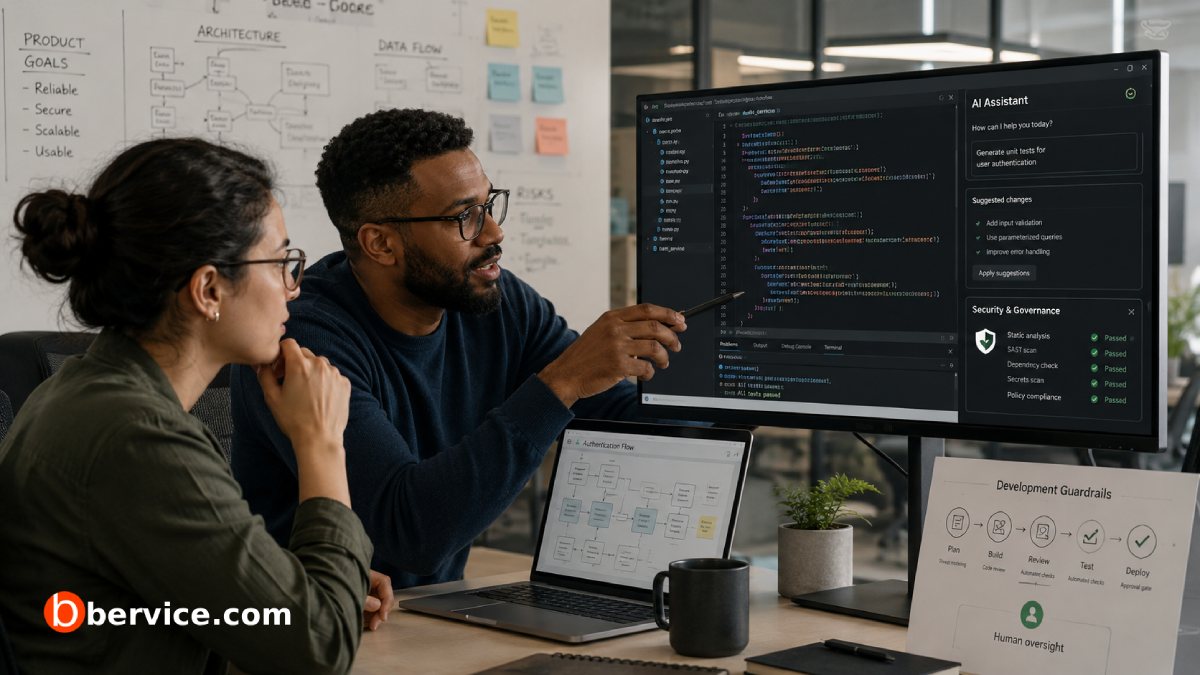
1. What Is Vibe Coding?
Vibe coding is a modern style of software development where a person describes what they want in natural language, and an AI coding tool generates, edits, or fixes the code. Instead of writing every line manually, the user guides the AI through prompts, feedback, errors, and desired outcomes.
The term became popular after Andrej Karpathy described it in 2025 as a way of building software by “giving in to the vibes” and letting AI handle much of the implementation. In practice, vibe coding means the human focuses more on intention, direction, testing, and product judgment, while the AI produces large parts of the actual code.
This can be extremely powerful. A founder can prototype a product quickly. A designer can create working interfaces. A product manager can test ideas without waiting for a full engineering cycle. Developers can move faster by asking AI to generate boilerplate, refactor code, write tests, or explain unfamiliar systems.
But vibe coding is not magic. It does not remove engineering responsibility. It moves the responsibility from “writing code manually” to “reviewing, validating, securing, and governing AI-generated code.”
2. Why Vibe Coding Is Attractive
The biggest advantage of vibe coding is speed. A feature that previously took days may be prototyped in hours. Teams can explore more ideas, test product assumptions faster, and reduce the friction between concept and execution.
It also lowers the barrier to building software. Non-engineers can create internal tools, dashboards, landing pages, automation scripts, and prototypes. For startups, this can be a serious advantage because early-stage teams often lack enough engineering resources.
For experienced developers, vibe coding can remove repetitive work. AI can help generate CRUD screens, database models, API handlers, tests, documentation, error handling, and migration scripts. This allows engineers to spend more time on architecture, security, business logic, and system reliability.
However, the same speed that makes vibe coding useful also makes it dangerous. If a team can generate software quickly, it can also generate insecure, duplicated, unmaintainable, or legally risky software quickly.
3. The Core Problem: Vibe Coding Can Bypass Engineering Discipline
Traditional software development usually has several control points: requirements, architecture review, code review, testing, security review, deployment process, monitoring, and incident response.
Vibe coding can accidentally skip many of these steps.
A user may ask an AI tool to “build a customer portal,” “connect it to our database,” or “make an admin dashboard,” and the AI may generate code that appears to work. But working code is not the same as safe code. It may expose secrets, skip authentication, use weak permissions, create insecure APIs, leak customer data, or store sensitive information incorrectly.
Recent reporting has shown that thousands of AI-generated or vibe-coded apps have exposed sensitive personal and corporate data online, including medical, financial, and internal business information. Researchers linked the issue partly to inexperienced users deploying apps without proper authentication, privacy settings, or security controls.
This is the main risk: vibe coding gives people production-level power before they have production-level judgment.
4. Vibe Coding Is Not the Same as Professional Engineering
Vibe coding is useful for exploration, but professional engineering requires accountability.
A professional software team must answer questions like:
- Can this code be maintained in six months?
- Does it follow our architecture?
- Does it expose secrets?
- Does it handle failure correctly?
- Does it comply with privacy rules?
- Can we test it?
- Can we monitor it?
- Can we roll it back?
- Can another engineer understand it?
AI-generated code often looks convincing, but it may be “brittle,” meaning it works for the happy path but breaks under real-world conditions. Even Karpathy has publicly warned that AI-written code can be bloated and fragile, despite his role in popularizing the term vibe coding.
So the correct mindset is not “AI wrote it, so it is done.” The correct mindset is “AI produced a draft, and now engineering begins.”
5. Where Vibe Coding Is Safe and Useful
Vibe coding is most useful when the cost of failure is low and the code is easy to inspect.
Good use cases include:
- Internal prototypes
- UI mockups
- Proof-of-concept features
- Admin tools with no sensitive data
- Test generation
- Documentation generation
- Refactoring suggestions
- Small automation scripts
- Developer productivity helpers
- Learning unfamiliar frameworks
In these cases, AI can accelerate the team without creating major business risk. The key is to keep the boundary clear: prototypes are not production systems.
A prototype can be built quickly with vibe coding. A production system must go through engineering review.
6. Where Vibe Coding Can Damage a Product
Vibe coding becomes dangerous when it touches sensitive areas without strict review.
High-risk areas include:
- Authentication and authorization
- Payment systems
- Customer data
- Health or financial information
- Admin panels
- Database permissions
- Encryption
- API security
- Infrastructure scripts
- Deployment pipelines
- Legal or compliance workflows
- AI agents with file system or network access
These areas require careful design, testing, and security validation. A small mistake can create serious damage. For example, an AI-generated admin route may forget role-based access control. A generated database query may expose all user records. A generated integration may store API keys in frontend code. A generated webhook handler may skip signature verification.
The product may appear functional, but the organization may be accumulating invisible risk.
7. The Hidden Organizational Risk
The biggest danger is not only bad code. It is uncontrolled code creation across the organization.
When everyone can build apps, dashboards, scripts, and automations, the company may develop a shadow software ecosystem. Different teams may create tools outside engineering visibility. These tools may connect to company data, customer data, spreadsheets, CRMs, Slack, GitHub, or internal APIs.
This creates several problems:
- No clear owner
- No security review
- No data classification
- No access control
- No monitoring
- No backup
- No documentation
- No update process
- No incident response plan
This is similar to the old “shadow IT” problem, but faster and more dangerous because AI can generate full applications, not just spreadsheets or simple scripts.
8. How to Plan Vibe Coding Safely
The safest approach is to treat vibe coding as a controlled capability, not a free-for-all activity.
Organizations should create a clear policy with four categories:
Category 1: Allowed Without Review
These are low-risk uses.
Examples:
- Learning code
- Writing documentation
- Generating unit test ideas
- Creating local-only prototypes
- Building throwaway UI experiments
- Generating sample data with no real customer information
This category should never touch production data, secrets, customer records, or live infrastructure.
Category 2: Allowed With Engineering Review
These are useful but require review before merging.
Examples:
- Feature code
- Backend APIs
- Database queries
- Refactoring existing services
- Internal dashboards
- Business logic
- CI/CD changes
The rule should be simple: AI-generated code is treated exactly like human-written code. It needs code review, tests, security checks, and ownership.
Category 3: Allowed Only With Security Approval
These are sensitive areas.
Examples:
- Authentication
- Payments
- Encryption
- Permission systems
- Admin access
- Customer data exports
- Infrastructure permissions
- Production database access
- AI agents connected to internal systems
These should not be handled by non-technical users or junior developers without senior review.
Category 4: Not Allowed
Some uses should be blocked completely.
Examples:
- Uploading production secrets into AI tools
- Uploading private customer data into public AI tools
- Generating malware-like code
- Bypassing access controls
- Building public apps without authentication
- Letting agents run commands on production systems without approval
- Using unknown packages without dependency review
This category protects the organization from avoidable damage.
9. Product-Safe Vibe Coding Workflow
A practical workflow should look like this:
Step 1: Define the Intent
Before prompting AI, the user should describe the purpose, users, data involved, and risk level.
Example:
“We need an internal dashboard for support tickets. It uses non-sensitive test data only. It is not production. It is for product discovery.”
This helps prevent the AI from making dangerous assumptions.
Step 2: Classify the Data
Before building anything, decide what data is involved.
- Public data
- Internal data
- Confidential business data
- Personal user data
- Financial data
- Health data
- Secrets or credentials
If the feature touches personal, financial, health, or credential data, it should not be treated as casual vibe coding.
Step 3: Generate in a Safe Environment
AI-generated code should first run locally or in a sandbox. It should not be connected directly to production systems.
- Use fake data.
- Use test API keys.
- Use isolated databases.
- Use temporary environments.
- Do not give the AI direct access to production secrets.
Step 4: Review the Diff
Never “accept all” blindly for production code.
The reviewer should inspect:
- New dependencies
- API routes
- Authentication checks
- Database access
- File access
- Network requests
- Error handling
- Logging behavior
- Secret handling
- Environment variables
- Permission checks
This is where many vibe coding risks are caught.
Step 5: Run Automated Checks
Every AI-generated change should pass automated validation.
Useful checks include:
- Type checking
- Linting
- Unit tests
- Integration tests
- Dependency vulnerability scanning
- Secret scanning
- Static application security testing
- License scanning
- Build checks
These checks reduce human review burden and catch obvious issues early.
Step 6: Add Human Ownership
Every generated feature must have an owner.
The owner is responsible for:
- Understanding the code
- Maintaining it
- Fixing bugs
- Responding to incidents
- Updating dependencies
- Removing it if it becomes unsafe
A feature without an owner should not enter production.
Step 7: Deploy Gradually
Do not deploy AI-generated features to all users immediately.
Use:
- Feature flags
- Staging environments
- Internal beta
- Small user rollout
- Monitoring
- Rollback plan
This reduces blast radius if something goes wrong.
10. The Right Role of AI in Product Development
AI should be treated as a fast assistant, not an autonomous engineer with unlimited trust.
A good mental model is:
- AI can draft.
- AI can suggest.
- AI can explain.
- AI can test ideas.
- AI can accelerate repetitive work.
- But humans must decide.
- Humans must review.
- Humans must secure.
- Humans must own the result.
This distinction is critical. The value of vibe coding is not replacing engineering discipline. The value is making engineering faster when discipline still exists.
11. How to Protect the Organization
To prevent vibe coding from damaging the company, organizations should create guardrails.
Create an AI Coding Policy
The policy should explain:
- Which tools are approved
- What data can be shared
- What data cannot be shared
- Who can generate code
- Which code needs review
- Which areas require security approval
- What must never be automated
This policy should be short, clear, and practical.
Use Approved AI Tools
Not every AI coding tool is suitable for company use.
Organizations should prefer tools that provide:
- Enterprise privacy controls
- No training on private code by default
- Audit logs
- Access management
- Repository-level permissions
- Secure deployment settings
- Data retention controls
- Clear terms of service
For sensitive organizations, local or self-hosted coding assistants may be safer than cloud-based tools.
Protect Secrets
AI coding workflows must never expose secrets.
Teams should use:
- Secret scanning
- Environment variable controls
- Vault-based secret management
- Restricted API keys
- Short-lived tokens
- Local test credentials
- No secrets in prompts
- No secrets in frontend code
Credential leaks are one of the easiest ways for vibe coding to become a security incident.
Control Dependencies
AI often installs packages quickly. This can introduce security and supply-chain risk.
Every new dependency should be checked for:
- Maintenance status
- Known vulnerabilities
- License
- Download reputation
- Transitive dependencies
- Package name typos
- Unnecessary complexity
A simple feature should not add ten unknown libraries.
Require Tests for AI-Generated Code
AI-generated code should not be merged without tests.
At minimum:
- Unit tests for logic
- Integration tests for APIs
- Access-control tests
- Input validation tests
- Regression tests for bug fixes
Security-sensitive features should include negative tests, such as confirming that unauthorized users cannot access protected data.
12. How to Protect the Product
A product can be damaged when AI-generated features create inconsistent UX, duplicate logic, poor architecture, or hidden technical debt.
To avoid this, teams should define product rules for AI-generated work.
Maintain Design Consistency
- AI may generate UI that works but does not match the product style.
- Use a design system.
- Use shared components.
- Use approved copywriting patterns.
- Use consistent spacing, colors, and states.
- Do not let every AI-generated screen invent its own UI.
Maintain Architecture Consistency
AI may solve the same problem in a new way every time.
The organization should provide the AI with architecture rules:
- Folder structure
- Naming conventions
- API patterns
- State management rules
- Database access patterns
- Error handling format
- Logging format
- Testing patterns
This makes AI output more predictable and easier to review.
Avoid Duplicate Logic
AI often creates new helper functions instead of reusing existing ones.
Reviewers should ask:
- Does this already exist?
- Is there an existing service?
- Is there a shared utility?
- Is this duplicating business logic?
- Can this create inconsistent behavior?
Duplicate logic creates long-term product bugs.
Keep the User Experience Human-Centered
Vibe coding can produce features quickly, but not every generated feature should exist.
Product teams should still ask:
- Does this solve a real user problem?
Is this simple enough?
- Does it add unnecessary complexity?
Can users understand it?
- Does it match the product strategy?
Fast building should not replace product judgment.
13. A Practical Governance Model
A mature organization can use a three-layer governance model.
Layer 1: Individual Responsibility
Every person using AI for code must understand basic rules:
- Do not share secrets.
- Do not use production data.
- Do not blindly accept code.
- Do not deploy without review.
- Do not bypass security controls.
Layer 2: Team Review
Engineering teams should review AI-generated code like normal code.
Pull requests should mention when AI was used, especially for large changes. This is not for blame. It helps reviewers know where to look carefully.
Layer 3: Organizational Controls
The company should enforce:
- Approved tools
- Access control
- Audit logs
- Secret scanning
- Dependency scanning
- CI/CD gates
- Security review for sensitive areas
- Incident response process
This makes vibe coding scalable without becoming chaotic.
14. The Best Way to Use Vibe Coding in Startups
For startups, vibe coding can be a major advantage, but only if used carefully.
A safe startup approach is:
- Use vibe coding for prototypes.
- Use it for landing pages.
- Use it for internal dashboards.
- Use it for MVP exploration.
- Use it to speed up senior developers.
- Do not use it blindly for payments, authentication, legal workflows, encryption, or customer data systems.
The founder or CTO should create a simple rule:
“AI can help us move faster, but no AI-generated production code ships without review, tests, and ownership.”
That one rule can prevent many future problems.
15. The Future: From Vibe Coding to Agentic Engineering
The industry is already moving from simple prompt-based coding toward agentic engineering, where AI agents can plan, edit multiple files, run tests, inspect errors, and iterate. Some people argue that “vibe coding” is too casual a term for what these systems are becoming.
This shift will make governance even more important.
When AI only writes one function, the risk is limited. When AI agents can modify entire repositories, run commands, install packages, and deploy changes, the risk becomes much larger.
The future of AI-assisted development will not be about who can generate the most code. It will be about who can control, verify, secure, and maintain AI-generated systems.
16. Conclusion
Vibe coding is not bad. It is one of the most powerful changes in software development. It can help organizations prototype faster, reduce repetitive work, empower small teams, and turn ideas into working products quickly.
But without planning, it can damage the organization. It can create insecure apps, expose sensitive data, introduce technical debt, weaken architecture, and allow non-reviewed software to spread across the company.
The safest way to use vibe coding is not to ban it. The safest way is to govern it.
- Use AI for speed, but keep humans responsible for judgment.
- Use AI for drafts, but require review before production.
- Use AI for prototypes, but protect real users and real data.
- Use AI to accelerate engineering, not to replace engineering discipline.
The organizations that win with vibe coding will not be the ones that generate code the fastest. They will be the ones that combine speed with structure, creativity with governance, and automation with accountability.
Connect with us : https://linktr.ee/bervice
Website : https://bervice.com